Stock Analysis · LKQ Corporation (LKQ)
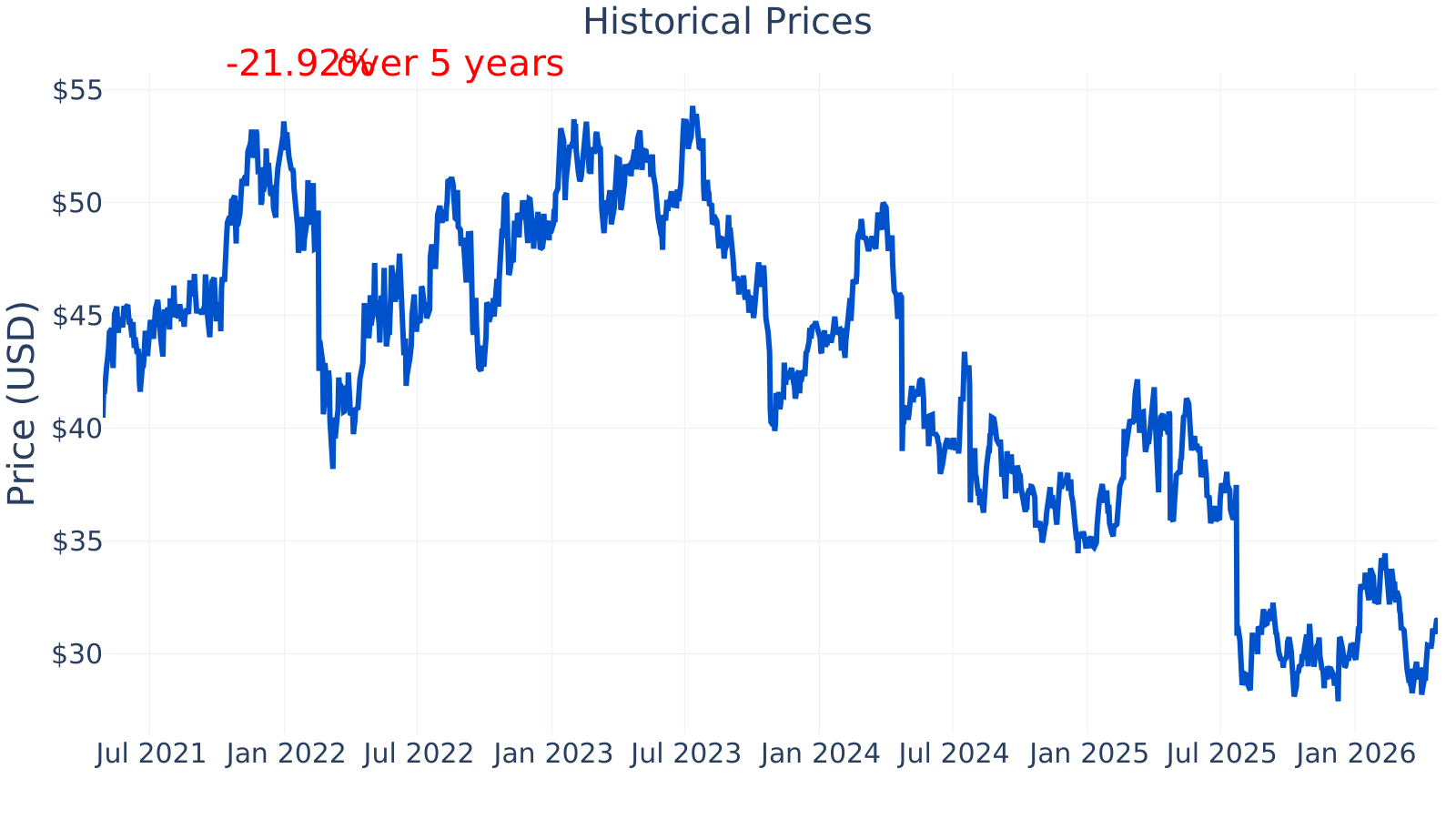
Overview
LKQ Corporation is a global distributor of alternative and specialty replacement parts for vehicles. In simple terms, it helps repair shops, insurers, and do-it-yourself customers fix and maintain cars by supplying parts that are often more cost-effective than brand-new original equipment parts. A major part of its model includes recycled (salvage) parts taken from end-of-life vehicles, along with aftermarket parts and specialty vehicle products (such as products used on recreational vehicles and performance vehicles).
The business is closely tied to the “vehicle repair and maintenance” cycle. When accidents happen or vehicles age, demand for replacement parts tends to rise. LKQ’s scale, logistics network, and relationships with repair ecosystems (including insurance-related repairs) are central to how it competes.
Based on company disclosures in its annual reporting, revenue is primarily generated from these broad areas (typically reported as segments):
- North America: recycled and aftermarket replacement parts and related services
- Europe: distribution of aftermarket parts and accessories
- Specialty: products and accessories for specialty vehicles and niche automotive markets
Percentages vary by year and reporting detail, and investors typically reference the company’s latest annual report segment note for the most current split.
Over the last several years, total revenue has stayed in a relatively tight range (roughly $12.8B–$14.4B from 2021 to 2025). During that same period, operating income and net income trended downward from their earlier highs, which suggests that costs (including operating expenses and interest expense) have weighed more heavily on profits recently than earlier in the period.
Key Figures
| Metric | Value | Industry ⓘ |
|---|---|---|
| Date | Apr 27, 2026 | |
| Context | ||
| Sector | Consumer Cyclical | |
| Industry | Auto Parts | |
| Market Cap ⓘ | $8.06B | |
| Beta ⓘ | 0.90 | |
| Fundamental | ||
| P/E Ratio ⓘ | 13.68 | 24.61 |
| Profit Margin ⓘ | 4.45% | 3.56% |
| Revenue Growth ⓘ | 2.70% | 5.40% |
| Debt to Equity ⓘ | 77.42% | 76.35% |
| PEG ⓘ | 1.06 | |
| Free Cash Flow ⓘ | $847.00M | |
LKQ’s market capitalization is about $8.1B, and the stock’s beta of ~0.90 indicates it has historically moved slightly less than the broader market on average (though this can change over time). The company’s P/E ratio is ~13.7, which is below the industry median of ~24.6 in the provided peer set. Profitability (profit margin) is about 4.45%, above the industry median of ~3.57%. Year-over-year revenue growth is about 2.7%, below the industry median of ~5.4%. Debt-to-equity is about 77%, close to the industry median of ~76%. Trailing twelve-month free cash flow is about $847M.
Growth (medium)
LKQ operates in an industry supported by long-term demand for vehicle maintenance and collision repair. Even as new vehicle technology evolves, large vehicle fleets require ongoing repairs, and many consumers keep cars longer during periods when new cars are expensive or interest rates are higher. In that environment, alternative parts (aftermarket and recycled) can remain relevant because they are often positioned as cost-conscious repair options.
The revenue growth pattern has been uneven. The company experienced strong year-over-year growth earlier in the timeline (including double-digit quarters), followed by periods of negative year-over-year growth. More recently, revenue growth has hovered around small declines to low single-digit changes. This kind of pattern can happen when end-market volumes (collision frequency, repair intensity, and miles driven) normalize, and when currency and pricing effects shift in international operations.
Free cash flow has remained sizable in absolute dollars (hundreds of millions annually), but it has also fluctuated meaningfully. For example, it was above $1.0B around 2024-03-31 and lower (about $566M) around 2025-03-31. For a parts distributor, this line is often influenced by profitability, inventory needs, and working capital timing. A consistent ability to produce cash can be important because it helps fund debt service, acquisitions, and shareholder returns.
As for catalysts, the company’s growth can be influenced by a mix of (1) collision repair volumes, (2) the age of the vehicle fleet (older cars tend to need more replacement parts), (3) supply chain and pricing conditions in parts distribution, and (4) operational execution (such as purchasing, logistics efficiency, and integration of acquisitions where applicable). In the company’s own filings, management discussion typically emphasizes margin management, efficiency initiatives, and segment-level execution as key drivers of results.
Risks (medium-high)
LKQ faces several practical business risks that long-term investors typically monitor. Demand is tied to vehicle repair activity, which can be affected by driving patterns, accident frequency, weather variability, and broader economic conditions. The business also depends on sourcing (including salvage supply for recycled parts), pricing discipline, and the ability to manage labor, freight, and distribution costs.
Leverage is a notable consideration. Debt-to-equity has moved around over time, rising into the roughly 90%–95% range during parts of 2023–2025 before coming down to about 77% most recently shown. A higher leverage profile can reduce flexibility during weaker operating periods, especially when interest expense is elevated. This matters because interest expense in the company’s multi-year profit bridge increased versus earlier periods (visible in the profit flow over time).
Profit margin has compressed over time versus earlier highs. In the earlier part of the series, margins were commonly in the 7%–9% range, while the more recent reading is about 4.36%. Even though the latest margin is still above the industry median shown (~3.4%), the direction of travel can be important: it suggests the company has faced headwinds (such as costs, pricing dynamics, mix, or other operational pressures) that have reduced bottom-line conversion from revenue.
In terms of competitive positioning, LKQ is widely known as a scaled player in alternative parts distribution, with a large distribution footprint and procurement network. Scale can be an advantage in parts distribution because it can improve purchasing terms, inventory breadth, delivery speed, and customer coverage. However, the competitive environment remains intense, and advantages are not permanent—service levels, availability, and price all matter daily in this market.
Main competitors vary by segment and region, but generally include:
- Aftermarket parts distributors and retailers (broad-line auto parts distribution and retail networks)
- Recyclers/salvage-focused parts providers (regional and national operators supplying used OEM parts)
- OEM channels (vehicle manufacturers’ original parts networks, often competing on fit and brand, sometimes at higher prices)
Another risk category is regulatory and compliance complexity. Handling end-of-life vehicles, recycled parts, and cross-border distribution (especially in Europe) can involve environmental rules, warranty/consumer standards, and varying local requirements. Execution risk also exists across a multi-segment, multi-country footprint, where results can be influenced by currency movements and local market conditions.
Valuation
On a simple earnings multiple basis, LKQ’s valuation level in the timeline shown has often been below the industry median. The most recent P/E shown is about 13.9, compared with an industry median of about 19.2 at the same date points displayed, and the latest snapshot in the table shows ~13.7 versus an industry median of ~24.6. A lower multiple can reflect many possibilities, including slower expected growth, uncertainty around margins, a more leveraged balance sheet, or market skepticism about the durability of earnings.
Whether the current valuation level is “high” or “low” depends heavily on forward fundamentals: if margins stabilize and cash generation remains strong, a lower multiple can persist or change; if profitability continues to compress or revenue remains choppy, the lower multiple can also be consistent with those conditions. In other words, the multiple needs to be interpreted alongside the recent margin and growth trends described above, not in isolation.
Conclusion
LKQ is a scaled participant in vehicle replacement parts distribution, with a business model tied to ongoing vehicle repair needs and a meaningful presence in recycled and aftermarket parts. Over recent years, revenue has been relatively stable at a high level, while profitability has weakened compared with earlier periods, and leverage has fluctuated.
The company’s profile can be summarized as follows: a large, established operator in a steady end-market, with cash generation that can be substantial but variable, and with recent pressure on margins that adds uncertainty. The valuation multiples shown are below the industry median in the provided peer set, which is consistent with a market view that is balancing LKQ’s scale and cash generation against slower growth and profitability headwinds.
Sources:
- U.S. SEC EDGAR — LKQ Corporation filings (Form 10-K, Form 10-Q)
- LKQ Corporation Investor Relations — Annual Report / Form 10-K (Business description and segment reporting sections)
- Wikipedia — “LKQ Corporation” (basic company background)
This article is for informational purposes only and does not constitute financial advice. Some content is AI-generated. See Disclaimer


