Stock Analysis · Kyndryl Holdings Inc (KD)
Overview
Kyndryl Holdings, Inc. (KD) is an information technology services company focused on running and modernizing large “back-office” technology for organizations. In simple terms, it helps enterprises keep critical systems operating day-to-day (reliability, security, and performance) while also helping them move to newer technology such as cloud platforms, modern data systems, and updated applications.
The company’s work is typically delivered through long-term service arrangements and project-based engagements. Its activities generally fall into two broad buckets: (1) ongoing managed services (operating IT infrastructure for clients) and (2) consulting and implementation services (helping clients modernize, migrate, and improve their environments). Kyndryl reports its business as one operating segment and provides revenue detail primarily by geography in its filings, rather than by detailed product lines with public percentages.
Main sources of revenue (high-level)
- Managed infrastructure services (operating and supporting clients’ IT environments; typically recurring/contract-based)
- Advisory, transformation, and implementation services (modernization projects such as cloud migration, app modernization, and workplace services)
- Other service-related items (varies by contract structures)
The multi-year financial view shows revenue trending lower over several fiscal years while profitability improved meaningfully, suggesting a business working through contract mix changes, cost actions, and a shift toward higher-value services.
Across the displayed period, total revenue declines from about $19.35B (FY 2021) to about $15.06B (FY 2025), while operating results improve from deeply negative to positive (operating income about $0.54B in FY 2025). This pattern is consistent with restructuring and margin improvement efforts even as the top line contracts.
Key Figures
| Metric | Value | Industry ⓘ |
|---|---|---|
| Date | Feb 16, 2026 | |
| Context | ||
| Sector | Technology | |
| Industry | Information Technology Services | |
| Market Cap ⓘ | $2.83B | |
| Beta ⓘ | 1.93 | |
| Fundamental | ||
| P/E Ratio ⓘ | 11.66 | 19.24 |
| Profit Margin ⓘ | 1.65% | 4.91% |
| Revenue Growth ⓘ | 3.10% | 5.85% |
| Debt to Equity ⓘ | 324.53% | 58.47% |
| PEG ⓘ | N/A | |
| Free Cash Flow ⓘ | -$99.00M | |
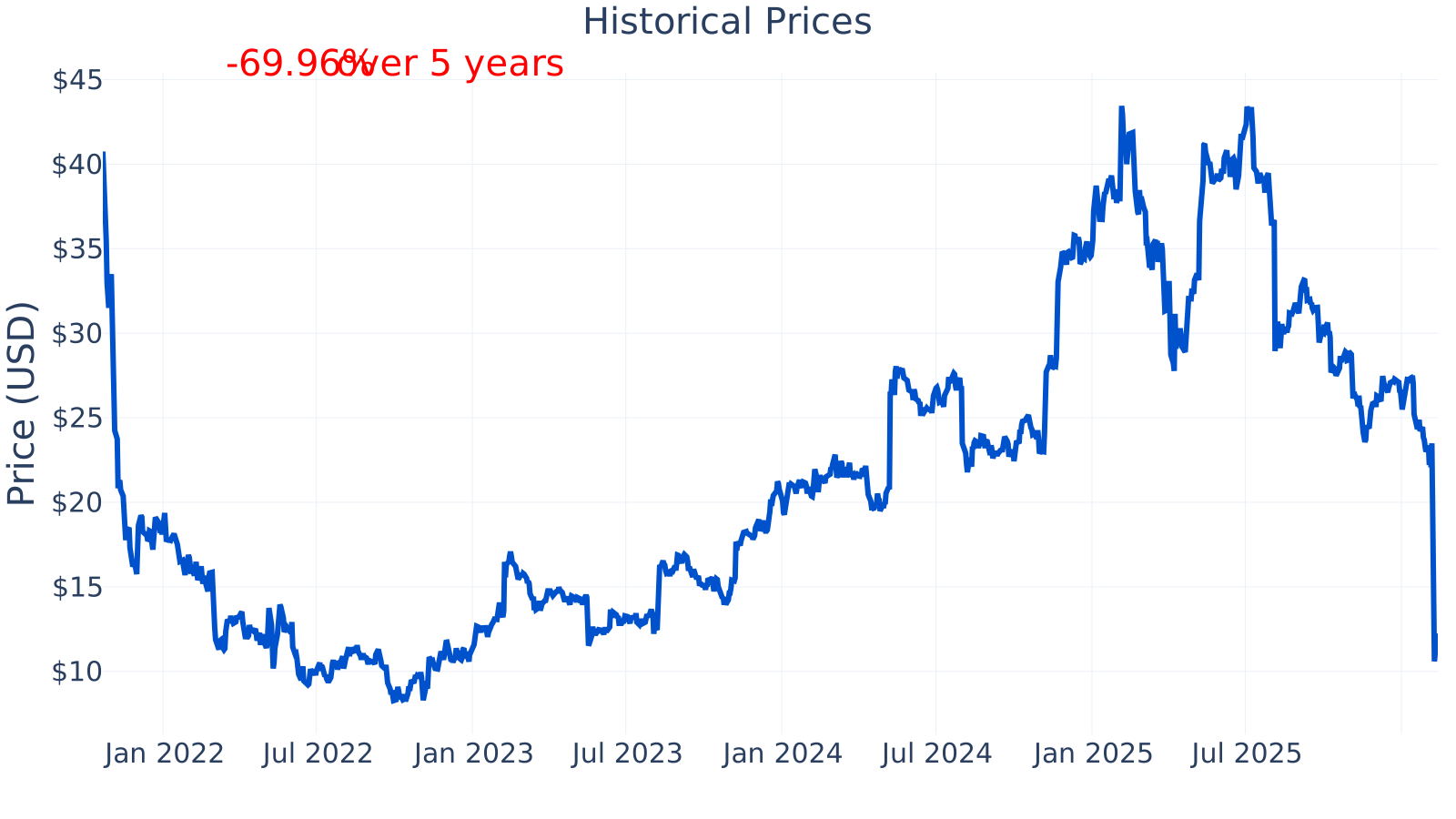
Kyndryl’s market capitalization is about $2.83B, and its beta (about 1.93) indicates the stock has tended to move more than the broader market. The P/E ratio is about 11.66 versus an industry median near 19.24, while profit margin is about 1.65% versus an industry median near 4.91%. Revenue growth (year-over-year) is about 3.10% compared with an industry median near 5.85%. Debt-to-equity is about 325% versus an industry median near 58%, and trailing twelve-month free cash flow is about -$99M.
Growth (Medium)
Kyndryl operates in a large, ongoing-demand area of technology: enterprises need their systems to be secure, resilient, compliant, and cost-effective, and they also need to modernize as software and infrastructure evolve. That underlying need is durable because many organizations run complex “mixed” environments (older systems plus newer cloud services) that require specialized skills to manage.
Strategically, the company’s opportunity is tied to improving the mix of its work: shifting from lower-margin, labor-intensive operations toward higher-value modernization, advisory, and platform-enabled services. For long-term outcomes, the key is whether Kyndryl can grow (or stabilize) revenue while maintaining the profitability progress implied by recent years.
The year-over-year revenue growth trend shown is uneven, with many quarters negative and a few recent quarters moving closer to flat to slightly positive (including around +3.07% in the most recent point shown). This suggests stabilization attempts, but not a clear multi-quarter acceleration.
Free cash flow (trailing twelve months) remains negative across the periods shown (for example, about -$197M in FY 2025 and about -$99M most recently). For a services business, sustained negative free cash flow can limit flexibility (debt reduction, reinvestment, or shareholder returns), so a durable shift to consistently positive free cash flow would be an important operational milestone.
Risks (High)
A central risk is execution: running mission-critical IT operations for large customers comes with tight service-level commitments. Cost overruns, service disruptions, cybersecurity incidents, or weak project delivery can lead to penalties, contract losses, or reputational damage. Another key risk is that revenue has declined over multiple years; even if margins improve, long-term business strength typically benefits from a stable or growing revenue base.
Financial leverage stands out as a major risk factor. Higher leverage can increase sensitivity to interest costs and reduce flexibility during slower demand periods or client spending pullbacks.
Kyndryl’s debt-to-equity is shown around 325% versus an industry median near 58%, and it has remained well above the industry median over time. This indicates a balance sheet structure that is more leveraged than many peers in the same broad industry category.
Profitability is improving but still trails typical industry levels in the metrics shown. That means there is less “buffer” if pricing pressure rises, costs increase, or a major customer relationship changes.
The profit margin trend moves from negative levels in earlier periods to positive more recently (around 2.70% at the latest point shown), yet it remains below the industry median in the same period (around 4.74%). This shows progress, but also highlights that the company’s profitability profile still appears weaker than the median peer.
On competitive positioning, Kyndryl operates in a highly competitive global IT services market. It is not the only large provider capable of managing complex enterprise infrastructure, and customers often run competitive bidding for major contracts. The company’s competitive advantages typically come from deep operational experience, long-standing enterprise relationships, and expertise in running large-scale, complex environments. However, switching costs are not absolute: over time, clients can re-bid contracts, bring work in-house, or shift workloads to cloud providers and other service firms.
Main competitors (examples)
- Large global IT services firms (broad outsourcing and consulting providers)
- Systems integrators and managed service providers (cloud migration, application, and infrastructure operations)
- Cloud platform providers and their partner ecosystems (as workloads move toward cloud-managed services)
Valuation
One simple valuation reference is the price-to-earnings ratio (P/E), which relates the stock price to earnings. Kyndryl’s latest P/E is about 11.66, below the industry median near 19.24. On that single measure, the stock appears priced at a lower multiple than the median peer group.
The historical P/E series shown is only available for more recent periods (earlier values are not displayed). In the displayed timeframe, Kyndryl’s P/E moves from a high level (around 66.65) down into the teens (around 15.82 at the latest point shown), while the industry median stays in the low-to-mid 20s. Interpreting P/E for a company that recently moved from losses toward profitability can be tricky because the ratio can swing sharply as earnings change.
Whether the current valuation is “justified” depends on the balance of several fundamentals visible in the operating picture: improving profitability, uneven/mostly weak recent revenue growth, negative free cash flow in the periods shown, and higher leverage than the industry median. A lower P/E versus peers can reflect the market assigning greater weight to these risks, particularly leverage and cash generation, even as profitability improves.
Conclusion
Kyndryl is a large-scale IT services operator focused on keeping critical enterprise technology running and helping clients modernize. The longer-term financial arc shown here is mixed: revenue declines across several years, while operating income and net income improve significantly, moving into positive territory in the most recent annual period shown.
For long-term evaluation, the most decision-relevant factors to track are (1) whether revenue stabilizes and begins to grow more consistently, (2) whether free cash flow turns sustainably positive, and (3) whether leverage trends down over time. The company’s competitive setting is demanding, with many capable alternatives for customers, making execution quality, contract economics, and balance sheet discipline especially important.
Sources:
- U.S. SEC EDGAR — Kyndryl Holdings, Inc. filings (Form 10-K, Form 10-Q, Form 8-K)
- Kyndryl Investor Relations — Annual Report and SEC filings archive
- Kyndryl Investor Relations — Earnings materials and prepared remarks (company-hosted)
- Wikipedia — “Kyndryl” (basic company background)
This article is for informational purposes only and does not constitute financial advice. Some content is AI-generated. See Disclaimer