Stock Analysis · Kontoor Brands Inc (KTB)
Overview
Kontoor Brands Inc. (KTB) is a global apparel company focused on everyday jeanswear and related clothing. The business designs, sources, markets, and sells products primarily under two long-standing brands: Wrangler and Lee. Its products are sold through a mix of wholesale channels (selling to retailers) and direct-to-consumer channels (brand websites and company-operated stores), with operations spanning multiple geographies.
In its SEC filings, the company presents its business around these two brand platforms, which are the main drivers of revenue and marketing investment. A simple way to think about Kontoor is as a “brand + distribution” company: it relies on brand recognition, product fit and quality, shelf space at retailers, and increasingly its own direct online/customer relationships.
Main sources of revenue (largest to smallest):
- Wrangler-branded apparel (largest share; percentage depends on the year and is disclosed in annual filings)
- Lee-branded apparel (second-largest share; percentage depends on the year and is disclosed in annual filings)
- Other / smaller categories (immaterial compared with the two core brands, as described in filings)
Looking at the multi-year income statement flow, total revenue stayed close to $2.6B from 2022 to 2024 (about $2.63B in 2022 vs. about $2.61B in 2024). Over the same period, net income remained in the ~$231M–$246M range, while interest expense stayed around $35M–$41M, showing that financing costs have been a consistent line item rather than a one-time swing.
Key Figures
| Metric | Value | Industry ⓘ |
|---|---|---|
| Date | Feb 08, 2026 | |
| Context | ||
| Sector | Consumer Cyclical | |
| Industry | Apparel Manufacturing | |
| Market Cap ⓘ | $3.73B | |
| Beta ⓘ | 1.19 | |
| Fundamental | ||
| P/E Ratio ⓘ | 17.28 | 22.80 |
| Profit Margin ⓘ | 7.68% | 4.94% |
| Revenue Growth ⓘ | 27.30% | 1.60% |
| Debt to Equity ⓘ | 283.31% | 109.04% |
| PEG ⓘ | N/A | |
| Free Cash Flow ⓘ | $225.96M | |
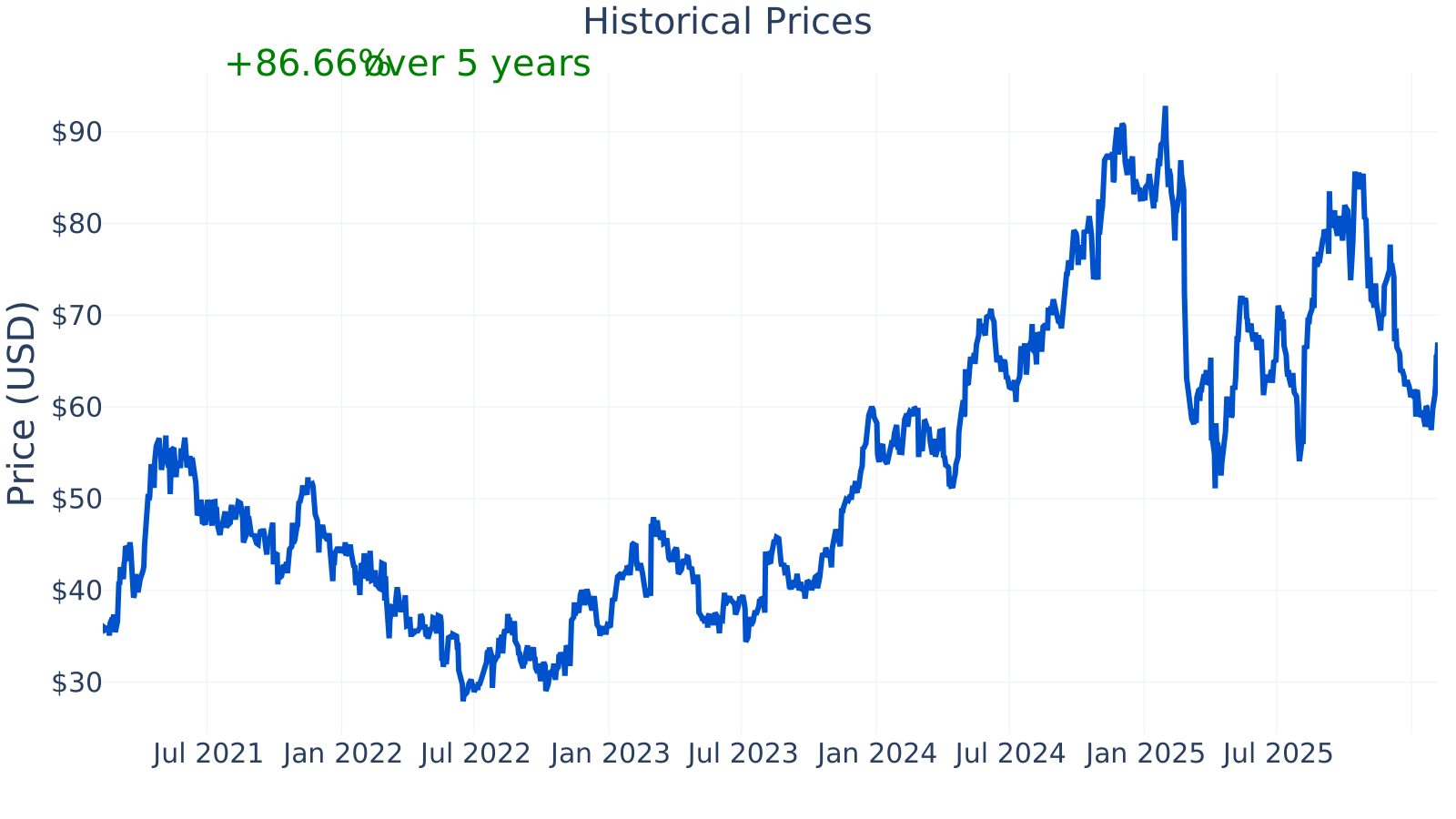
Kontoor’s market capitalization is about $3.7B. The stock’s beta of ~1.19 suggests it has historically moved somewhat more than the broader market. On profitability, the latest profit margin is ~7.7%, which is above the industry median shown (~4.9%). Recent year-over-year revenue growth is ~27.3%, also well above the industry median shown (~1.6%), although apparel demand can be uneven from quarter to quarter. The company’s debt-to-equity is ~283%, which is notably higher than the industry median shown (~109%), making leverage an important part of the overall picture. Trailing twelve-month free cash flow is ~$226M, indicating the business has been generating cash after operating needs and capital spending.
Growth (Medium)
Kontoor operates in the apparel and jeanswear market, which tends to be mature rather than structurally high-growth. Demand is influenced by consumer spending, fashion cycles, and retailer inventory decisions. In a mature category, growth often comes less from “more people buying jeans” and more from brand strength, market share gains, product innovation, pricing discipline, and channel mix (for example, expanding direct-to-consumer where feasible).
The year-over-year revenue growth pattern has been volatile across quarters (including periods of negative growth), which is common in apparel when retailer orders and promotions shift. The latest point shown is a strong rebound (~27%), but the earlier fluctuations suggest it is more useful to view growth across a full cycle rather than extrapolating a single strong quarter.
Cash generation has also moved meaningfully over time: free cash flow shifted from positive levels in 2021–2022 to a negative period in 2023, then rebounded to roughly $397M by 2024 and about $370M by early 2025 (based on the timeline shown), with the latest trailing twelve-month value at ~$226M in the table. For long-term business resilience, sustained free cash flow matters because it can support debt service, dividends, share repurchases, and reinvestment in the brands.
Potential catalysts discussed in company materials typically revolve around brand execution (new fits/fabrics and marketing), improving product mix, expanding direct-to-consumer capabilities, and international opportunities. In a mature apparel category, these catalysts are usually execution-driven rather than driven by a single transformative technology shift.
Risks (High)
This article is for informational purposes only and does not constitute financial advice. Some content is AI-generated. See Disclaimer