Stock Analysis · Knowles Cor (KN)
Overview
Knowles Corporation (KN) is a technology company that designs and manufactures specialized components used to sense, filter, and process sound and signals. Its products are generally small parts that are built into larger systems made by other companies. In plain terms, Knowles sells the “behind-the-scenes” hardware that helps equipment capture sound accurately, reduce noise, or handle delicate signal performance in demanding environments.
Based on the company’s public reporting, its business is organized around specialty components, with a major emphasis on markets where performance and reliability matter (for example, certain industrial, defense, or medical uses). Revenue is primarily generated from selling these components to manufacturers (B2B sales). Percentages by revenue line can vary by year and are typically detailed in the company’s annual report segment information.
Main sources of revenue (high-level):
- Specialty components used in applications such as precision acoustics and high-performance electronics (reported through business segments in filings)
- Other/legacy product lines depending on the period and how the company reports segments and product categories
One useful way to read Knowles is as a company whose results can be influenced by (1) demand cycles in electronics-related end markets, and (2) its ability to maintain strong margins through differentiated engineering and careful cost control.
Across the years shown, total revenue dropped sharply from 2021 to 2022, then stabilized and began recovering through 2025. Operating income remained positive in each year shown, while net income swung widely (including large losses in 2022 and 2024), which is consistent with earnings being affected by items beyond day-to-day operating profit (for example, non-cash charges or other non-operating factors).
Key Figures
| Metric | Value | Industry ⓘ |
|---|---|---|
| Date | Feb 16, 2026 | |
| Context | ||
| Sector | Technology | |
| Industry | Electronic Components | |
| Market Cap ⓘ | $2.32B | |
| Beta ⓘ | 1.51 | |
| Fundamental | ||
| P/E Ratio ⓘ | 47.05 | 41.71 |
| Profit Margin ⓘ | 7.45% | 6.11% |
| Revenue Growth ⓘ | 13.80% | 13.80% |
| Debt to Equity ⓘ | 19.37% | 39.00% |
| PEG ⓘ | 1.12 | |
| Free Cash Flow ⓘ | $81.90M | |
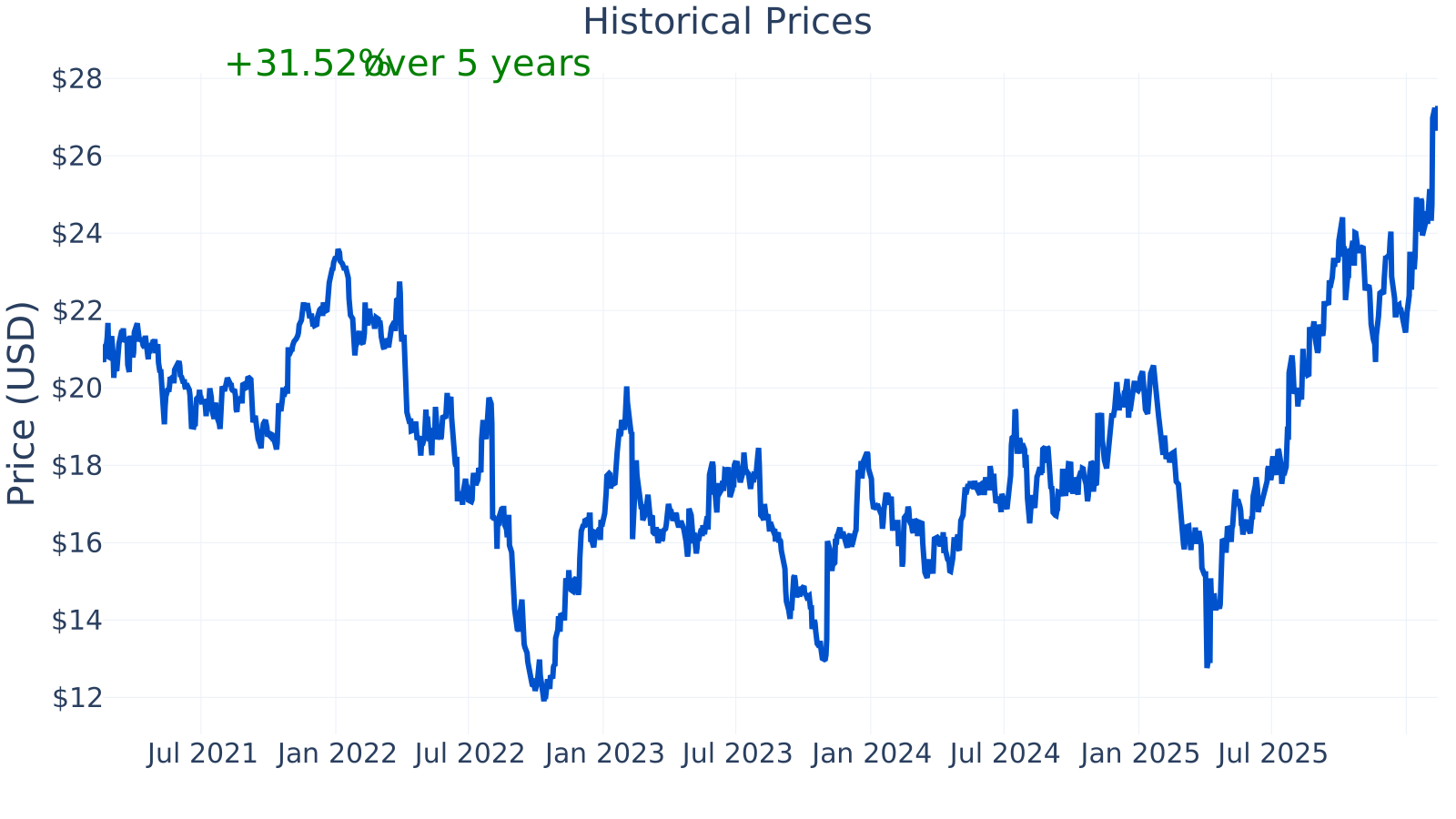
At the latest point shown, Knowles has a market capitalization of about $2.32B and a beta of ~1.51, indicating the stock has historically moved more than the broader market. The P/E ratio is ~47.1 versus an industry median near 41.7, while the profit margin is ~7.45% versus an industry median around 6.11%. Year-over-year revenue growth is shown at ~13.8% (in line with the industry median). Debt-to-equity is about 19%, below the industry median near 39%. Trailing twelve-month free cash flow is approximately $81.9M.
Growth (Medium)
Knowles operates in parts of the broader electronics and component ecosystem, where long-term demand is often supported by continued “electronics content” growth in end products (more sensors, more signal processing, higher performance requirements). However, this type of business can also be cyclical: customer inventory adjustments and end-market slowdowns can cause large swings in orders.
A key question for long-term growth is whether Knowles can keep focusing on higher-value, specialized components—the kind that compete more on performance and reliability than on price alone. In that scenario, growth comes not only from unit volumes but also from capturing more value per device/system through differentiated engineering.
The year-over-year revenue growth pattern shown is uneven: strong growth in parts of 2021, a long stretch of contraction across 2022–2023, and then a return to positive growth during 2024–2025, reaching about 13.8% most recently. This suggests the business has been moving through a downcycle and recovery rather than following a smooth, steady expansion path.
Free cash flow over the trailing twelve-month periods shown remained positive, moving from about $140M (2021) down to the $76–$101M range (2023–2025), and most recently around $81.9M. Consistently positive free cash flow can matter because it indicates the company is generating cash after operating needs and capital spending—cash that can be used for reinvestment, debt reduction, or other corporate purposes.
Potential catalysts (in a neutral, factual sense) typically include: a sustained recovery in customer demand after a downturn, additional design wins that scale into production, and improved operating efficiency that converts revenue into cash flow more consistently.
Risks (High)
Knowles’ results have shown meaningful volatility, which is a central risk for long-term shareholders. Even when operating income is positive, net income can swing significantly, and that can affect valuation multiples and market sentiment. Cyclicality in electronics demand, customer concentration in certain end markets, and pricing pressure are common risks in component businesses.
Debt-to-equity is shown at about 19% most recently, below the industry median near 39%. Earlier in the period shown it was lower, then rose during 2023–2024 before coming down again. Lower leverage can reduce financial risk, but it does not remove operating risk from demand swings and margin variability.
Profit margins have been highly variable across the period shown, including several quarters with negative margins, followed by a return to positive territory. The most recent value is about 7.45%, modestly above the industry median near 6.11%. This history indicates that profitability has not been steady, and that performance can be sensitive to volume, pricing, product mix, and cost structure.
Competitive positioning in electronic components is usually defined by a combination of engineering capability, manufacturing quality, long qualification cycles, and relationships with OEM customers. Knowles’ competitive advantages (as described in company materials) are typically tied to specialized know-how in acoustics and high-performance components. Still, it operates in markets where customers often have alternatives, and where some competitors can compete aggressively on price.
Main competitors depend on the exact product category (acoustic components, precision devices, and other electronic components). Competitive pressure can come from both specialized firms and larger diversified component suppliers. The practical risk is that if competitors match Knowles on performance or undercut pricing, Knowles may have to accept lower margins or lose share in certain programs.
Valuation
The latest P/E ratio is about 47.1, above the industry median near 41.7. Over the historical window shown, Knowles’ P/E has moved widely, with some periods not showing meaningful values (which can occur when earnings are very low or negative). In more “normal” periods where it is displayed, the P/E ranged from the low teens (2022) to higher levels more recently (2025).
Interpreting this valuation in context depends heavily on earnings stability. When profits are volatile, a P/E ratio can change quickly even without a large move in the stock price. The company’s PEG ratio of ~1.12 suggests the market price reflects expected growth to a meaningful degree, but PEG calculations can be less reliable when earnings are choppy or when forecasts shift.
From a fundamentals standpoint, the valuation discussion tends to hinge on whether recent improvements in revenue growth and margins can persist through a full cycle. If profitability remains inconsistent, market multiples can remain unstable even if revenue grows.
Conclusion
Knowles is a specialty electronic components company whose products play enabling roles in sound and signal-related applications. The company’s recent profile shows a mix of recovering revenue growth, positive free cash flow, and moderate leverage, alongside a history of large swings in net income and profit margins. That combination can be consistent with a cyclical business where performance depends on end-market demand, customer programs, and maintaining a favorable product mix.
From a long-term perspective, the main factual trade-off is clear: the company participates in markets that can support ongoing electronics content growth, but its financial results have not been smooth. Whether the current valuation level remains appropriate over time is closely tied to how durable the recovery in growth and profitability turns out to be across future cycles.
Sources:
- SEC EDGAR — Knowles Corporation filings (Form 10-K, Form 10-Q)
- Knowles Investor Relations — Annual Report / SEC filings repository
- Wikipedia — “Knowles Corporation” (basic company background)
This article is for informational purposes only and does not constitute financial advice. Some content is AI-generated. See Disclaimer


