Stock Analysis · Keysight Technologies Inc (KEYS)
Overview
Keysight Technologies Inc. (KEYS) designs and sells electronic test and measurement equipment and related software. In simple terms, it provides the tools that engineers use to design, validate, and troubleshoot advanced electronics—such as wireless networks, data centers, semiconductor chips, aerospace/defense systems, and automotive electronics.
The company generally earns money from a mix of physical instruments (hardware), software, and services/support. Its products are typically used in research and development (R&D), manufacturing, and network deployment/maintenance, where accuracy and reliability are critical and where customers may standardize on a vendor’s ecosystem of tools over many years.
In its annual filings, Keysight typically discusses revenue by operating segments rather than a simple “product A vs product B” breakdown. A common segment framing includes:
- Commercial communications (test solutions for wireless, networking, and data center-related applications)
- Aerospace, defense, and government (test solutions for defense and aerospace programs)
- Electronic industrial solutions (broad industrial and general electronics test needs)
- Software and services (often sold alongside instruments, and can be recurring depending on structure)
For exact percentages by segment and geography, the company’s latest Form 10-K segment note is the most direct reference, as mix can change over time with customer demand cycles.
Across the years shown, total revenue has fluctuated around the $5–$5.5B range, with operating expenses including meaningful ongoing investment in research and development (roughly around $0.8B–$1.0B in the periods shown). Net income has been more cyclical, reflecting demand cycles as well as expense levels and other non-operating items.
Key Figures
| Metric | Value | Industry ⓘ |
|---|---|---|
| Date | Mar 02, 2026 | |
| Context | ||
| Sector | Technology | |
| Industry | Scientific & Technical Instruments | |
| Market Cap ⓘ | $52.80B | |
| Beta ⓘ | 1.20 | |
| Fundamental | ||
| P/E Ratio ⓘ | 54.01 | 37.61 |
| Profit Margin ⓘ | 16.95% | 12.72% |
| Revenue Growth ⓘ | 23.30% | 7.60% |
| Debt to Equity ⓘ | 47.67% | 23.85% |
| PEG ⓘ | 1.94 | |
| Free Cash Flow ⓘ | $1.47B | |
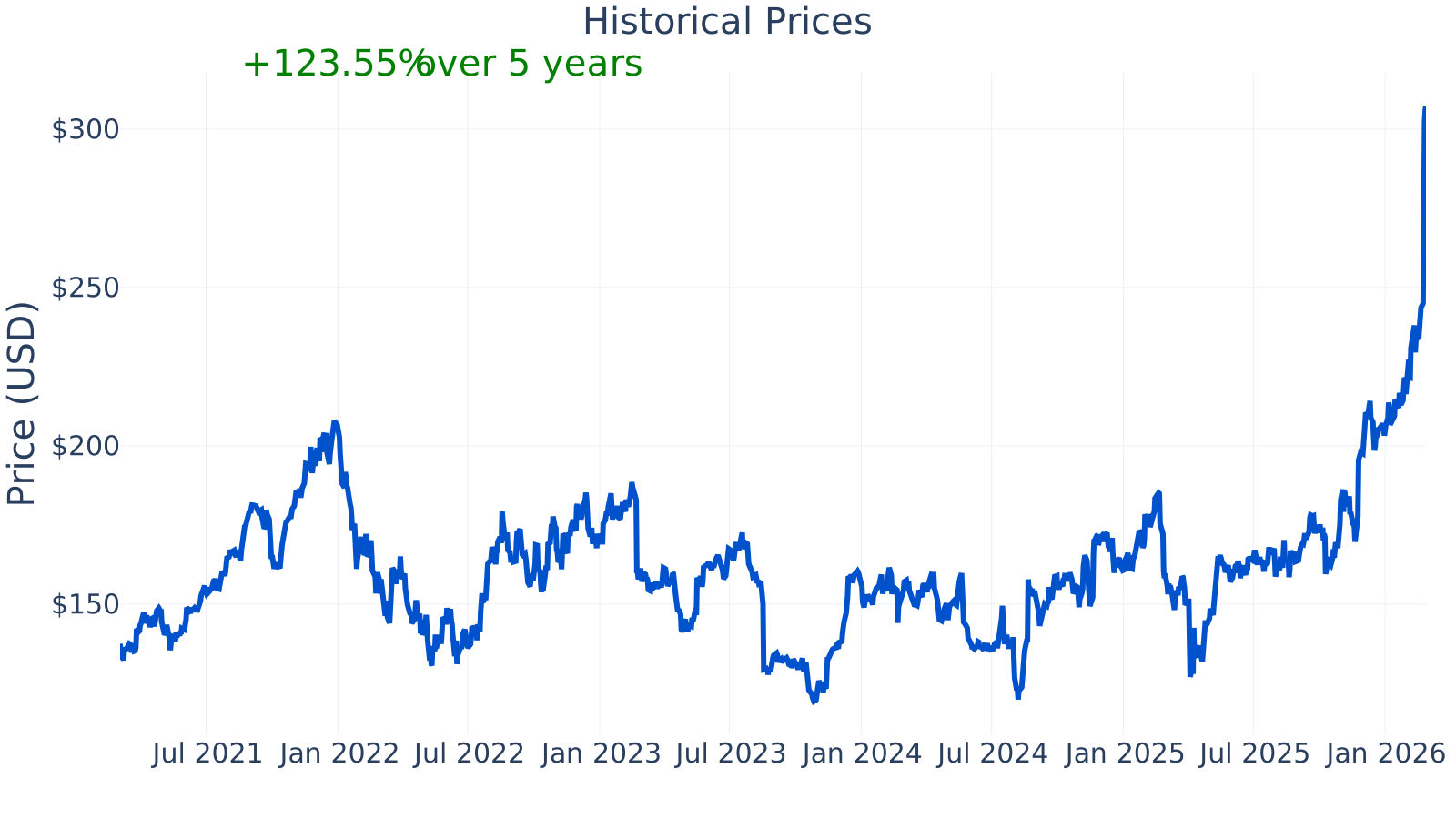
Keysight’s market capitalization is about $52.8B. The stock’s beta of ~1.20 indicates it has historically moved somewhat more than the overall market (though beta can shift over time).
On profitability, Keysight’s profit margin is ~16.95% versus an industry median of ~12.72%, suggesting stronger-than-typical profitability compared with a peer set of scientific and technical instrument companies.
On growth, the latest year-over-year revenue growth shown is ~23.3% versus an industry median of ~7.6%, indicating a stronger recent growth rate than the typical peer in the same broad category (noting that this metric can be volatile and influenced by timing and customer spending cycles).
Keysight’s debt-to-equity is ~47.7%, which is higher than the industry median of ~23.9%, pointing to a more leveraged balance sheet than many peers (though still not unusual for a mature technology supplier with steady cash generation).
Free cash flow (trailing twelve months) is shown at approximately $1.466B, which matters because free cash flow is the cash remaining after operating needs and capital spending—cash that can be used for acquisitions, debt reduction, or returning capital to shareholders.
Growth (Medium)
Keysight is tied to long-term technology trends that tend to increase testing complexity: faster wireless standards, higher-speed data transmission in data centers, more advanced semiconductor designs, and greater electronic content in industrial and automotive systems. As electronics become more complex and operate at higher frequencies and speeds, engineers generally need more sophisticated and expensive test solutions to verify performance, reliability, and compliance.
A key practical point for long-term business durability is that test and measurement is often “mission critical.” If a chip, network device, or defense system cannot be properly validated, it can delay product launches or raise failure risks. That tends to support ongoing demand for high-end instruments and software, although spending can still be cyclical when customers pause capital expenditures.
The revenue growth pattern shown is cyclical: strong growth earlier in the period, a downturn (negative year-over-year growth through parts of 2023–2024), and then a re-acceleration to ~23% in the most recent point. This type of swing is consistent with end markets that can pause and restart spending (for example, telecom/network investment cycles or semiconductor test demand cycles).
Free cash flow has remained positive across the period shown and rose to about $1.466B most recently after a dip around early 2025. Consistently positive free cash flow can support flexibility through cycles (for example, maintaining R&D investment even when some customers slow spending).
Potential catalysts discussed in company materials often relate to technology transitions (such as new wireless standards, faster compute/networking, and more advanced chip design and manufacturing), as well as the company’s ability to attach software and services to instrument sales. The durability of these catalysts depends on timing and customer budgets rather than a single one-time event.
Risks (Medium-High)
Keysight’s results can be sensitive to customer capital spending cycles. Large customers in communications, semiconductor-related ecosystems, and government/defense can meaningfully influence quarterly and annual results, and spending can be delayed when customers reduce budgets or work through excess capacity.
Competition is another structural risk. Keysight competes with other test and measurement vendors as well as niche specialists, and in some cases customers may develop internal testing approaches or use lower-cost options when requirements allow. Competitive pressure can show up as pricing pressure, slower growth, or the need for sustained R&D spending to defend product leadership.
On competitive positioning, Keysight is commonly viewed as one of the major global players in high-end electronic test and measurement, alongside companies such as Rohde & Schwarz (private), Tektronix (part of Fortive), Anritsu, and other specialized providers. Differentiation often comes from measurement accuracy, breadth of product portfolio, software workflows, and long-standing customer relationships. Leadership can vary by sub-category (for example, RF/microwave, high-speed digital, protocol solutions, or specific vertical applications).
The debt-to-equity ratio has generally been in the ~39%–57% range over the period shown and stands at ~47.7% most recently. This is above the industry median shown (~23.7% at the latest point), meaning Keysight is using more debt relative to equity than many peers. Higher leverage can amplify outcomes in both directions and may reduce flexibility if a downturn lasts longer than expected.
Profit margin has also been cyclical. It peaked above 20% during parts of 2022–2023, dipped to the low teens in parts of 2024–2025, and most recently is about 16.9%. Even with the swings, the latest margin is above the industry median shown (~12.3%), which may indicate resilient pricing power and/or operating efficiency relative to peers, but it also highlights that profitability can move meaningfully with revenue mix and demand levels.
Other common risks referenced in filings for global technology suppliers include supply chain constraints, export controls and trade restrictions (given sensitive technologies and international customers), cybersecurity and IP protection, and acquisition integration risk if the company uses M&A to expand capabilities.
Valuation
Keysight’s latest P/E ratio is about 54.0, above the industry median shown of ~37.6. Historically in the period displayed, Keysight’s P/E has moved widely (roughly from the low 20s up to the 40s/50s), and in several periods it traded above the industry median.
A higher P/E can be consistent with expectations for stronger growth, higher-quality earnings, or durable competitive positioning. At the same time, a higher multiple can leave less room for disappointment if growth slows, margins compress, or customer spending weakens. The table also shows a PEG ratio of ~1.94, which is one way investors relate valuation to growth expectations; values near or above ~2 are often interpreted as requiring sustained growth to justify the multiple, though PEG depends heavily on the growth estimate used and can change quickly.
In practice, interpreting Keysight’s valuation often comes down to whether its end-market cycles (telecom/networking/semiconductor test demand) and its margin profile are expected to be strong and durable enough to support a premium versus the peer group.
Conclusion
Keysight is a specialized technology company that supports critical engineering work in communications, high-speed computing/networking, semiconductor-related ecosystems, and aerospace/defense. The business is tied to long-term trends that increase electronic complexity, which generally increases the need for advanced testing and validation tools.
The metrics shown reflect a company with solid profitability relative to peers and strong recent revenue growth after a cyclical slowdown, alongside meaningful free cash flow generation. At the same time, the business appears exposed to customer spending cycles, and the balance sheet is more leveraged than the industry median in the comparison shown.
From a valuation standpoint, the stock is currently priced at a higher P/E than the industry median, which suggests the market is assigning a premium that may require continued execution and supportive end-market conditions. The overall picture is of a high-quality tools provider in a technically demanding niche, with cyclical demand and a valuation that reflects relatively elevated expectations.
Sources:
- U.S. SEC EDGAR — Keysight Technologies, Inc. filings (Form 10-K, Form 10-Q)
- Keysight Technologies — Investor Relations (Annual Report materials and press releases)
- Wikipedia — “Keysight Technologies” (basic company background)
This article is for informational purposes only and does not constitute financial advice. Some content is AI-generated. See Disclaimer