Stock Analysis · Keysight Technologies Inc (KEYS)
Overview
Keysight Technologies Inc. designs and sells electronic test and measurement equipment and software. In simple terms, it provides the tools engineers use to design, test, and troubleshoot complex electronics. These tools are used across areas like wireless communications (including 5G/6G), data centers and high-speed digital systems, semiconductors, aerospace and defense, automotive electronics, and general industrial applications.
The company typically earns revenue by selling:
- Hardware instruments (test equipment used in labs and manufacturing)
- Software (applications that control instruments, analyze results, and help simulate designs)
- Services (calibration, support, and other lifecycle services)
In its SEC filings, Keysight also reports its business in major operating segments, commonly described as Communications Solutions Group (CSG) and Electronic Industrial Solutions Group (EISG), reflecting different end markets (communications-focused vs. broader electronic/industrial and aerospace/defense-oriented demand). Specific up-to-date percentage splits can vary by fiscal year and are detailed in the company’s annual report segment disclosures.
Over the last several fiscal years shown, total revenue has fluctuated around the $5.0–$5.5B range, while the company has continued spending heavily on research and development (R&D), reaching about $1.0B in the most recent period shown. Net income has been more variable than revenue, which is consistent with a business exposed to cycles in customer spending and product mix.
Key Figures
| Metric | Value | Industry ⓘ |
|---|---|---|
| Date | Feb 07, 2026 | |
| Context | ||
| Sector | Technology | |
| Industry | Scientific & Technical Instruments | |
| Market Cap ⓘ | $39.68B | |
| Beta ⓘ | 1.20 | |
| Fundamental | ||
| P/E Ratio ⓘ | 46.10 | 45.31 |
| Profit Margin ⓘ | 15.81% | 12.33% |
| Revenue Growth ⓘ | 10.30% | 7.45% |
| Debt to Equity ⓘ | 50.55% | 49.68% |
| PEG ⓘ | 1.75 | |
| Free Cash Flow ⓘ | $1.37B | |
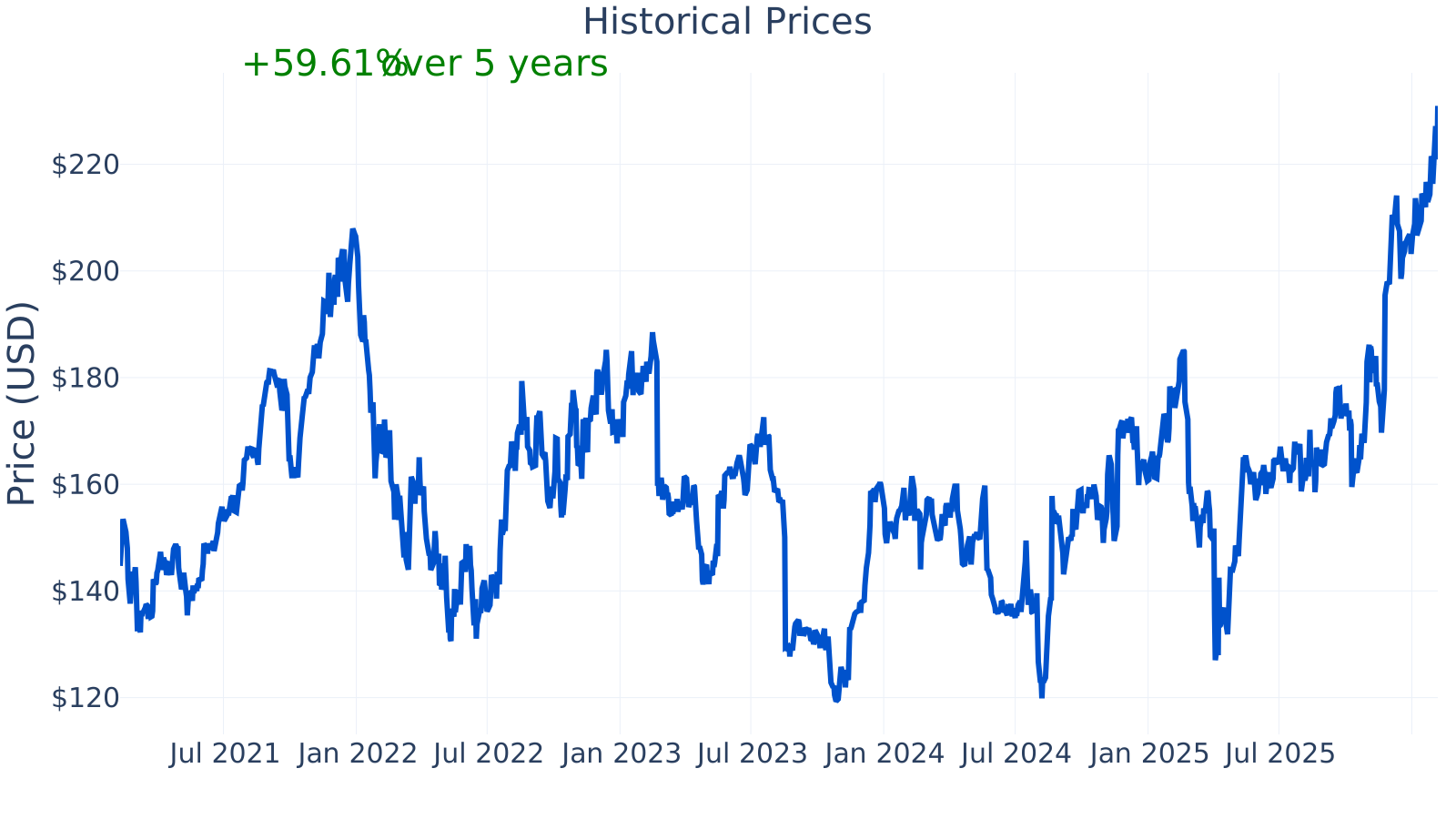
Keysight’s market capitalization is about $39.7B. The stock’s beta of ~1.20 suggests it has tended to move somewhat more than the broader market. The company’s P/E ratio is ~46.1, close to the industry median (~45.3). Recent profit margin is ~15.8%, above the industry median (~12.3%), and year-over-year revenue growth is ~10.3%, also above the industry median (~7.5%). Debt-to-equity is about 50.6%, roughly in line with the industry median (~49.7%). Trailing twelve-month free cash flow is ~$1.37B, showing meaningful cash generation that can support reinvestment and balance-sheet flexibility.
Growth (Medium)
Keysight operates in markets that can grow over the long run, because as electronics become more complex, companies need more advanced tools to verify performance and reliability. Demand often rises with major technology transitions—such as new wireless standards, higher-speed networking for data centers, and increasingly sophisticated semiconductor designs. At the same time, this is not a “straight-line” growth profile: customers can delay or accelerate spending depending on their own product cycles and budgets.
The revenue growth pattern shows this cyclicality. After stronger growth earlier in the period, growth turned negative for several quarters, then moved back into positive territory and reached roughly ~10% most recently. This kind of swing is common in test-and-measurement markets because large customers (for example, in communications infrastructure, smartphones, networking, or semiconductors) can change spending quickly based on end-market demand and inventory conditions.
Free cash flow has remained substantial (roughly $1.0B–$1.2B in several periods shown), with a dip around early 2025 (about $0.96B) followed by a more recent level of around $1.37B. For a business like Keysight, steady cash generation matters because it supports ongoing R&D, potential acquisitions, and the ability to manage through downturns without cutting back as sharply on long-term product development.
From a strategy perspective, Keysight’s ongoing investment in R&D (around $1.0B in the most recent fiscal year shown) aligns with an industry where performance leadership and new capabilities can be a key differentiator. Potential catalysts are typically tied to broad technology upgrade cycles (for example, next-generation wireless, higher-speed data center interconnects, and new semiconductor architectures) rather than one-time events.
Risks (Medium-High)
This article is for informational purposes only and does not constitute financial advice. Some content is AI-generated. See Disclaimer