Stock Analysis · KB Home (KBH)
Overview
KB Home (KBH) is a U.S. homebuilder. It develops communities, builds and sells primarily single-family homes, and also delivers some attached products (such as townhomes) depending on the local market. The company typically controls lots, designs floor plans, manages construction (often through subcontractors), and sells homes directly to buyers through its sales offices and online tools.
For a homebuilder, revenue is mainly tied to how many homes are delivered (closed) and at what average selling price. KB Home’s business is largely domestic and closely linked to U.S. housing demand, mortgage rates, build costs (labor/materials), and the availability and price of land.
Revenue sources are generally organized as:
- Home sales (majority of revenue): revenue recognized at the time a home is delivered to the buyer.
- Land sales and other: occasional sales of land or lots and other smaller items, depending on the period.
The company’s results can shift meaningfully from year to year because housing is cyclical and because margins depend on both pricing power and construction/land costs.
Across recent fiscal years shown, total revenue rose from about $5.7B (FY2021) to about $6.9B (FY2024), then moved down to about $6.2B (FY2025). Net income followed a similar pattern, peaking higher earlier in the period and then easing in FY2025 (about $429M), which is consistent with a cooler demand environment and/or margin pressure.
Key Figures
| Metric | Value | Industry ⓘ |
|---|---|---|
| Date | Mar 30, 2026 | |
| Context | ||
| Sector | Consumer Cyclical | |
| Industry | Residential Construction | |
| Market Cap ⓘ | $3.19B | |
| Beta ⓘ | 1.45 | |
| Fundamental | ||
| P/E Ratio ⓘ | 9.83 | 11.26 |
| Profit Margin ⓘ | 5.96% | 8.65% |
| Revenue Growth ⓘ | -22.60% | -7.90% |
| Debt to Equity ⓘ | 41.85% | 34.13% |
| PEG ⓘ | 5.97 | |
| Free Cash Flow ⓘ | $290.25M | |
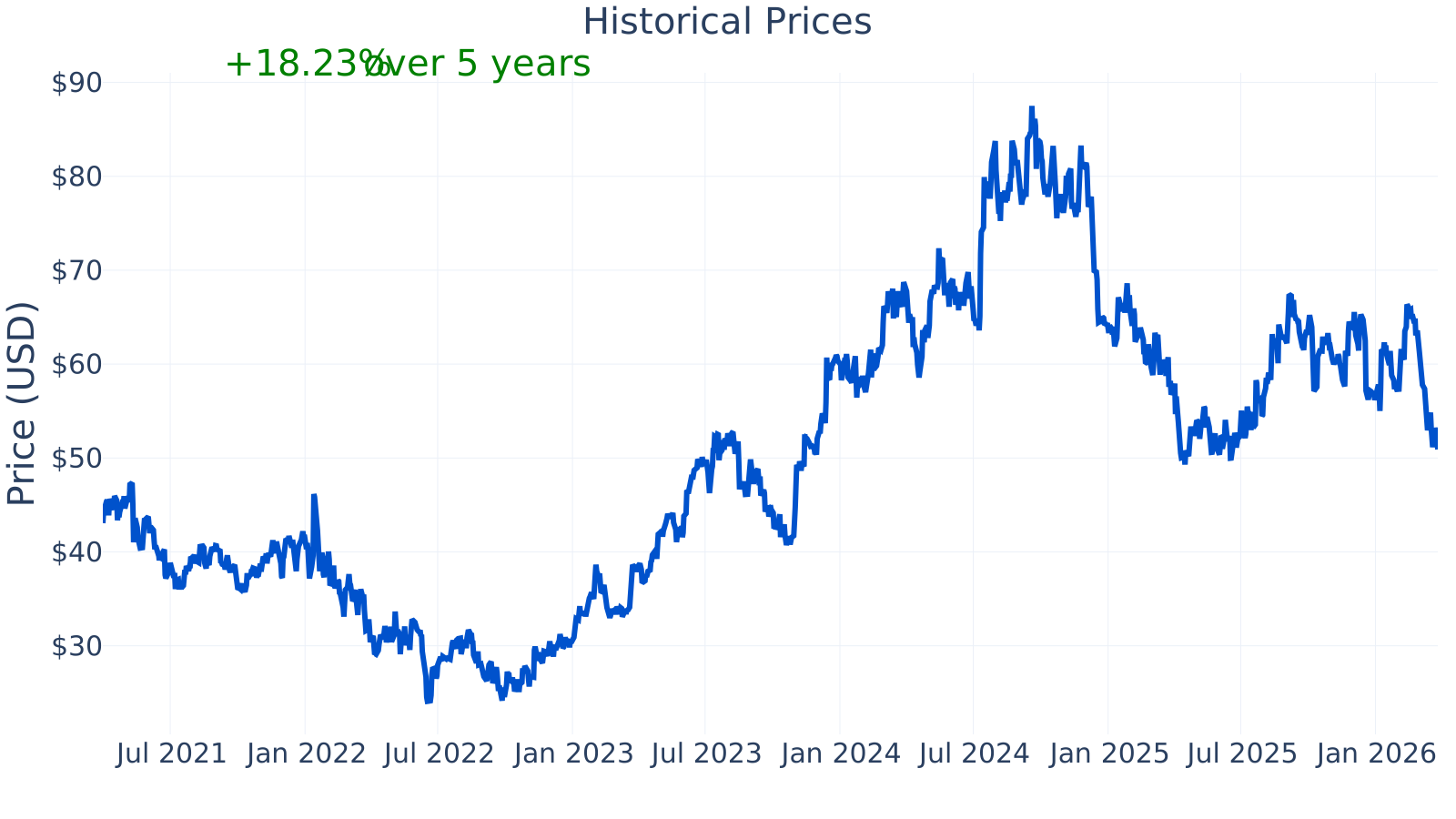
KB Home’s market capitalization is about $3.19B, and the stock’s beta (~1.45) suggests it has tended to move more than the broader market (up or down). The latest P/E ratio (~9.83) is below the industry median shown (~11.26), while the latest profit margin (~6.0%) is below the industry median (~8.7%). Year-over-year revenue growth is currently negative (about -22.6%), which is weaker than the industry median shown (about -7.9%). Debt-to-equity is about 41.9%, higher than the industry median (~34.1%).
Growth (Medium)
Homebuilding is a long-term essential industry (people need housing), but it is also highly cyclical. Growth over time is shaped by household formation, employment, wage growth, housing supply levels, and—crucially—mortgage rates and credit availability. In periods when financing is cheaper and demand is strong, builders can raise prices and expand deliveries; when financing becomes more expensive, demand often slows and incentives may rise.
From a strategy perspective, builders that can (1) keep a steady pipeline of lots/land, (2) manage build times and costs, and (3) adjust product and incentives to match affordability tend to navigate cycles better. KB Home’s model—developing communities and selling homes to order with choices for buyers—can support price discipline in stronger markets, while also allowing adjustments (floor plans, features, incentives) when affordability is pressured.
The year-over-year revenue growth trend illustrates the cycle clearly: strong positive growth earlier in the period, then a multi-quarter slowdown that recently reached about -22.6%. That pattern is consistent with a housing environment where demand is more rate-sensitive and volumes can soften.
Free cash flow has also been volatile—common for builders because cash use rises when land is acquired/developed and homes are built ahead of delivery. The chart shows a swing from negative to strongly positive and back near break-even/negative (most recently about $290M in trailing twelve-month free cash flow in the table, while the time series also shows notable fluctuations). For long-term growth, the key is whether cash generation remains sufficient across the cycle while maintaining an adequate land pipeline.
Potential catalysts for improved growth in the industry are typically macro-driven rather than company-specific: sustained declines in mortgage rates, improving affordability, and a stronger existing-home turnover environment (which can free up move-up demand). Company-specific catalysts often include improved construction efficiency, better land positioning, and a more favorable mix of communities—factors that tend to show up gradually in margins and returns.
Risks (High)
Homebuilding carries meaningful risk because results can change quickly with the economy and interest rates. When mortgage rates rise, monthly payments increase, affordability declines, cancellations can rise, and builders may need to offer incentives or accept lower pricing—pressuring revenue and profit.
Execution risk is also important: controlling land and building homes requires accurate forecasting of demand, costs, and build timelines. Materials and labor inflation, local permitting delays, and supply constraints can reduce profitability. Land strategy matters as well—overpaying for lots or holding land too long can weigh on future returns, while underinvesting can limit the ability to grow deliveries when demand improves.
Leverage is a central topic for builders. KB Home’s debt-to-equity ratio is about 41.9%, above the industry median shown (~34.1%), though it has come down substantially compared with earlier levels in the historical series (which were notably higher). Lower leverage generally improves flexibility during downturns, but the company still remains exposed to financing costs and capital market conditions.
Profitability has weakened versus earlier periods: the latest profit margin is about 6.0%, down from low-double-digit levels in prior years in the series, and below the industry median (~8.7%). For a homebuilder, margin changes can reflect both pricing power (or incentives) and cost pressures (materials, labor, land, and overhead absorption as volumes change).
Competitive positioning in homebuilding is usually regional rather than national, with competition varying by metro area and price segment. Large public builders often compete on land access, construction scale, product offering, cycle management, and financing/incentive programs. KB Home competes with other large U.S. builders such as D.R. Horton, Lennar, PulteGroup, Toll Brothers, and Taylor Morrison, as well as numerous private and regional builders. The company is not the largest in the group by size, which can matter in purchasing scale and market reach, but competitive strength often comes down to local land positions and execution in specific markets.
Valuation
On an earnings multiple basis, KB Home’s current P/E (about 9.8) is below the industry median shown (about 11.1), and the historical series indicates the stock has often traded at single-digit P/E levels over the period displayed. In cyclical industries like homebuilding, lower P/E ratios can reflect the market’s expectation that earnings may be closer to a mid-cycle or late-cycle level, rather than a stable long-run trend.
Whether today’s valuation is “high” or “low” depends heavily on how durable earnings are under current housing conditions. Recent indicators in this summary point to a softer phase—negative year-over-year revenue growth and a lower profit margin than earlier periods—while the company continues operating with moderate leverage. In that context, a below-industry P/E can be interpreted as the market applying caution around the cycle and near-term fundamentals rather than placing a premium on growth.
Conclusion
KB Home is a U.S. homebuilder whose results are largely driven by home deliveries, pricing, and the cost of land and construction. The business participates in a necessary long-term industry, but one that is strongly influenced by interest rates and economic conditions.
Recent fundamentals in this snapshot show a cooler phase of the cycle: revenue is declining year over year and profit margin has moved down compared with prior years, while leverage is moderate and improved versus earlier levels. The valuation picture, based on the P/E ratio, sits below the industry median shown, which aligns with the market’s typical caution toward cyclical earnings. A long-term assessment usually depends on how the company manages affordability-driven demand shifts, protects margins through cost and land discipline, and maintains enough financial flexibility to operate through downturns.
Sources:
- SEC EDGAR — KB Home Form 10-K (Annual Report)
- SEC EDGAR — KB Home Form 10-Q (Quarterly Report)
- KB Home Investor Relations — SEC Filings & Annual Reports (company-hosted)
- Wikipedia — “KB Home”
This article is for informational purposes only and does not constitute financial advice. Some content is AI-generated. See Disclaimer