Stock Analysis · Jumia Technologies AG (JMIA)
Overview
Jumia Technologies AG is a consumer internet company focused on e-commerce in selected African countries. Through its online marketplace, customers can browse and purchase products, while third-party sellers and brands use the platform to reach shoppers. The company also operates supporting services that aim to make online shopping work more smoothly in markets where logistics and payments can be challenging, including delivery and a fintech product (JumiaPay) used for paying on the platform and, in some cases, for other payment use cases described in its filings.
In its reporting, Jumia generally describes revenue through a few main streams tied to marketplace activity and supporting services. The mix can change year to year as the company shifts strategy (for example, emphasizing marketplace commissions and reducing first-party retail exposure in certain periods). The main revenue sources commonly described in filings include:
- Marketplace revenue (such as commissions and fees charged to sellers for transactions on the platform)
- Logistics revenue (fees for fulfillment and delivery services, including services provided to third parties in some cases)
- Digital/advertising and other platform services (monetization tools for sellers and brands)
- Payment-related revenue tied to JumiaPay and transaction services (as described in company filings)
From an income statement perspective, the company has worked to reduce losses over time by lowering operating expenses while trying to stabilize and re-accelerate revenue. Total revenue was about $167.6M in 2021, $203.3M in 2022, $186.4M in 2023, $167.5M in 2024, and about $188.9M in 2025, while net losses narrowed meaningfully over the same period (though remained negative).
One notable pattern is that operating expenses declined materially versus earlier years (for example, total operating expenses fell from about $323.0M in 2021 to about $163.7M in 2025). Over the same span, net loss improved from roughly -$226.9M (2021) to about -$61.5M (2025). Revenue, however, has not shown a steady upward path across these years, which matters for long-term operating leverage.
Key Figures
| Metric | Value | Industry ⓘ |
|---|---|---|
| Date | Mar 02, 2026 | |
| Context | ||
| Sector | Consumer Cyclical | |
| Industry | Internet Retail | |
| Market Cap ⓘ | $1.23B | |
| Beta ⓘ | 2.30 | |
| Fundamental | ||
| P/E Ratio ⓘ | N/A | 34.06 |
| Profit Margin ⓘ | -42.52% | 6.50% |
| Revenue Growth ⓘ | 25.10% | 12.40% |
| Debt to Equity ⓘ | 44.62% | 32.25% |
| PEG ⓘ | N/A | |
| Free Cash Flow ⓘ | -$52.59M | |
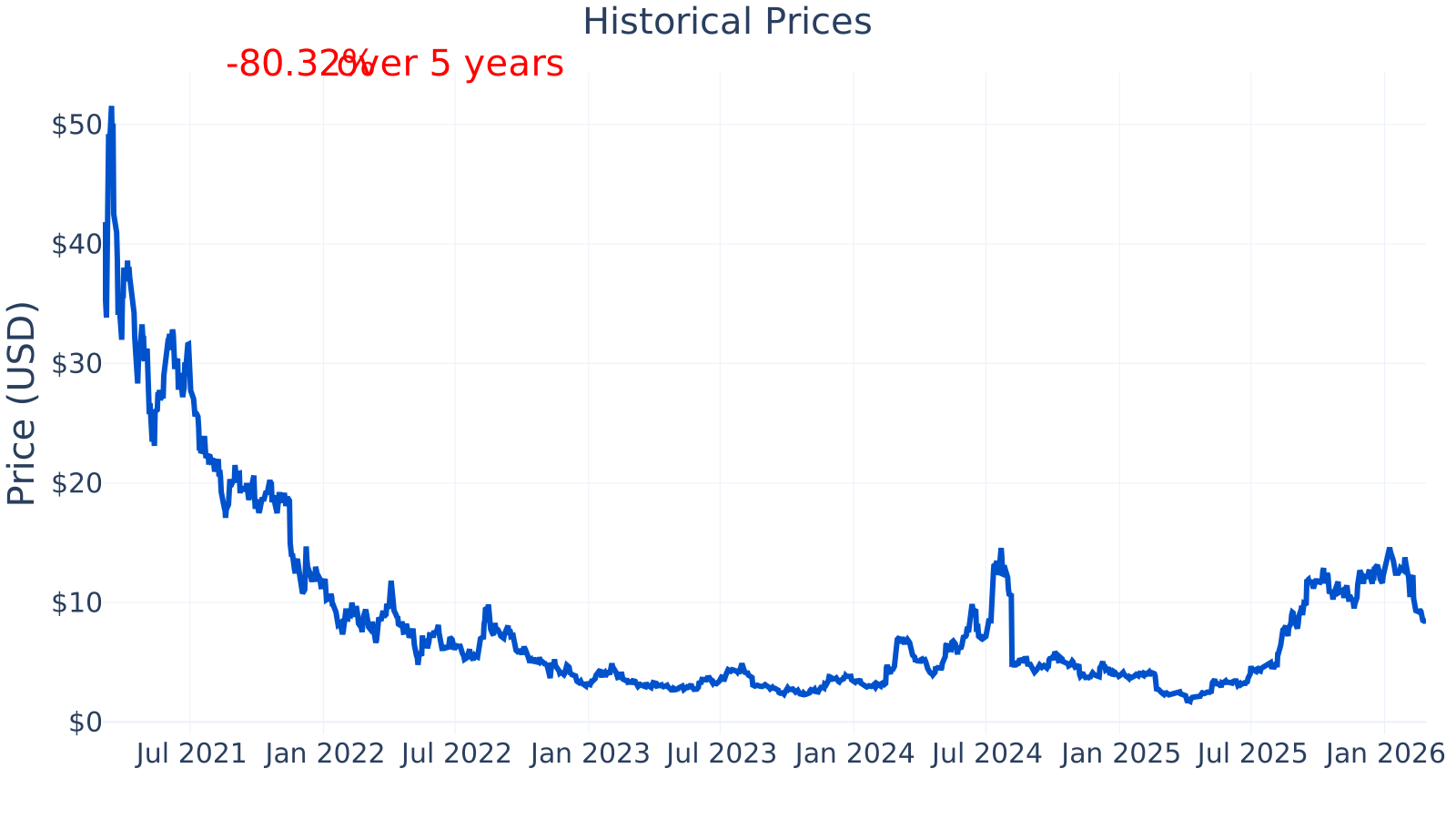
Jumia’s market capitalization is about $1.23B. The stock’s beta of ~2.30 indicates historically high volatility compared with the broader market. Profitability remains a central issue: the latest profit margin is about -42.5% versus an industry median of about 6.5%, meaning the company is still losing money on a net basis while many peers in the broader internet retail group are profitable. Growth is uneven but the latest year-over-year revenue growth shown is about 25.1% (industry median ~12.4%). Leverage appears moderate but rising: debt-to-equity is ~44.6% versus an industry median near 32.2%. Free cash flow over the trailing twelve months is still negative at about -$52.6M.
Growth (Medium)
Jumia operates in online retail and digital services, areas that can benefit over the long run from increasing internet penetration, smartphone adoption, improving logistics networks, and the shift from cash to digital payments. In Africa specifically, the addressable opportunity can be large because modern retail and card-based payments have historically been underdeveloped in many markets. That said, industry potential does not automatically translate into durable company-level growth, because execution and local operating complexity are major factors.
Strategically, Jumia’s filings emphasize building an ecosystem around its marketplace with logistics and payments as supporting pillars. In principle, this approach can strengthen customer experience and merchant adoption, which can reinforce activity on the platform. A key question for long-term fundamentals is whether the company can grow orders and active customers while keeping fulfillment, marketing, and overhead costs under control.
The revenue growth path has been volatile. The company moved from strong positive growth in parts of 2022 to declines through much of 2023 and portions of 2024, then returned to positive territory in 2025 (with the most recent quarters shown around the mid-20% to mid-30% range year over year). This pattern suggests the business has been adjusting its model and cost structure, and that growth can re-accelerate, but it has not yet been consistent.
Cash generation remains a key “proof point” to watch. Trailing free cash flow is still negative, but it improved significantly versus earlier years (for example, from roughly -$219.5M in 2022 to about -$50.0M in 2024, before worsening to about -$87.2M in 2025 and standing near -$52.6M most recently). A durable shift toward consistently positive free cash flow would typically reduce reliance on external funding and may increase strategic flexibility.
Risks (High)
The main risk is that Jumia is still unprofitable and has not yet demonstrated sustained net income profitability. Even with improving losses, operating in multiple countries with complex logistics, payment behavior, and regulatory environments can keep costs elevated and make outcomes less predictable than in more mature e-commerce markets.
Another major risk is competitive pressure. E-commerce and consumer internet services tend to have low switching costs for customers, and competition can come from local marketplaces, social commerce, individual brand websites, and offline retail chains expanding their digital presence. Competitive intensity can force higher marketing spend, lower take rates (fees/commissions), or subsidies to maintain volume, all of which can delay profitability.
Funding and balance-sheet risk also matters for a business that is still consuming cash. If free cash flow remains negative, the company may need to rely on cash reserves, debt, or equity financing over time, each of which can come with trade-offs (higher interest expense, tighter covenants, or shareholder dilution).
Debt-to-equity has increased over the period shown, rising from very low levels in 2021 (around 2–3%) to about 44.6% by 2025. While this is not extreme in absolute terms, the upward trend is important because rising leverage can reduce flexibility if profitability takes longer than expected, and because interest expense becomes a more meaningful line item when losses persist.
Profit margins have improved substantially from very negative levels (around -100% or worse in 2021–2022) to roughly -32.6% by late 2025. Even with this improvement, profitability remains far below the broader industry median (about 6.3% in the latest period shown). This gap highlights that the turnaround is in progress but not complete.
On competitive advantages, Jumia’s potential strengths come from local operating experience, an established brand in certain markets, and integrated services (marketplace + delivery + payments). However, leadership is difficult to claim broadly across a continent with many distinct national markets, and advantages can be challenged by well-funded competitors, specialized logistics providers, or payment companies with deeper distribution.
Competitors vary by country and category and may include other online marketplaces, large regional retailers with online channels, social media-driven merchants, and payment or delivery platforms that can disintermediate parts of the value chain. This fragmented landscape can limit pricing power and make scale benefits harder to sustain.
Valuation
For profitable companies, valuation discussions often lean heavily on earnings-based metrics such as the P/E ratio. For JMIA, the P/E ratio is not meaningful in the periods shown because earnings are negative, so the company’s P/E is effectively not applicable (displayed as 0 in the chart for this reason). In practice, valuation often shifts toward measures like revenue multiples, gross profit trends, unit economics, cash runway, and the pace of improvement in operating losses and free cash flow—items that can be cross-checked in filings.
The broader internet retail industry median P/E shown fluctuates (often in the mid-double-digits), which provides context for what profitable peers may trade at, but it is not directly comparable to a loss-making business. With a market capitalization around $1.23B and annual revenue around $189M (2025), the market’s pricing implicitly places significant weight on the company’s ability to keep narrowing losses and eventually achieve sustainable cash generation. If revenue growth proves inconsistent or margins stop improving, valuation can be harder to support; if operating leverage continues to improve, valuation may look more explainable relative to the company’s longer-term potential.
Conclusion
Jumia is an Africa-focused e-commerce and digital services platform that has made visible progress in reducing losses by cutting operating expenses. Revenue has been uneven across recent years, but growth reappears in the latest periods shown. The largest open questions for a long-term view remain the durability of revenue growth, the timeline to consistent positive free cash flow, and the company’s ability to defend its position amid fragmented and fast-moving competition.
The available figures point to a business in transition: improving (but still negative) margins, negative (but smaller) free cash flow than earlier years, and rising leverage. From a fundamentals perspective, monitoring operating loss trends, cash usage, and evidence of repeatable growth in core marketplace activity are central to understanding how the long-term picture is evolving.
Sources:
- SEC EDGAR — Jumia Technologies AG filings (Form 20-F / annual report equivalents, and other periodic filings as available)
- Jumia Technologies AG Investor Relations — Annual reports, shareholder materials, and press releases (company-hosted)
- Wikipedia — “Jumia” (basic company background)
This article is for informational purposes only and does not constitute financial advice. Some content is AI-generated. See Disclaimer


