Stock Analysis · Jamf Holding (JAMF)
Overview
Jamf Holding (JAMF) builds software that helps organizations set up, secure, and manage Apple devices (Mac, iPhone, iPad, Apple TV) at work and in schools. In practice, this means IT teams can automatically enroll devices, install approved apps, apply security settings, and keep devices compliant—without manually touching every device.
The business is primarily subscription-based. Customers typically pay recurring fees to use Jamf’s platform, and Jamf also earns a smaller amount from professional services (such as onboarding and implementation support). The company describes its revenue in broad buckets rather than detailed product-by-product public percentages in the provided materials here, but it is commonly framed as:
- Subscription revenue (recurring) — generally the large majority of total revenue
- Services and other revenue (non-recurring) — typically the smaller portion
From a business model perspective, recurring subscriptions tend to make revenue more predictable than one-time software sales, but it also raises expectations around ongoing customer retention and product competitiveness.
Over the last several years, total revenue increased meaningfully (from about $366M in 2021 to about $627M in 2024), while the company still reported operating losses. A notable positive is that gross profit grew alongside revenue (about $276M in 2021 to about $486M in 2024), but operating expenses remained large relative to gross profit, which helps explain why net income stayed negative.
Key Figures
| Metric | Value | Industry ⓘ |
|---|---|---|
| Date | Mar 09, 2026 | |
| Context | ||
| Sector | Technology | |
| Industry | Software - Application | |
| Market Cap ⓘ | $1.75B | |
| Beta ⓘ | 0.52 | |
| Fundamental | ||
| P/E Ratio ⓘ | N/A | 27.00 |
| Profit Margin ⓘ | -5.98% | 7.87% |
| Revenue Growth ⓘ | 15.20% | 16.65% |
| Debt to Equity ⓘ | 97.78% | 25.51% |
| PEG ⓘ | N/A | |
| Free Cash Flow ⓘ | $108.00M | |
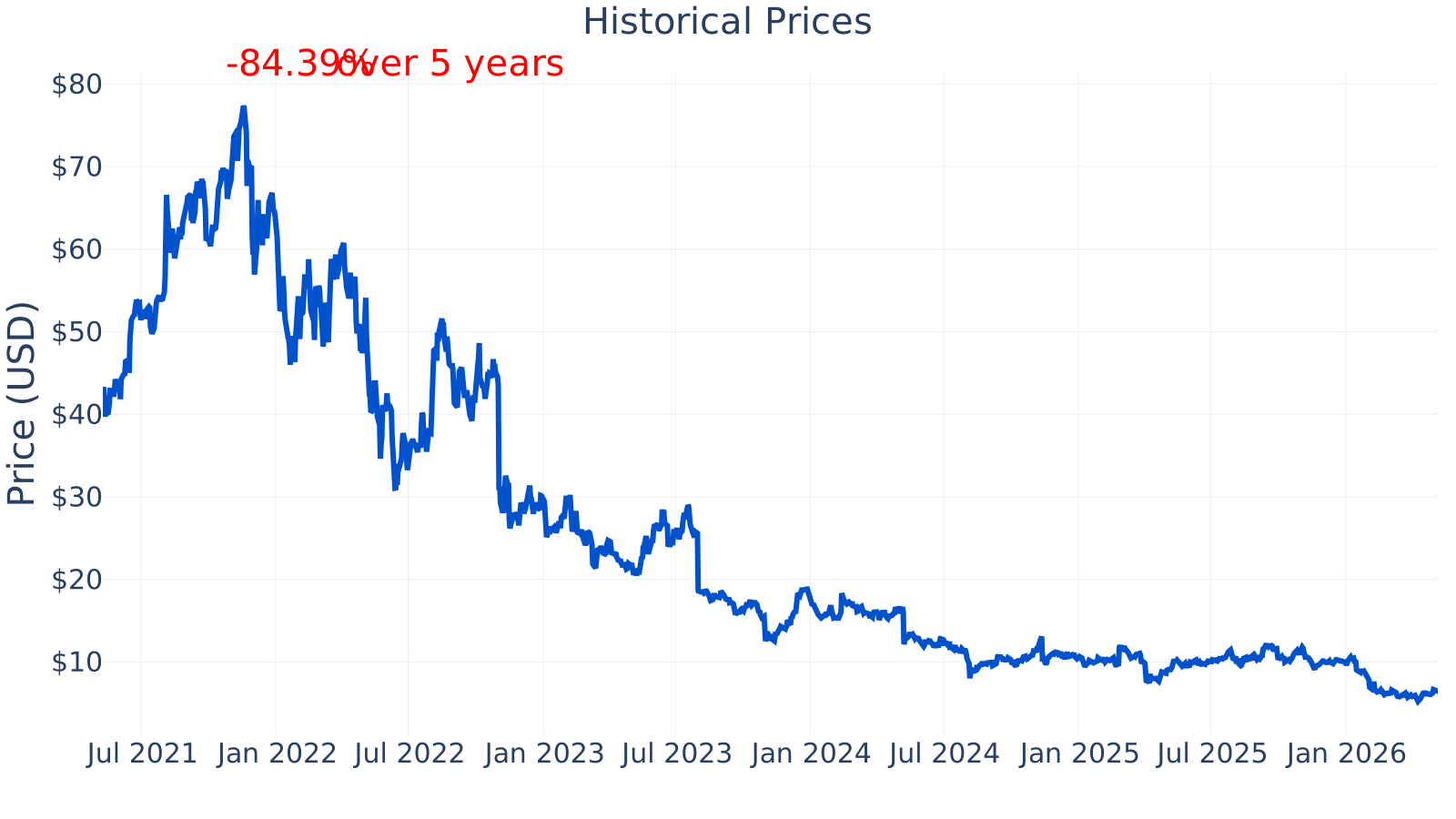
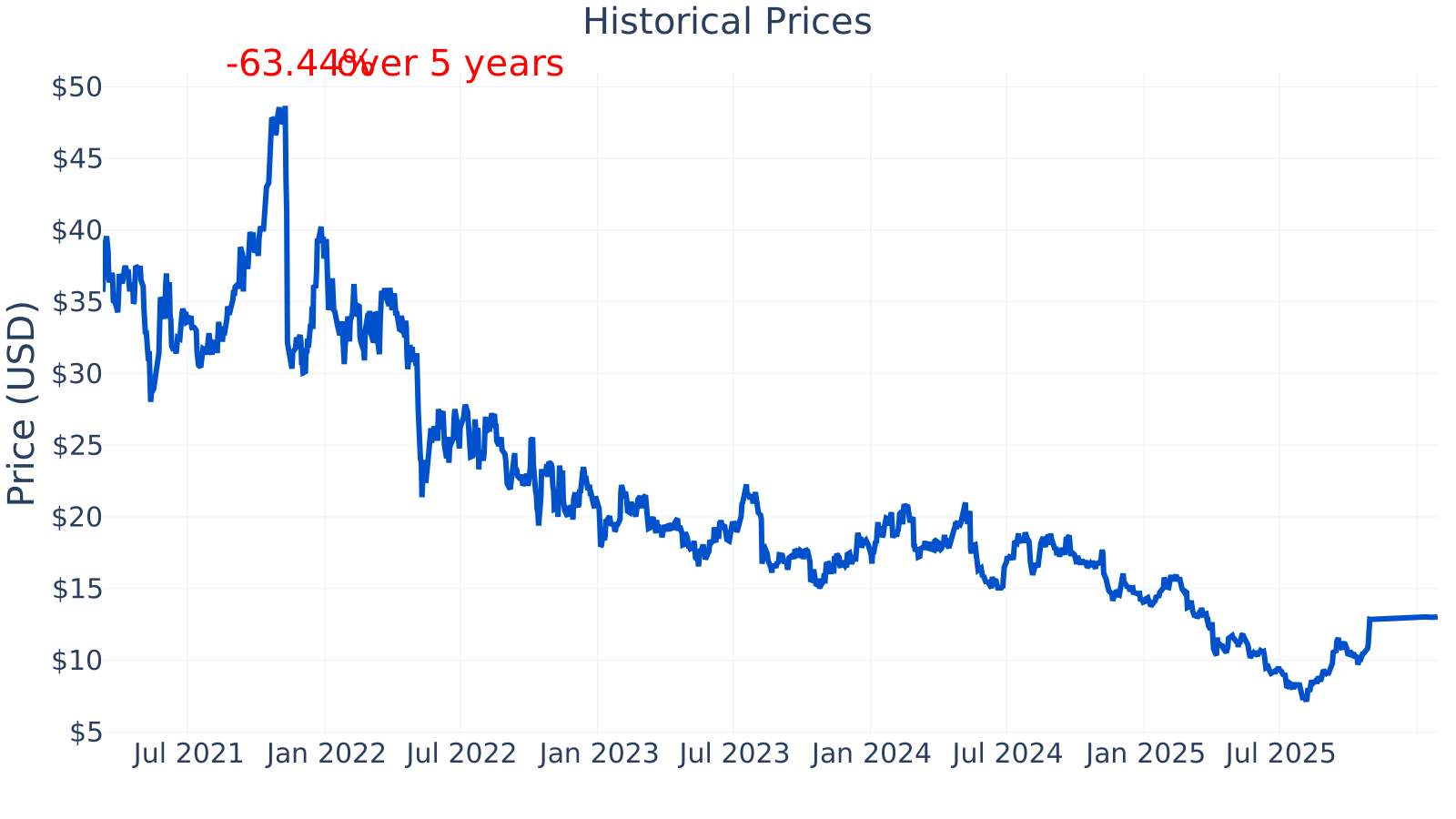
Jamf’s market capitalization is about $1.75B, placing it in the small-to-mid range among public software companies. The stock’s beta of ~0.52 indicates it has historically moved less than the overall market on average, though company-specific events can still cause meaningful price swings.
On operating performance, the company’s latest profit margin is about -6.0% versus an industry median around +7.9%, showing that it is still not profitable on a net basis. At the same time, year-over-year revenue growth is about 15.2%, close to the industry median of roughly 16.7%.
Balance-sheet leverage looks higher than many peers: debt-to-equity is about 97.8% versus an industry median near 25.5%. Free cash flow (trailing twelve months) is shown at about $108.0M, which can matter because cash generation can help fund product development and reduce reliance on external financing.
Growth (Medium)
Jamf operates in device management and endpoint security—areas tied to long-term trends such as workplace mobility, hybrid work, and the broad need for security controls on employee devices. Apple’s presence in enterprises and education is also a structural demand driver for tools that simplify Apple device administration at scale.
The company’s strategy—selling subscriptions that combine management and security workflows for Apple fleets—aligns with how many organizations prefer to buy IT software today (recurring services, frequent updates, and centralized administration). As Apple devices remain important in many workplaces (and especially in education), Jamf’s focus can remain relevant, but it also concentrates the company’s exposure to one ecosystem.
Revenue growth has been positive but has slowed compared with earlier periods: it was above 30% year-over-year in 2021 and trended down into the low-to-mid teens more recently, with the latest figure around 15%. A key long-term question is whether Jamf can sustain mid-teens growth (or re-accelerate) as the business becomes larger.
Free cash flow has been positive in each period shown, but it has fluctuated: roughly $59M (2021), $50M (2022), $61M (2023), then down to about $41M (2024) and $39M (2025) in the points displayed. For long-term fundamentals, investors often watch whether cash generation becomes consistently stronger as a company scales and moves closer to sustained profitability.
Risks (High)
A central risk is profitability. Jamf’s net margin remains negative (about -6% most recently), even though it has improved versus much deeper losses in prior years. If operating expenses do not scale efficiently, the company could remain reliant on cost control, pricing, and sustained growth to reach durable profitability.
The profit margin trend shows improvement over time—from roughly -20% to -34% losses in 2021–2022 to around -6% more recently—but it is still below the industry median (positive mid-single-digit percentages). That gap highlights the execution challenge: improving margins while continuing to invest in product and go-to-market capabilities.
Another risk is leverage and financing flexibility. Higher leverage can reduce room to maneuver during slower growth periods, and it can increase the importance of steady cash generation.
Debt-to-equity rose sharply in 2025 in the chart (reaching roughly 102% and then about 98%), which is well above the industry median in the same periods (generally around the high-20% to mid-30% range). This does not automatically imply distress, but it does mean balance-sheet structure is a more important part of the story than it is for many software peers.
Competition is also a meaningful risk. Device management and endpoint security are crowded categories. Jamf’s competitive advantage is its specialization and brand association with Apple device management, plus workflow depth built around Apple-specific deployment and administration needs. However, large platform vendors can bundle device management or security features into broader suites, which can pressure pricing or reduce Jamf’s differentiation for some buyers.
Main competitors often include:
- Microsoft (e.g., Intune as part of a broader enterprise stack)
- VMware / Broadcom (Workspace ONE offerings historically in UEM)
- IBM (enterprise mobility management offerings)
- Other UEM and endpoint management/security vendors with cross-platform positioning
Jamf is widely recognized as a specialist in Apple-focused management, but it is not competing in a vacuum: many organizations value cross-platform tools and consolidation, which can be a headwind when procurement prioritizes suite buying over best-of-breed.
Valuation
Traditional valuation measures like the price-to-earnings (P/E) ratio are often less informative when a company has negative net income. In the P/E history shown, Jamf’s P/E appears as 0 (a common display outcome when earnings are negative or the metric is not meaningful), while the industry median P/E remains positive and fluctuates in a broad range (roughly ~41 to ~62 in the periods shown).
Given this, valuation discussions typically lean more on revenue growth, gross margin profile, operating leverage (whether operating costs grow more slowly than revenue over time), and cash flow. Jamf shows mid-teens revenue growth and positive free cash flow, but also continued net losses and higher leverage than the industry median. Whether the current market capitalization is “expensive” or “cheap” cannot be concluded from P/E in this case; it depends largely on how investors weigh the path to sustained profitability, the durability of Apple-focused demand, and competitive pressure from broader platform suites.
Conclusion
Jamf is a subscription software company focused on managing and securing Apple devices for organizations, with revenue that has expanded substantially over the last several years. The business shows characteristics long-term investors often track in software—recurring subscriptions and positive free cash flow—while still facing a clear profitability gap versus the industry median.
The main fundamentals to monitor over time are (1) whether revenue growth remains durable as the company scales, (2) whether margins continue improving toward sustained profitability, and (3) whether leverage trends stabilize relative to peers. Competitive dynamics—especially suite-based alternatives from larger vendors—remain an ongoing factor that can influence pricing power and customer retention.
Sources:
- U.S. SEC EDGAR — Jamf Holding Corp. filings (Form 10-K, Form 10-Q)
- Jamf Investor Relations — SEC filings and shareholder materials
- Wikipedia — “Jamf” (company background and general description)
This article is for informational purposes only and does not constitute financial advice. Some content is AI-generated. See Disclaimer