Stock Analysis · Jabil Circuit Inc (JBL)
Overview
Jabil Circuit Inc. is a global manufacturing and supply chain services company. In simple terms, it helps other companies design, build, and deliver products at scale. This can include electronics and other complex products that require specialized manufacturing processes, quality controls, and worldwide logistics.
Jabil’s role is often “behind the scenes.” Many well-known brands rely on partners like Jabil to ramp production up or down efficiently, manage sourcing of components, and operate factories in multiple regions. This business model tends to produce large revenue numbers, but it can also come with relatively thin profit margins because manufacturing services are competitive and costs (materials, labor, logistics) represent a large portion of sales.
Main revenue sources are typically described by end-market (the type of customer industry served) and by the manufacturing programs Jabil runs for customers. Jabil’s annual filings are the most reliable place to find the exact breakdown by segment and major end-markets; the mix can shift over time as customer demand changes.
Revenue mix (high-level)
- Manufacturing and related services (the core activity, generally representing the large majority of sales)
- End-market exposure typically includes areas such as cloud/data center, industrial, healthcare, automotive/transportation, and other electronics programs (exact proportions vary by year and are reported in company filings)
One practical way to understand Jabil is to see where each dollar of revenue tends to go: a very large share to the cost of materials and production, with a smaller remainder to operating expenses, interest and taxes, and net income.
Across the periods shown, revenue has fluctuated (rising into 2023, falling in 2024, then stabilizing/rebounding in 2025), while costs remain the dominant use of revenue. Net income also varies meaningfully year to year, which is common in manufacturing-heavy models where product mix, factory utilization, and customer demand can change.
Key Figures
| Metric | Value | Industry ⓘ |
|---|---|---|
| Date | Mar 17, 2026 | |
| Context | ||
| Sector | Technology | |
| Industry | Electronic Components | |
| Market Cap ⓘ | $27.56B | |
| Beta ⓘ | 1.18 | |
| Fundamental | ||
| P/E Ratio ⓘ | 40.31 | 40.26 |
| Profit Margin ⓘ | 2.26% | 6.11% |
| Revenue Growth ⓘ | 18.70% | 17.40% |
| Debt to Equity ⓘ | 250.60% | 41.32% |
| PEG ⓘ | 0.82 | |
| Free Cash Flow ⓘ | $1.19B | |
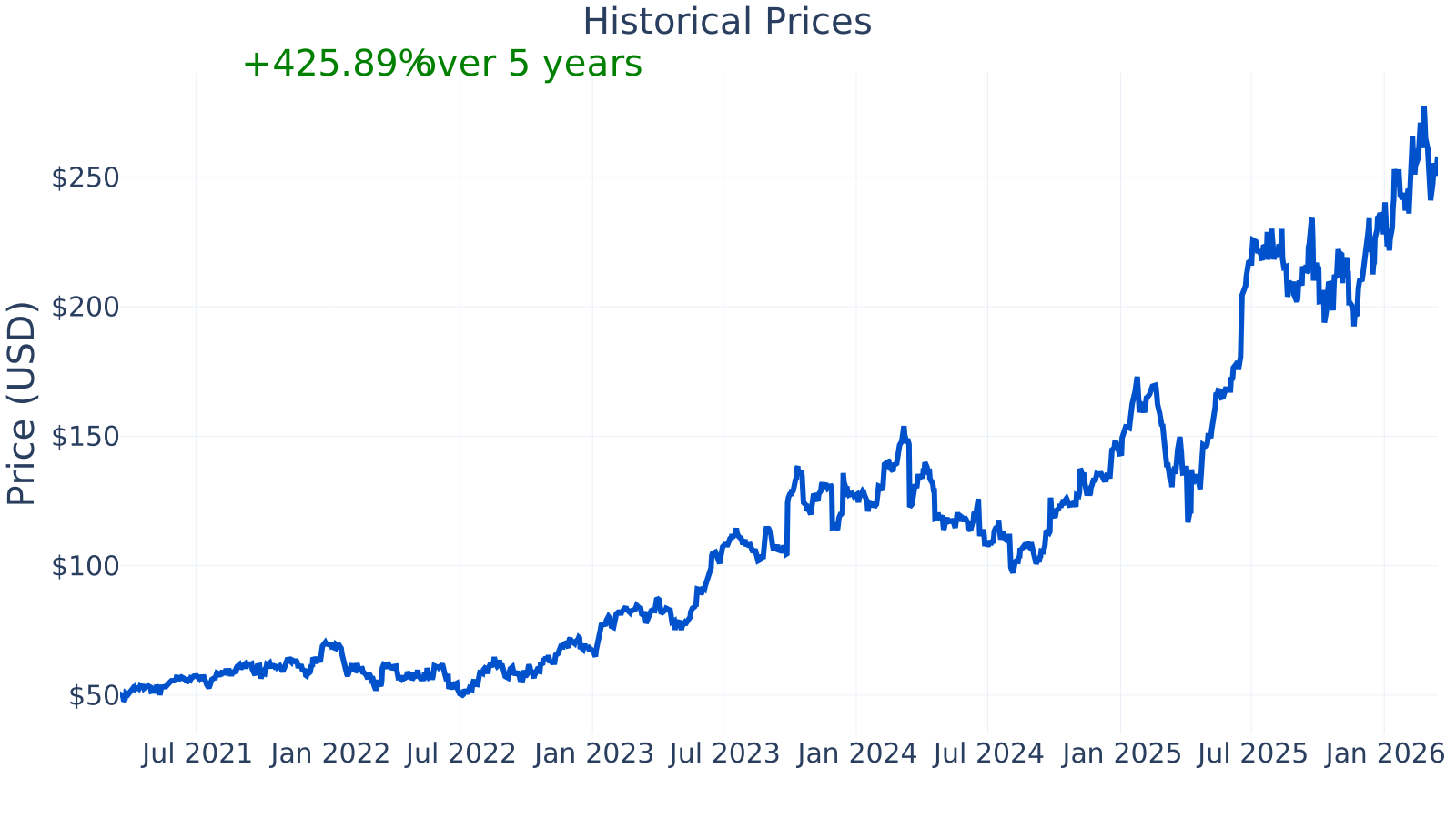
Jabil’s market capitalization is about $27.6B, placing it among larger, established players in its space. The stock’s beta of ~1.18 suggests it has tended to move somewhat more than the overall market (though beta can change over time).
The company shows a P/E ratio of ~40.3, which is close to the industry median (~40.3) in the provided peer group. Profit margin is about 2.26%, lower than the industry median (~6.11%), reflecting how competitive, cost-heavy manufacturing services can be.
On growth, the latest year-over-year revenue growth is ~18.7%, slightly above the industry median (~17.4%). Jabil’s debt-to-equity is ~250.6%, which is substantially higher than the industry median (~41.3%), indicating heavier reliance on debt and/or a smaller equity base. Trailing twelve-month free cash flow is about $1.185B, which is a key metric for understanding how much cash the business generates after operating needs and capital spending.
Growth (Medium)
Jabil operates in global manufacturing services and electronic components-related ecosystems, which are supported by long-term trends such as increasing electronics content in everyday products, growth in data infrastructure, and continued outsourcing of manufacturing and supply chain operations. That said, the industry is also known for cycles: customer demand can rise and fall based on consumer spending, enterprise investment, and inventory corrections.
A central part of Jabil’s growth logic is scale and execution: running large, efficient operations across regions, handling complex builds, and managing supply chains for customers who want flexibility. Over time, manufacturers can also try to improve results by shifting toward more specialized, higher-value programs (where pricing power and margins may be better), although success depends on customer mix and competition.
The year-over-year revenue pattern shown is uneven: solid growth in parts of 2021–2022, a downturn through portions of 2023–2024, followed by a return to positive growth in 2025 (reaching about 18.7% most recently). This kind of volatility is consistent with an outsourced manufacturing model tied to customer production cycles.
Free cash flow has grown from about $345M (2022) to around $1.253B (2025) on the timeline shown, with the latest level near $1.185B. For a manufacturing services company, sustained free cash flow matters because it can support debt servicing, reinvestment in facilities, and other corporate priorities.
Potential catalysts in this type of business usually come from (1) winning large multi-year manufacturing programs, (2) customer ramps in fast-growing end-markets, and (3) efficiency improvements (better factory utilization, improved product mix, tighter working-capital management). The exact near-term drivers, however, can change quickly and are typically discussed in quarterly filings and company communications.
Risks (High)
Jabil’s biggest risks are closely tied to the nature of contract manufacturing. Demand can be concentrated in a limited number of large customers, and customers can change production volumes, shift programs to other suppliers, or bring manufacturing in-house. Revenue can therefore be sensitive to a few major relationships and to broader economic cycles.
Another structural risk is profitability. When a business has high costs of revenue and tight margins, small changes in pricing, labor costs, component availability, freight, or factory utilization can meaningfully affect earnings. Execution and cost control are critical, and results may vary with product mix (some programs are inherently lower margin than others).
The debt-to-equity ratio rises to about 250.6% in the latest reading shown, far above the industry median (roughly 41.3%). Higher leverage can increase financial risk because interest expense and refinancing needs become more significant—especially when interest rates are higher or cash flows weaken. It also reduces flexibility if the company needs to invest heavily during an industry downturn.
Profit margin is about 2.26% most recently, below the peer median (about 5.65% at the same point on the chart). The series also shows meaningful swings over time, including a period where margins were higher (around the mid-4% range in parts of 2024) before returning closer to ~2% in 2025. This variability highlights how changes in volumes, mix, and costs can quickly influence bottom-line results.
Competitive positioning in this industry typically comes from global scale, manufacturing know-how, quality systems, and the ability to execute reliably across regions. Jabil is one of the larger global players, but it competes in a crowded field where price and execution both matter. Key competitors in electronics manufacturing services commonly include Flex, Celestica, Sanmina, and large Asia-based manufacturers such as Foxconn (Hon Hai) and Pegatron. Relative standing often depends on specific end-markets and customer programs rather than a single “winner-takes-all” position.
Valuation
The valuation picture here is best described in relation to earnings and the company’s own history. The latest P/E is about 40.3, which is roughly in line with the industry median in the provided peer group. Historically in the chart, Jabil’s P/E spent long periods materially lower (often in the low teens for much of 2021–2024), then moved sharply higher in 2025 (roughly mid-30s to low-40s).
A rising P/E can happen for two main reasons: the stock price increases faster than earnings, or earnings temporarily fall (which mechanically makes the P/E higher). For a cyclical, low-margin manufacturer, it is important to interpret P/E alongside business conditions, recent margin trends, and whether earnings are at a normalized level.
Given the combination of (1) meaningful revenue growth in the latest period, (2) relatively low and volatile profit margins compared with peers, and (3) higher financial leverage than the industry median, the current valuation multiples place more weight on continued execution and stable-to-improving profitability.
Conclusion
Jabil is a large, global manufacturing and supply chain services company with a business model built on scale, operational execution, and customer program wins. The company’s recent history shows that revenue and profitability can move up and down with customer cycles, while free cash flow has improved substantially over the multi-year window shown.
The main long-term discussion points are straightforward: the company participates in important end-markets tied to ongoing electronics and infrastructure needs, but it operates with relatively thin margins and faces strong competition. The latest leverage level (debt relative to equity) stands out as higher than the industry median, which can amplify outcomes in both good and challenging periods.
At the current valuation levels shown (P/E near the industry median but higher than much of its own recent history), the interpretation depends heavily on whether earnings and margins are expected to remain resilient through cycles and whether the balance-sheet risk remains manageable relative to cash generation.
Sources:
- U.S. Securities and Exchange Commission — EDGAR database (Jabil Circuit Inc. filings, including Form 10-K and Form 10-Q)
- Jabil Investor Relations — SEC filings and annual report materials (company-hosted)
- Wikipedia — “Jabil” (basic background information)
This article is for informational purposes only and does not constitute financial advice. Some content is AI-generated. See Disclaimer


