Stock Analysis · Jabil Circuit Inc (JBL)
Overview
Jabil Circuit Inc (JBL) is a global manufacturing services company. In simple terms, it helps other brands design, build, and deliver electronic products at large scale. Jabil’s work can include product design support, engineering, sourcing components, assembling products, testing/quality control, packaging, and managing logistics. This “build it for you” model is widely used by companies that want flexible production capacity without owning and running all factories themselves.
In its SEC filings, Jabil explains its business through operating segments. Revenue is typically described as coming primarily from these areas (ordered broadly from larger to smaller in many recent years, though the exact mix can shift over time):
- Electronics Manufacturing Services (EMS): High-volume manufacturing and supply chain services for large programs (often in areas like cloud, networking, mobility, and other electronics categories).
- Diversified Manufacturing Services (DMS): Manufacturing programs that are more specialized and often tied to specific end-markets (such as healthcare, automotive/transportation, industrial, and other diversified areas).
Because customer programs can change, the exact percentages by segment and by end-market should be taken from the latest annual report, where Jabil provides segment reporting and customer concentration disclosures.
How the business economics tend to look: Jabil operates on large revenue volumes with relatively thin net profit margins, which is common in contract manufacturing. This makes execution, cost control, supply chain management, and customer relationships especially important.
Over the periods shown, total revenue has moved up and down with customer demand cycles, while costs remain the largest part of sales (typical for manufacturing services). Net income also varies meaningfully from year to year, highlighting that profitability can be sensitive to mix, utilization, and broader industry conditions.
Key Figures
| Metric | Value | Industry ⓘ |
|---|---|---|
| Date | Feb 07, 2026 | |
| Context | ||
| Sector | Technology | |
| Industry | Electronic Components | |
| Market Cap ⓘ | $27.59B | |
| Beta ⓘ | 1.24 | |
| Fundamental | ||
| P/E Ratio ⓘ | 40.48 | 41.23 |
| Profit Margin ⓘ | 2.26% | 6.11% |
| Revenue Growth ⓘ | 18.70% | 12.20% |
| Debt to Equity ⓘ | 250.60% | 39.00% |
| PEG ⓘ | 0.91 | |
| Free Cash Flow ⓘ | $1.19B | |
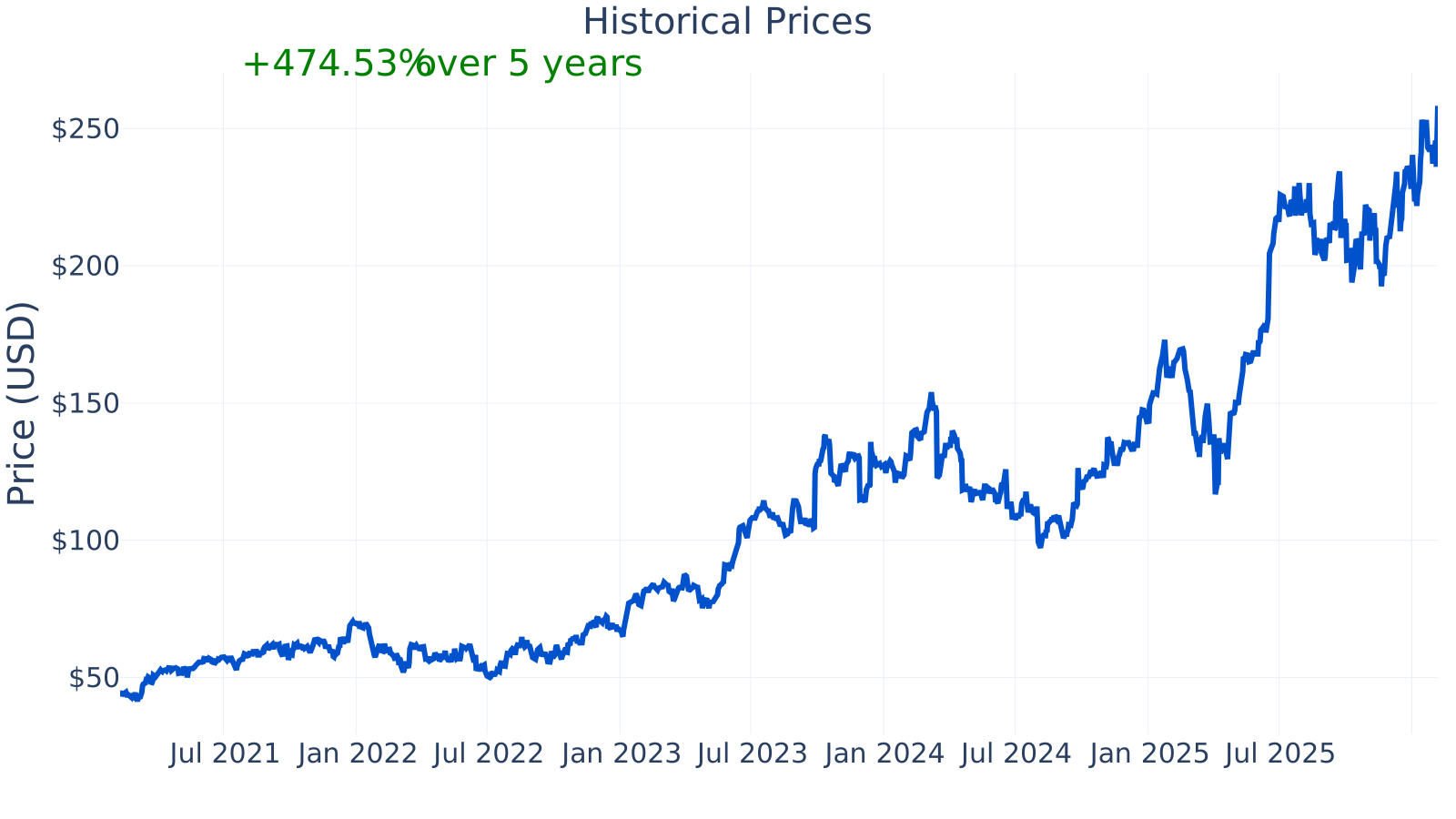
Jabil’s market capitalization is about $27.6B, and the stock’s beta of 1.24 suggests it has historically moved more than the broader market on average. The P/E ratio is ~40.5, close to the industry median (~41.2). Profitability at the bottom line is relatively thin: net profit margin ~2.26% versus an industry median around 6.11%. On the other hand, the company’s year-over-year revenue growth is ~18.7%, above the industry median (~12.2%). Balance sheet leverage stands out: debt-to-equity is ~251% versus an industry median around 39%. Over the trailing twelve months, free cash flow is about $1.185B. The PEG ratio of ~0.91 is a growth-adjusted valuation indicator that can look lower when growth expectations are higher, but it depends heavily on forward assumptions and how “growth” is measured.
Growth (Medium)
Jabil sits in a broad, long-running trend: more companies outsource manufacturing and supply chain execution to specialized partners. Demand is supported by increasing product complexity (electronics content in many devices), the need for resilient supply chains, and the push to manage costs and speed up time-to-market. At the same time, this is not a straight-line growth industry—electronics and industrial demand can be cyclical, and customer programs can ramp up or down quickly.
Strategically, Jabil’s approach—serving multiple end-markets and running large-scale global operations—can help smooth out downturns in any single category. Its “factory + supply chain + services” model is also designed to integrate tightly with customers, which can increase switching costs when the relationship is deeply embedded in product launches and ongoing production.
The revenue growth pattern shows clear cycles: periods of strong expansion followed by contraction, and then a return to growth. The most recent readings show a rebound into positive territory (around the high-teens year-over-year), which indicates improving demand versus the prior period, but it also underlines that growth can be uneven.
Free cash flow has risen materially over the period shown—from tens of millions to well over $1B trailing twelve months. For a manufacturing services company, sustained free cash flow can be an important signal because it reflects not only earnings but also working capital management (inventory and receivables) and disciplined capital spending. The key question for long-term compounding is how consistently this cash generation can be maintained across demand cycles.
Risks (High)
This article is for informational purposes only and does not constitute financial advice. Some content is AI-generated. See Disclaimer


