Stock Analysis · Iridium Communications Inc (IRDM)
Overview
Iridium Communications Inc. (IRDM) is a U.S.-based satellite communications company. It operates a network of satellites that provide voice and data connectivity in places where traditional cellular networks do not reach well—such as oceans, air routes, deserts, mountains, and remote industrial sites. The business is typically described as “global mobile satellite services,” meaning it focuses on mobile users and equipment (ships, aircraft, vehicles, handheld devices, connected sensors) rather than replacing home broadband.
Iridium’s services are used across commercial markets (maritime, aviation, and land-based industrial/IoT uses) and also by government customers. The company sells connectivity and related services through a mix of direct sales and partners (including equipment makers and service providers), which helps it reach specialized end users across different industries.
In its SEC filings, Iridium generally breaks revenue into a few recurring categories. The largest portion tends to be service revenue (ongoing connectivity subscriptions/usage). Other meaningful contributors typically include equipment-related revenue (sale of devices and terminals) and engineering & support work under government and commercial contracts. The exact mix can shift year to year based on equipment cycles and contract timing.
Typical revenue categories described in filings include:
- Service revenue (recurring connectivity: voice/data, IoT, maritime/aviation/land mobility)
- Subscriber equipment revenue (devices and terminals sold through channels)
- Government services (connectivity and related services for government users)
- Engineering and support / hosted payloads (contracted technical services and mission-related support where applicable)
Across the last several years shown, total revenue increased steadily (from about $614.5M in 2021 to about $871.7M in 2025). Over the same period, profitability improved materially, with net income moving from a small loss in 2021 to over $100M in 2024–2025. Interest expense remains a notable ongoing cost, which matters when assessing how much operating profit ultimately reaches net income.
Key Figures
| Metric | Value | Industry ⓘ |
|---|---|---|
| Date | Apr 20, 2026 | |
| Context | ||
| Sector | Communication Services | |
| Industry | Telecom Services | |
| Market Cap ⓘ | $4.42B | |
| Beta ⓘ | 0.48 | |
| Fundamental | ||
| P/E Ratio ⓘ | 39.48 | 14.70 |
| Profit Margin ⓘ | 13.12% | 7.29% |
| Revenue Growth ⓘ | N/A | 3.60% |
| Debt to Equity ⓘ | 380.57% | 116.61% |
| PEG ⓘ | 2.53 | |
| Free Cash Flow ⓘ | $299.79M | |
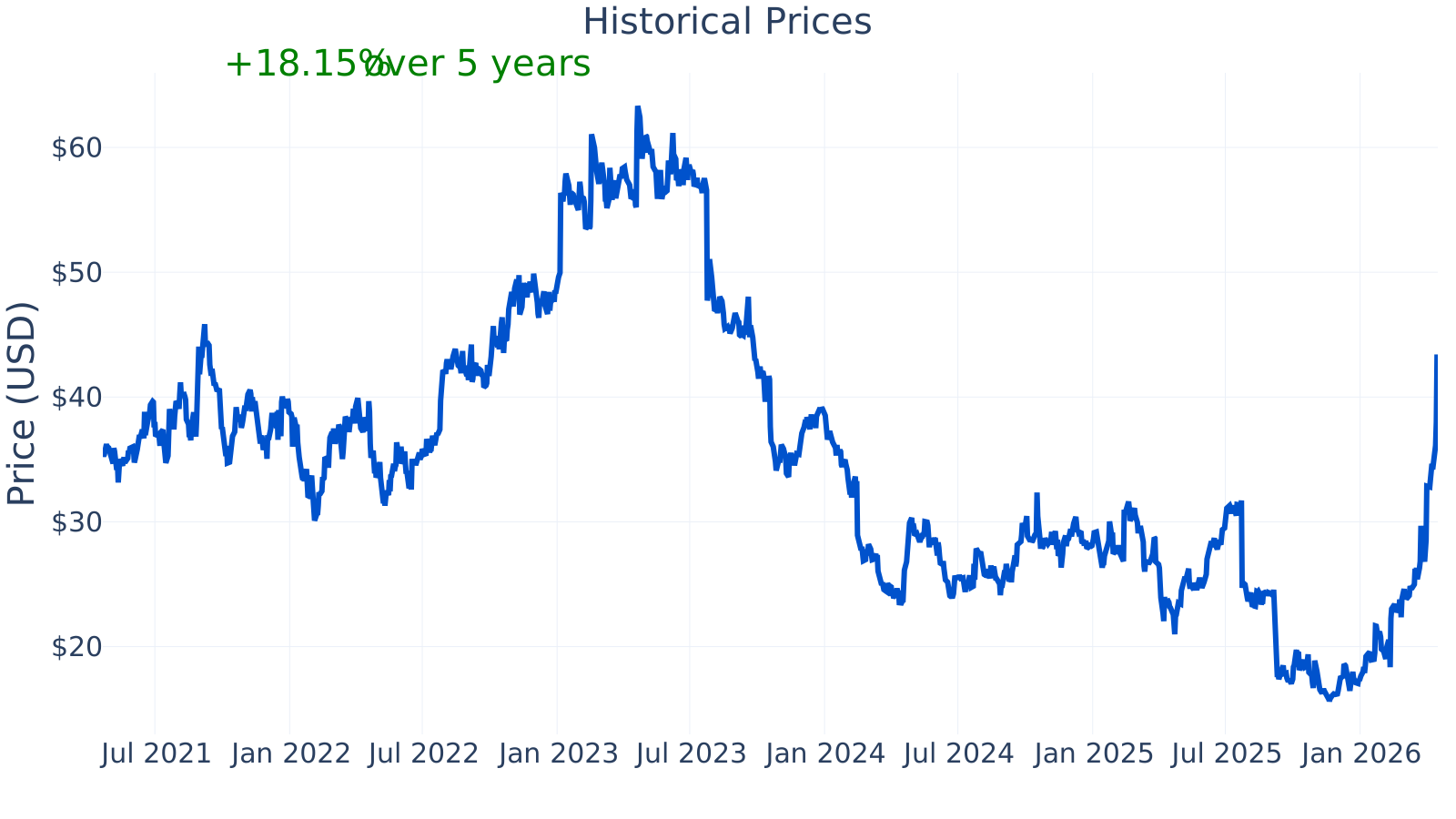
Iridium’s market capitalization is about $4.4B, and its beta of about 0.48 suggests the shares have historically moved less than the broader market on average. Profit margin is about 13.1%, above the industry median shown (~7.3%). The latest P/E ratio is about 39.5, which is higher than the industry median shown (~14.7). Revenue growth year-over-year is shown as approximately 0% at the latest point, versus an industry median of ~3.6%. Free cash flow over the trailing twelve months is about $300M. Debt-to-equity is about 381%, above the industry median shown (~117%), indicating heavier leverage than many peers.
Growth (Medium)
Iridium operates in a segment of communications that benefits from long-term demand for connectivity “beyond the tower.” Several end markets have structural reasons to use satellite links: maritime safety and operations, aircraft tracking and connectivity, remote energy/mining operations, disaster response, and an expanding set of connected sensors and devices in hard-to-reach locations (often described as industrial IoT). These use cases are less about consumer streaming and more about reliable coverage and mission-critical communications.
Strategically, Iridium’s model is built around recurring service revenue. Once a device or terminal is deployed on a vessel, aircraft, or remote asset, connectivity tends to renew because it is embedded in operations. That can support durable cash generation, especially when the company adds subscribers, increases average usage, or expands through partners that bundle Iridium connectivity into specialized solutions.
The year-over-year revenue growth trend shows a strong period in 2022 and early 2023 (including several quarters above 10% and peaking above 20%), followed by a visible slowdown toward low single digits and roughly flat growth more recently. In practical terms, this places more weight on execution levers such as subscriber additions, pricing/plan mix, and scaling higher-value services rather than relying on broad top-line acceleration.
Trailing free cash flow has been fairly stable in the high $200M range over the period shown (roughly $252M to $286M), reaching about $300M most recently. For a satellite operator, free cash flow is important because the business requires long-lived infrastructure; consistent cash generation can help support debt service and future investments.
Potential catalysts in this type of business often include expanding distribution partnerships, growth in aviation/maritime connectivity adoption, additional government demand for resilient communications, and new product introductions that increase data usage per device. The pace of growth can also be influenced by timing of large contracts and equipment refresh cycles described in company filings.
Risks (High)
Satellite communications is capital-intensive and operationally demanding. A central risk is that service quality depends on space-based infrastructure that is expensive to build, launch, insure, operate, and periodically replace. Even with redundancy, satellite or launch anomalies can affect capacity, coverage, or costs. Regulatory and licensing requirements (including spectrum) also matter because satellite services depend on permissions coordinated across jurisdictions.
Competition is another major factor. Iridium competes with other satellite operators in various niches (maritime, aviation, government, and IoT), and it can also face indirect competition from terrestrial cellular networks as coverage expands. Competitive pressure can show up through pricing, bundle offers via partners, or customers choosing multi-network solutions for redundancy. Iridium’s competitive position is often associated with its global coverage and mobility focus, but the market includes multiple well-funded players.
Financial structure is an additional risk area because leverage can amplify both outcomes and constraints. Higher debt can limit flexibility during downturns or periods of higher interest rates and can make refinancing terms more important.
The debt-to-equity line shows a meaningful increase over time, reaching roughly 381% most recently, well above the industry median shown (about 117%). This indicates Iridium is more leveraged than many peers in the same broad industry grouping, so debt servicing and covenant/refinancing considerations can carry more weight in long-term analysis.
Profitability has improved, but margins have also shown volatility across quarters, which is common for businesses influenced by contract timing, equipment revenue swings, and accounting impacts.
The profit margin trend moved from negative territory in 2021–2022 to sustained positive levels more recently, reaching the low-to-mid teens and ending around 13.1%. That is above the industry median shown (about 7.8% at the latest point), suggesting improved operating leverage and/or a more favorable mix—but the historical variability highlights that margins may not rise in a straight line.
Main competitors discussed in many satellite industry contexts include:
- Globalstar (satellite connectivity with consumer/industrial and partner-driven use cases)
- Inmarsat/Viasat (especially in aviation and maritime connectivity, depending on service type)
- Orbcomm (notably in IoT-oriented satellite services)
- Newer low-Earth-orbit broadband constellations (primarily indirect competition, depending on region, pricing, and mobility needs)
Iridium’s differentiation is commonly framed around its global coverage and established mobility-focused ecosystem, but competitive positioning depends on the exact application (handheld voice, narrowband IoT, maritime safety, cockpit services, etc.) and on the end customer’s tolerance for cost, equipment choices, and redundancy requirements.
Valuation
The P/E ratio shown most recently is around 39.5, compared with an industry median near 14.7. Over the historical period displayed, Iridium’s P/E (when meaningful) has generally remained above the industry median, though it has also compressed from very high levels seen in early 2024 to lower levels more recently. A higher P/E can reflect expectations of durable cash flows, improved profitability, and the perceived scarcity value of a global satellite network—but it can also leave less room for disappointment if growth slows or costs rise.
Another way to contextualize valuation is the PEG ratio (P/E relative to growth), shown around 2.53. In general terms, a higher PEG can indicate that the current earnings multiple is high relative to the company’s expected growth profile, which becomes more relevant when revenue growth moderates, as seen in the recent trend.
Given the combination of (1) improved profitability and solid free cash flow, (2) moderating recent revenue growth, and (3) higher leverage than the industry median, the valuation picture is mixed: the stock is priced at a higher earnings multiple than many telecom-services peers while also carrying balance-sheet risk that can matter over multi-year periods.
Conclusion
Iridium is a specialized communications provider built around a global satellite network serving remote and mission-critical connectivity needs. The company’s recent multi-year financial trajectory shows steady revenue expansion and a clear improvement in profitability, alongside consistent free cash flow generation. At the same time, the more recent slowdown in year-over-year revenue growth suggests the next phase of performance may rely more on execution, mix, and adoption in targeted end markets than on broad-based acceleration.
The long-term profile includes meaningful strengths—recurring service revenue characteristics and a differentiated coverage footprint—but also material risks typical of satellite operators, including high capital intensity, operational dependencies on space infrastructure, competitive pressures across multiple niches, and a relatively high debt-to-equity level. Valuation metrics shown (including a P/E above the industry median) indicate the market is embedding stronger expectations than for many peers, which increases sensitivity to future growth and financial execution.
Sources:
- SEC EDGAR — Iridium Communications Inc. Form 10-K (Annual Report) (Business, Risk Factors, and Financial Statements)
- SEC EDGAR — Iridium Communications Inc. Form 10-Q (Quarterly Reports) (Management’s Discussion and Analysis and Financial Statements)
- Iridium Investor Relations — SEC filings and shareholder materials (company-hosted)
- Wikipedia — “Iridium Communications” (basic company background and context)
This article is for informational purposes only and does not constitute financial advice. Some content is AI-generated. See Disclaimer