Stock Analysis · Iridium Communications Inc (IRDM)
Overview
Iridium Communications Inc. (IRDM) operates a satellite network designed to provide voice and data connectivity where traditional cellular coverage is weak or unavailable. Instead of relying on ground-based towers, Iridium’s service is delivered through satellites, which makes it useful for customers that travel or work in remote areas such as oceans, polar regions, deserts, and certain industrial sites.
The company’s business is centered on selling access to its satellite network and related services. In practical terms, that can include handheld satellite phones and devices, airtime/service plans, and connectivity embedded into equipment used by maritime, aviation, government, emergency response, and industrial customers. A key part of the model is recurring service revenue (ongoing subscriptions/usage), which can be more stable than one-time equipment sales.
Based on how the company reports its operations in filings, Iridium’s revenue generally comes from a mix of service revenue and equipment-related sales, with service typically representing the larger and more recurring portion. Percentages can change by period and by product cycle, so the most reliable breakdown should be taken from the latest annual report’s segment and revenue disclosures.
Across the years shown, total revenue rises from about $614.5M (2021) to about $871.7M (2025). Over the same span, net income moves from a small loss (2021) to positive profitability (2022 onward), with a notably higher net income level in 2024 and 2025. Interest expense remains meaningful each year, which highlights the importance of financing costs in the overall earnings profile.
Key Figures
| Metric | Value | Industry ⓘ |
|---|---|---|
| Date | Feb 16, 2026 | |
| Context | ||
| Sector | Communication Services | |
| Industry | Telecom Services | |
| Market Cap ⓘ | $1.96B | |
| Beta ⓘ | 0.64 | |
| Fundamental | ||
| P/E Ratio ⓘ | 17.92 | 15.09 |
| Profit Margin ⓘ | 14.44% | 6.18% |
| Revenue Growth ⓘ | 6.70% | 2.10% |
| Debt to Equity ⓘ | 387.14% | 113.97% |
| PEG ⓘ | 1.01 | |
| Free Cash Flow ⓘ | $299.79M | |
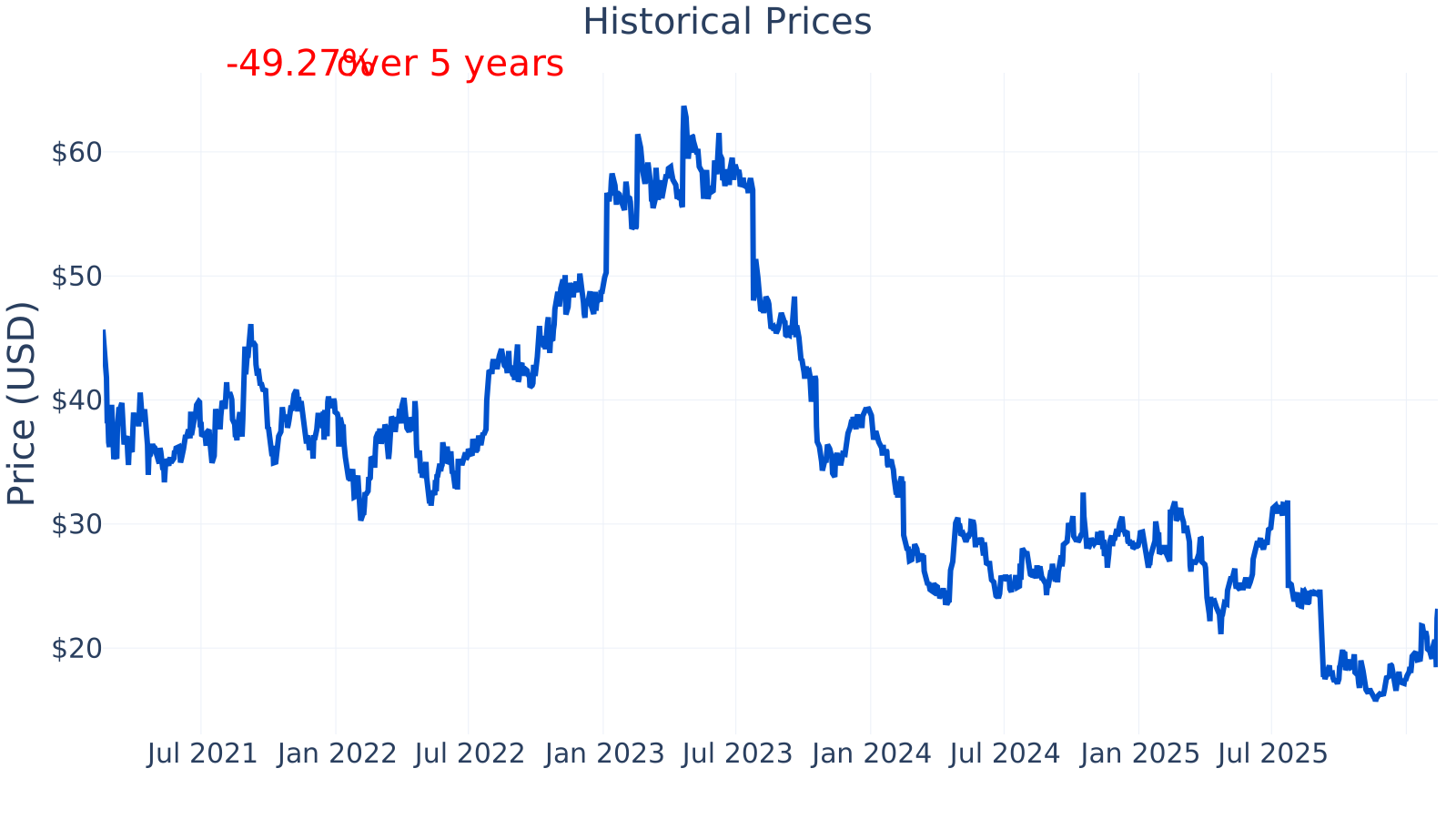
Iridium’s market capitalization is about $2.0B. The stock’s beta is about 0.64, which indicates it has historically moved less than the broader market on average (though that can change). The company’s P/E ratio is about 17.9 versus an industry median near 15.1. Profit margin is about 14.4% compared with an industry median near 6.2%, and year-over-year revenue growth is about 6.7% versus an industry median around 2.1%. Debt-to-equity is about 387% versus an industry median near 114%, showing meaningfully higher leverage than many peers. Trailing twelve-month free cash flow is about $300M.
Growth (medium)
Iridium operates in a part of communications that is supported by long-term demand for “connectivity everywhere.” Several end markets that depend on coverage beyond normal cellular footprints—maritime operations, aviation connectivity, remote industrial activity, and government use—are structurally tied to reliable communications. This supports an industry backdrop where global coverage and resilience can matter as much as raw speed.
From a strategy perspective, a satellite network is a capital-intensive asset, but it can also create a platform effect: once the network is in place, incremental subscribers and usage can improve the economics over time, particularly when growth comes from recurring service revenue. In addition, connectivity for machines (tracking, telemetry, and operational monitoring) can expand alongside broader digitization trends, potentially increasing the number of devices using the network even if consumer usage is not the primary driver.
The year-over-year revenue growth pattern shows strong growth in 2022 and early 2023 (often above 10% and at times above 20%), followed by a noticeable slowdown in late 2023 and parts of 2024–2025, including a near-flat reading at the end of 2025. This mix suggests growth has not been linear, and future expansion may depend on continued adoption in core verticals, pricing/usage trends, and new service initiatives.
Trailing free cash flow trends upward overall from roughly $221M (2021) to roughly $286M (2025), with a dip around 2024. For a capital-intensive communications business, sustained free cash flow can be an important support for funding operations, servicing debt, and investing in network capabilities over time.
Risks (high)
This article is for informational purposes only and does not constitute financial advice. Some content is AI-generated. See Disclaimer