Stock Analysis · IONQ Inc (IONQ)
Overview
IONQ Inc. is a technology company focused on quantum computing, a type of computing that aims to solve certain problems much faster than traditional computers by using quantum-mechanical effects. The company develops quantum systems and makes access to its quantum computers available through cloud platforms, while also working with government, research, and commercial customers on specific quantum projects.
In simple terms, IonQ’s near-term business is less about selling large volumes of finished hardware and more about getting paid to provide quantum-computing access and related services, while it continues investing heavily to improve performance and scale.
Based on company reporting categories commonly used by IonQ in its SEC filings, revenue generally comes from a mix of:
- Quantum computing access (cloud-based) — usage and access arrangements that allow customers to run jobs on IonQ systems via cloud providers.
- Professional services and other revenue — customer-funded development work, consulting-type services, and related arrangements.
Percentages can change meaningfully from year to year because revenue is still relatively small and can be influenced by the timing and size of individual contracts.
Across the years shown, revenue rises sharply (from about $2.1M in 2021 to about $130.0M in 2025), but operating expenses expand even faster, led by research and development and selling, general, and administrative costs. This pattern fits an early-stage company prioritizing product development and go-to-market investment over near-term profitability.
Key Figures
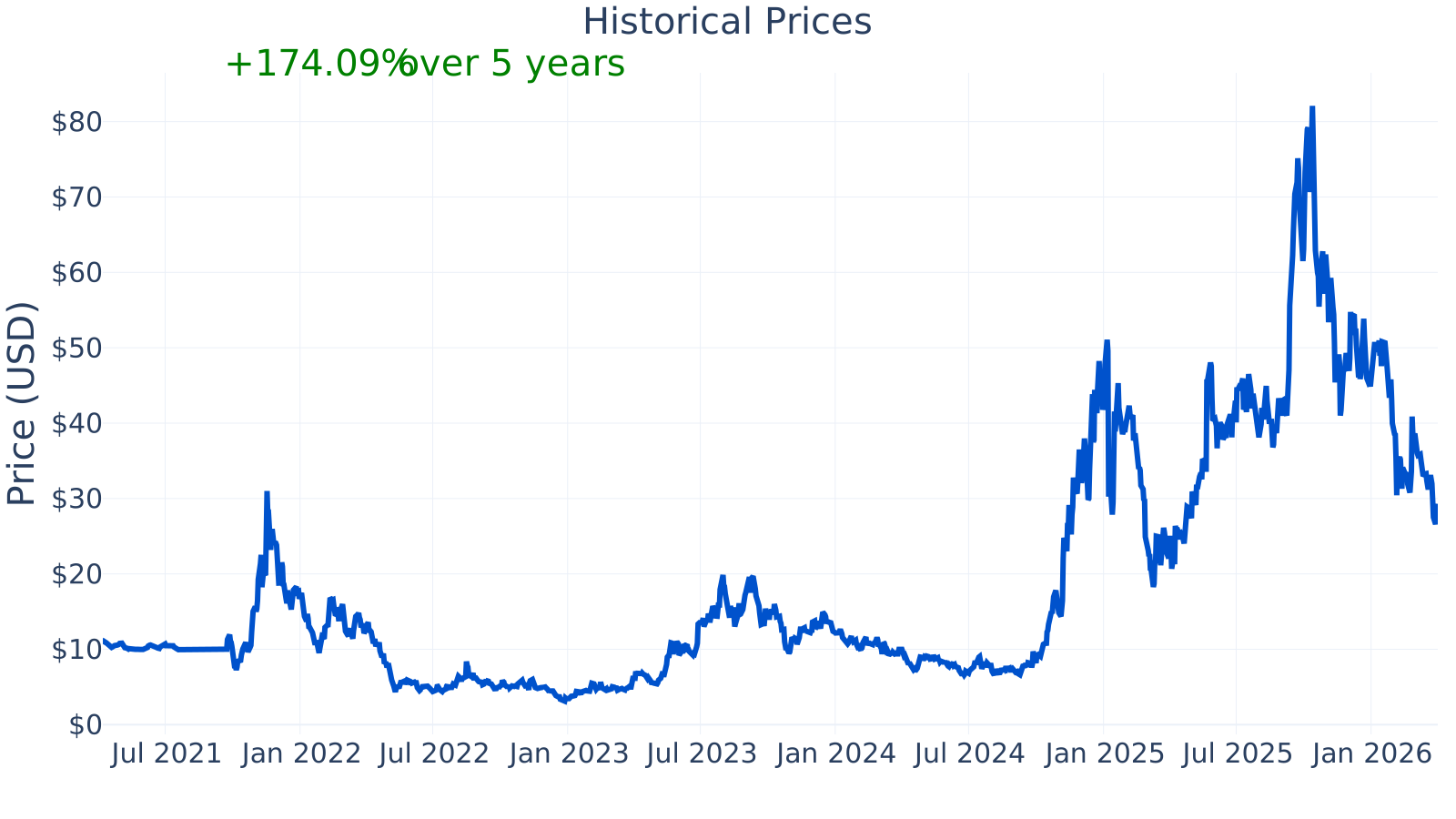
The stock price history shown indicates very large swings over time, including steep increases and drawdowns. This kind of volatility is common in early-stage technology companies where expectations about future adoption can change quickly.
| Metric | Value | Industry ⓘ |
|---|---|---|
| Date | Apr 06, 2026 | |
| Context | ||
| Sector | Technology | |
| Industry | Computer Hardware | |
| Market Cap ⓘ | $10.77B | |
| Beta ⓘ | 2.80 | |
| Fundamental | ||
| P/E Ratio ⓘ | N/A | 24.00 |
| Profit Margin ⓘ | N/A | 4.46% |
| Revenue Growth ⓘ | 428.50% | 25.20% |
| Debt to Equity ⓘ | 0.79% | 5.95% |
| PEG ⓘ | N/A | |
| Free Cash Flow ⓘ | -$301.80M | |
IonQ’s market capitalization is about $10.8B, and the stock shows a high beta (2.803), which is consistent with larger-than-market price moves. Profit margin is shown as 0% in the latest snapshot, while the longer history (below) indicates substantial losses in many periods. Year-over-year revenue growth is reported at about 429%, far above the industry median (~25%), but this should be read in context: growth rates can look extreme when the business is scaling from a relatively small base. Debt-to-equity is extremely low at about 0.8%, below the industry median (~5.9%), suggesting the balance sheet is not heavily reliant on borrowing.
Growth (Very High)
Quantum computing is widely viewed as a potentially transformative field, with possible long-term use cases in areas like materials science, chemistry simulation, optimization, and cryptography. However, it remains an early and uncertain market: many real-world applications still require continued improvements in hardware performance, error rates, and software tooling.
IonQ’s strategy—building quantum hardware and providing access through the cloud—aims to reduce friction for adoption by letting customers experiment without owning quantum machines. If quantum computing becomes more commercially useful, cloud access and enterprise/government relationships could support long-term scaling.
The year-over-year revenue growth pattern is uneven, with very high growth rates in several periods and at least one period near flat (around early 2025). The most recent figure shown (about 429%) indicates a sharp acceleration. In early-stage businesses, this can happen when a small number of contracts ramp up or when the prior-year comparison period was unusually low, so the sustainability of any single quarter’s growth rate is typically hard to infer.
Free cash flow remains negative and has become more negative over time in the period shown (from about -$33M to about -$140M on a trailing basis). This usually means the company is spending substantially on operations and investment relative to cash coming in. For long-horizon growth stories, this is not unusual, but it increases dependence on cash reserves and/or future funding if losses persist.
Potential catalysts (in a purely factual sense) generally come from: (1) continued improvements in quantum performance metrics and reliability, (2) larger multi-year customer arrangements, and (3) broader developer adoption through cloud availability. The challenge is that timing is uncertain and progress is difficult for non-specialists to measure without relying on the company’s technical disclosures.
Risks (Very High)
IonQ faces substantial risks typical of frontier technology companies. The most important is technology and commercialization risk: quantum computing may take longer than expected to deliver consistent economic value for customers, which could slow adoption. In parallel, the company must keep improving performance while controlling costs—something that is difficult in hardware-heavy R&D environments.
Another key risk is competitive intensity. Quantum computing includes multiple technical approaches (often called “modalities”), and different players may progress at different rates. IonQ competes for talent, customers, and credibility against well-funded technology companies and specialized quantum firms. In practical terms, leadership can be difficult to define because “best” depends on the task, the maturity of error correction, system reliability, and the pace of iteration.
IonQ’s competitive advantages, as described in its filings, are typically tied to its chosen hardware approach, its IP and engineering know-how, and its distribution via cloud partners. Whether these translate into durable advantages depends on execution and whether customers standardize around its tools and systems.
Financial risk also matters. IonQ is currently operating at significant losses, which can lead to future dilution (issuing shares), spending cutbacks, or other financing actions depending on market conditions and cash needs.
Debt-to-equity is very low (ending around 0.8%), and it has generally been below the industry median through most of the timeline. Low leverage can reduce financial strain during down cycles, but it does not remove the underlying risk created by ongoing operating losses and cash outflows.
Profit margins have been deeply negative across the periods shown (often many hundreds of percentage points below zero), while the industry median is modestly positive in many periods. This gap highlights how far IonQ is from the profitability profile of more mature “computer hardware” peers, and it underscores that today’s results reflect a company still in heavy build-out mode rather than a scaled operating model.
Main competitors are not listed here to avoid relying on non-filing sources; however, IonQ’s SEC filings discuss a competitive landscape that includes large technology companies and other quantum-focused firms pursuing different hardware designs and software stacks.
Valuation
Valuing an early-stage quantum computing company is difficult because current financials reflect investment rather than mature earnings power. Traditional metrics like the price-to-earnings ratio often become less informative when net income is negative.
The P/E series for IonQ is shown as 0 across the chart, which is consistent with a company that does not have meaningful positive earnings for a standard P/E calculation in the periods displayed. By contrast, the industry median P/E appears in a more typical range (roughly in the teens to 30s over time, with a latest industry median around 24.0). In practice, that means comparisons based on earnings multiples are not very useful for IonQ right now, and valuation discussions often shift toward revenue scale, growth expectations, cash burn, and the probability/timing of reaching sustainable margins.
With a market capitalization around $10.8B and ongoing negative free cash flow, the current market value implicitly depends on expectations of substantial future growth and eventual operating leverage. The key question for context is less about whether the price is “cheap” or “expensive” on today’s earnings (not meaningful here) and more about whether future adoption and margins can become large enough to justify the gap between current fundamentals and the market value.
Conclusion
IonQ operates in a field with potentially large long-term impact, and the company’s revenue has increased substantially over the multi-year period shown. At the same time, the business remains in an early stage: profitability is negative, free cash flow is negative, and results can be heavily influenced by investment pace and the timing of customer arrangements.
The overall picture is a company with very high potential upside tied to a still-developing industry, alongside very high uncertainty around timelines, competitive outcomes, and the path to sustainable economics. A long-term view of IonQ typically depends on monitoring progress in commercialization (repeatable customer demand) and evidence that cost growth can eventually slow relative to revenue growth.
Sources:
- SEC EDGAR — IonQ, Inc. Form 10-K (Annual Report)
- SEC EDGAR — IonQ, Inc. Form 10-Q (Quarterly Report)
- IonQ Investor Relations — Press Releases and Shareholder Materials
- IonQ, Inc. — Earnings Call Materials/Transcripts (company-hosted, where available)
- Wikipedia — “IonQ” (basic company background)
This article is for informational purposes only and does not constitute financial advice. Some content is AI-generated. See Disclaimer


