Stock Analysis · Intuit Inc (INTU)
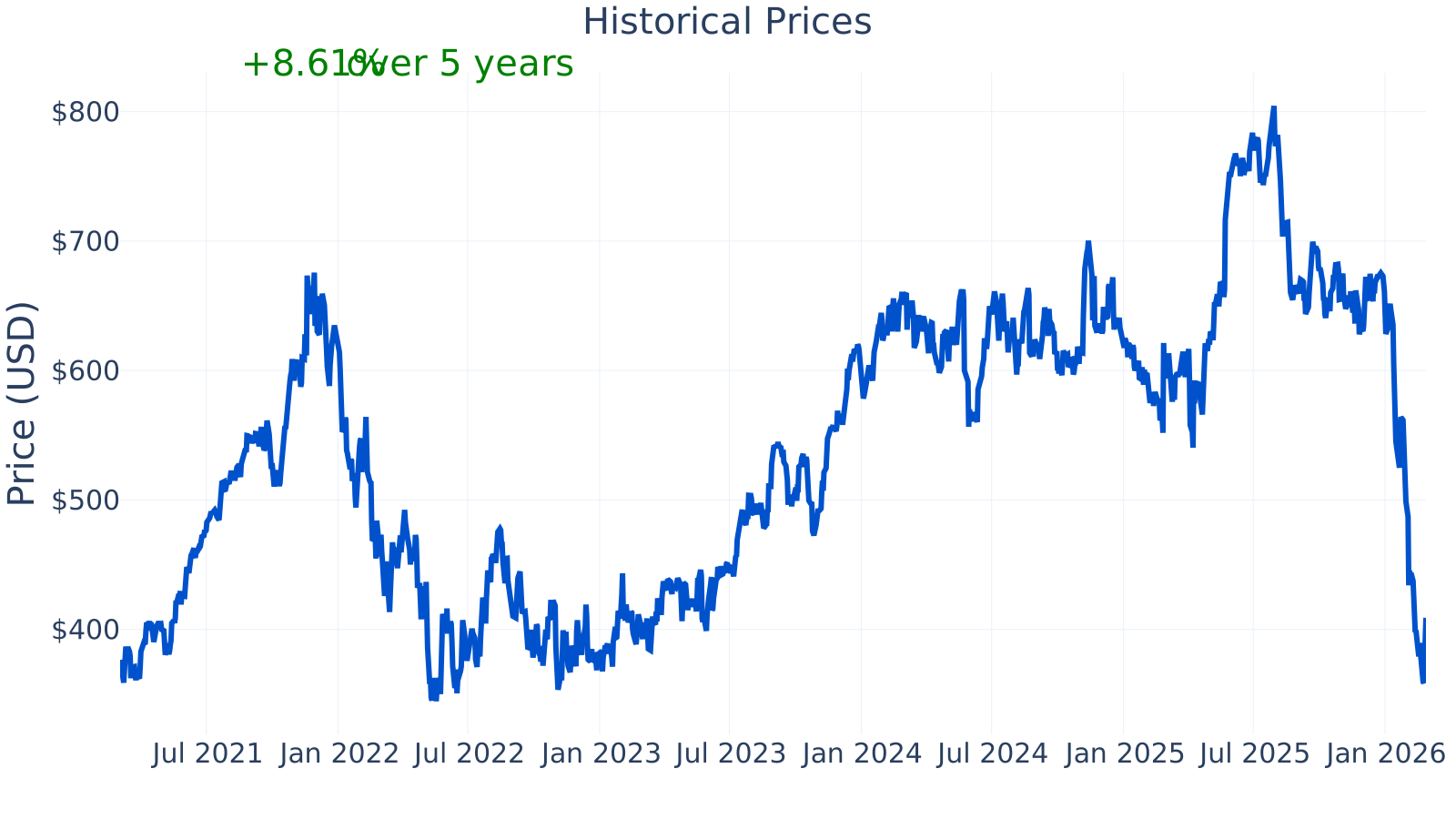
Overview
Intuit Inc. is a software company focused on financial management for consumers, small businesses, and accounting professionals. Its best-known products include TurboTax (tax preparation), QuickBooks (accounting and payroll for small businesses), Credit Karma (consumer credit and personal finance), and Mailchimp (marketing automation for small businesses). In simple terms, Intuit’s tools help people file taxes, run business finances, get paid, manage cash flow, and make decisions using financial insights.
Intuit primarily generates revenue from subscriptions and services tied to these platforms (for example, QuickBooks Online subscriptions, payroll services, and payments), as well as consumer tax products (TurboTax) and advertising/lead-generation activities in Credit Karma. In its official reporting, Intuit organizes revenue into operating segments rather than product-by-product public percentages. The main segments are typically:
- Small Business & Self-Employed (centered on QuickBooks and related services)
- Consumer (centered on TurboTax)
- Credit Karma (consumer finance platform, largely performance-based revenue)
- ProTax (tools for professional accountants and tax preparers)
Across these segments, Intuit’s business model benefits from recurring subscriptions (especially in small business software), plus seasonal strength driven by the annual U.S. tax filing cycle (especially in Consumer).
Over the years shown, revenue rises materially (from about $9.6B to about $18.8B). Operating income and net income also increase, while research and development spending grows as well, reflecting continued investment in product capabilities alongside expanding scale.
Key Figures
| Metric | Value | Industry ⓘ |
|---|---|---|
| Date | Mar 02, 2026 | |
| Context | ||
| Sector | Technology | |
| Industry | Software - Application | |
| Market Cap ⓘ | $113.87B | |
| Beta ⓘ | 1.23 | |
| Fundamental | ||
| P/E Ratio ⓘ | 28.09 | 25.64 |
| Profit Margin ⓘ | 21.57% | 7.25% |
| Revenue Growth ⓘ | 41.00% | 16.65% |
| Debt to Equity ⓘ | 37.43% | 24.64% |
| PEG ⓘ | 1.10 | |
| Free Cash Flow ⓘ | $6.84B | |
Intuit’s market capitalization is about $113.9B, placing it among the larger software companies. The stock’s beta of ~1.23 suggests it has tended to move somewhat more than the broader market. Profitability stands out: the latest profit margin is ~21.6%, notably higher than the industry median (~7.2%) shown. Recent year-over-year revenue growth is ~41% versus an industry median (~16.7%), though growth can fluctuate from period to period. Leverage is moderate with debt-to-equity of ~37% (industry median ~24.6%). The company also produces sizable cash generation, with trailing twelve-month free cash flow of about $6.84B.
Growth (Medium)
Intuit operates in areas with long-term tailwinds: digitization of small business operations (accounting, payroll, invoicing, payments), ongoing complexity in tax preparation, and growing consumer demand for tools that make personal finance easier to understand. These needs tend to persist across economic cycles, even if customer spending patterns can change.
Strategically, Intuit aims to connect multiple financial “jobs” in one ecosystem. For example, a small business may start with accounting software, then add payroll, payments, invoicing, and cash-flow tools. This type of expansion can matter because it may increase how embedded the software becomes in daily workflows, which can support recurring revenue over time.
The growth rate shown is uneven across time (including a brief negative period), but more recently it appears to settle into a mid-to-high teens range, before the latest reading of about 17.4% (and a latest-metric snapshot of 41%). For readers, the key takeaway is that growth is not perfectly smooth, and single periods can be affected by product mix, timing, and seasonal factors.
Free cash flow increases steadily across the periods shown (roughly $3.0B to $6.8B). Consistent cash generation can provide flexibility for internal investment, acquisitions, and returning capital to shareholders, although how it is used can vary year to year.
Risks (Medium)
Intuit’s results can be influenced by seasonality, particularly in the Consumer segment tied to tax filing. Tax-related revenue and customer activity are naturally concentrated around the filing season, which can make some quarters far more important than others.
Competition is a real factor. In small business accounting and adjacent services, Intuit competes with software providers such as Xero and other business platforms that bundle financial tools. In consumer tax preparation, it competes with other tax software and assisted preparation offerings. In consumer finance (Credit Karma’s category), competition includes other personal finance and credit platforms. In marketing automation (Mailchimp’s category), competitors include a range of marketing software providers. Intuit’s competitive advantages are generally associated with strong brand recognition (especially TurboTax and QuickBooks), a broad installed base, and integrated workflows that can make switching less convenient for customers once processes are set up.
Regulatory and policy changes are another important risk area. Changes in tax laws, tax filing processes, data privacy rules, or consumer finance regulations can require product updates and may change demand patterns. Because Intuit handles sensitive financial information, cybersecurity and data protection are also critical operational risks.
Debt-to-equity trends mostly remain in a moderate range over time, moving from the mid-20% area earlier in the chart to the mid-to-high 30% range more recently, with periods above 40% in between. The latest level is about 37%, somewhat above the industry median shown (~25%), implying slightly higher balance-sheet leverage than the typical peer in this comparison set.
Profit margin trends show Intuit consistently positive and improving from the mid-teens to the low-20% range, reaching about 21.6% most recently. The industry median shown is much lower (about 7.4% recently), which highlights Intuit’s relatively strong profitability versus many application software peers.
Valuation
On an earnings multiple basis, the latest P/E ratio is about 28.1, compared with an industry median around 25.6 in the latest snapshot. In the historical series shown, Intuit’s P/E has ranged much higher in prior periods (often above 50), and more recently trends downward into the mid-to-high 40s by late 2025 (with peer medians also declining in that time window). Differences between the latest snapshot and the historical chart can happen due to timing, earnings changes, and how trailing earnings are measured at each point.
In general descriptive terms, a higher P/E typically implies the market is placing more weight on future growth and/or durability of profits. Intuit’s above-median profitability and substantial free cash flow can support a higher multiple than some peers, while competitive, regulatory, and execution risks can limit how far valuation expands. The PEG ratio shown (~1.10) is often interpreted as a valuation relative to growth, and a value near 1 is commonly viewed as roughly aligned, though this measure depends heavily on growth assumptions and is not a definitive indicator on its own.
Conclusion
Intuit is a large application software company built around well-known financial products for consumers and small businesses. The information shown points to strong profitability (with margins well above the peer median), meaningful cash generation that has expanded over time, and revenue growth that has generally remained positive despite periodic variability.
The long-term narrative depends on continued adoption of digital financial tools, Intuit’s ability to expand customer usage across its ecosystem, and disciplined execution in highly competitive categories. Key uncertainties include policy and regulatory shifts (especially related to taxes and consumer finance), cybersecurity requirements associated with sensitive data, and competitive pressure from both focused and broad platform providers. Valuation metrics shown place Intuit somewhat above the median peer on P/E in the latest snapshot, which is consistent with a market expectation of durable earnings power, but also means results and guidance can matter for how the stock is priced over time.
Sources:
- SEC EDGAR — Intuit Inc. Form 10-K (Annual Report) (business description, segment reporting, risk factors, financial statements)
- SEC EDGAR — Intuit Inc. Form 10-Q (Quarterly Report) (updates to financials, seasonality, risk disclosures)
- Intuit Investor Relations — Annual Report / Form 10-K materials (company-hosted)
- Wikipedia — “Intuit” (basic company background and product overview)
This article is for informational purposes only and does not constitute financial advice. Some content is AI-generated. See Disclaimer


