Stock Analysis · International Paper (IP)
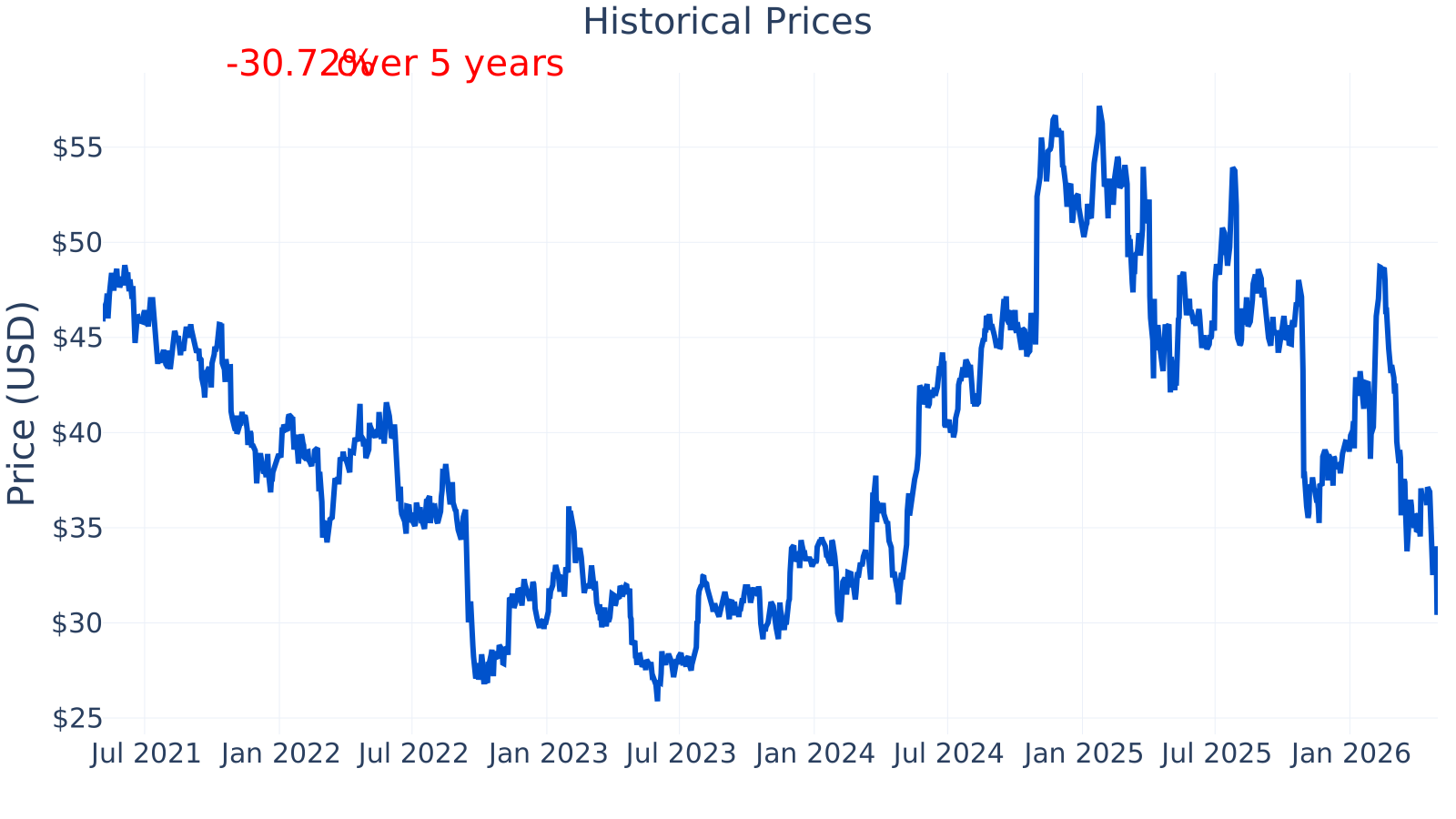
Overview
International Paper (IP) is a large paper and packaging company. In practical terms, it makes the corrugated packaging used to ship goods (boxes and containerboard) and it produces cellulose fibers that go into absorbent products and other specialty applications. The company sells primarily to industrial and consumer-products customers that need packaging for distribution and e-commerce supply chains.
International Paper’s revenue is largely tied to packaging demand and to market pricing for containerboard and related products, with results typically moving up and down with economic activity, inventory cycles, and input costs (like energy, chemicals, and recovered fiber).
Main sources of revenue are generally described by operating segment (exact percentages vary by year):
- Industrial Packaging (containerboard, corrugated packaging, and related services) — typically the largest contributor
- Global Cellulose Fibers (pulp-based fibers used in absorbent and specialty products)
Across the years shown in the operating statement flow, total revenue and profitability have been volatile. For example, revenue increased from about $19.4B (2021) to about $24.9B (2025), while net income moved from positive results in 2021–2024 to a large net loss in 2025. This type of swing is important context for long-term analysis because it highlights how sensitive results can be to cycle conditions and one-time charges.
Key Figures
| Metric | Value | Industry ⓘ |
|---|---|---|
| Date | May 04, 2026 | |
| Context | ||
| Sector | Consumer Cyclical | |
| Industry | Packaging & Containers | |
| Market Cap ⓘ | $16.82B | |
| Beta ⓘ | 1.10 | |
| Fundamental | ||
| P/E Ratio ⓘ | N/A | 17.20 |
| Profit Margin ⓘ | -13.77% | 5.65% |
| Revenue Growth ⓘ | 1.20% | 1.40% |
| Debt to Equity ⓘ | 64.44% | 112.14% |
| PEG ⓘ | 1.58 | |
| Free Cash Flow ⓘ | $553.00M | |
International Paper’s market capitalization is about $16.8B, placing it among the larger public companies in the packaging space. The stock’s beta of ~1.10 suggests it has historically moved somewhat more than the overall market.
Recent operating profitability is a key item to watch: the latest profit margin is about -13.8%, compared with an industry median around 5.7%. That gap indicates the company has recently been earning meaningfully less (and in this period, losing money) than the typical peer, which can affect how valuation metrics should be interpreted.
On growth, the latest year-over-year revenue growth is about 1.2%, broadly similar to the industry median near 1.4%, suggesting the company’s recent top-line change has been roughly in line with the overall sector’s current pace.
Leverage appears moderate relative to the peer set: debt-to-equity is ~64% versus an industry median around 112%. Free cash flow over the trailing twelve months is about $553M, showing the business is currently generating cash even though profitability (net margin) has been weak recently.
Growth (Medium)
Packaging demand is generally supported by long-run trends such as shipping needs, population growth, and ongoing logistics activity. At the same time, it is not a straight-line growth industry: demand and pricing can fluctuate with industrial production, consumer spending, and inventory restocking cycles. As a result, companies like International Paper often focus on efficiency, reliability, and cost position as much as (or more than) pure volume growth.
The year-over-year revenue growth pattern shows sizable swings over time, including periods of contraction and periods of sharp expansion. The latest reading is close to flat (~1%), which fits a “steady but cyclical” profile rather than a consistently fast-growing one.
Free cash flow has also been uneven, moving from stronger levels earlier in the period to near break-even around 2025, and then recovering to a positive ~$553M most recently. For a capital-intensive manufacturer, sustained free cash flow matters because it supports debt service, reinvestment in mills and converting plants, and resilience during downturns.
Potential catalysts over time tend to be operational rather than “new product” driven: improving mill reliability and cost structure, optimizing capacity, and pricing discipline in containerboard and corrugated packaging markets. Longer-term results can also be influenced by portfolio actions (acquisitions, divestitures, or restructuring), which are commonly used in mature industrial categories to reshape earnings stability.
Risks (High)
International Paper’s main risk is cyclicality. Packaging volumes and pricing can weaken during economic slowdowns, and input costs (energy, chemicals, labor, transportation) can pressure margins when price increases lag cost inflation. The company’s recent negative profit margin underlines how quickly earnings can deteriorate in unfavorable conditions, including the impact of restructuring, impairments, or other significant charges that sometimes occur in asset-heavy industries.
The profit margin trend shows a clear deterioration from mid-single-digit to low-double-digit positive margins earlier in the period to negative territory more recently (about -13% at the latest point), while the industry median stayed positive. This divergence indicates the company has faced company-specific and/or timing-related pressures beyond what the “typical” peer experienced.
Another major risk is capital intensity. Paper and packaging assets require ongoing maintenance and periodic large upgrades. When industry conditions are weak, required spending can limit flexibility. Environmental and regulatory compliance, including emissions, water usage, forestry practices, and recycling requirements, also adds cost and execution complexity.
Leverage looks lower than the industry median in this period, with debt-to-equity around 64%. While that can be a stabilizing factor, debt still matters because earnings volatility can reduce coverage ratios (the ability to comfortably pay interest and other fixed obligations) during downturns.
In terms of competitive positioning, the company operates in markets where scale, mill integration, logistics, and customer relationships are meaningful advantages, but products can be relatively standardized. Competitive advantages often come from:
- Cost position and asset efficiency (operating mills at high uptime and favorable unit costs)
- Scale and network density (serving large customers across regions)
- Customer switching frictions (packaging specifications, service levels, supply reliability)
Main competitors typically include other large containerboard and corrugated packaging producers and integrated packaging companies. Examples include WestRock (now part of Smurfit WestRock), Packaging Corporation of America, and Graphic Packaging (more focused on paperboard cartons, but still a relevant packaging peer group). International Paper’s relative standing depends heavily on operating performance and cost competitiveness at its mills rather than on differentiated intellectual property.
Valuation
The P/E ratio history shown is highly variable, with periods where the company traded at single-digit to teens multiples (for example in 2021–2022) and later spikes to much higher levels (for example during 2023–2025). Large swings in P/E often happen when earnings are temporarily depressed (or distorted by significant charges), because the “E” in P/E becomes unusually small or negative, making the ratio less meaningful as a yardstick.
For context, the industry median P/E in the chart is generally in the mid-teens to around 20x depending on the date. When International Paper’s P/E rises far above that while profitability is weak (as also reflected in the negative margin), it can indicate that current earnings are not representative of the company’s longer-run earnings power, or that investors are looking through a temporary earnings trough. In this situation, it becomes especially important to pair valuation ratios with operating measures such as margins, cash generation, and balance sheet capacity rather than relying on P/E alone.
Conclusion
International Paper is a large, established participant in packaging and cellulose fiber markets, with results that tend to follow economic and industry cycles. The business benefits from scale and a broad manufacturing and distribution footprint, but it operates in competitive categories where pricing, costs, and execution drive outcomes.
The recent picture is mixed: revenue growth has been modest and close to the industry’s current pace, free cash flow is positive on a trailing basis, and leverage appears moderate versus peers. At the same time, profitability has recently been significantly weaker than the industry median, and earnings-based valuation measures (like P/E) can be difficult to interpret when net income is volatile or negative. For long-term analysis, the key factors to track are whether margins and cash generation normalize sustainably, and whether the company maintains balance sheet flexibility through the cycle.
Sources:
- SEC EDGAR — International Paper filings (Form 10-K, Form 10-Q)
- International Paper — Investor Relations (Annual Report / filings archive and press releases)
- Wikipedia — “International Paper” (basic company background)
This article is for informational purposes only and does not constitute financial advice. Some content is AI-generated. See Disclaimer


