Stock Analysis · InterDigital Inc (IDCC)
Overview
InterDigital, Inc. (IDCC) is a technology company that develops and licenses wireless and video-related inventions. Instead of mainly selling physical products, InterDigital focuses on creating patented technologies that are used in everyday connected devices and networks (for example, smartphones and other cellular-enabled products). Companies that use these technologies typically pay InterDigital license fees, often through multi‑year agreements.
This business model is built around long research cycles and patent protection. In practice, InterDigital spends heavily on research and development, files patents, and then monetizes that intellectual property through licensing programs and, when needed, enforcement of its patent rights.
In its financial reporting, InterDigital’s revenue is largely associated with patent license agreements (commonly discussed by the company as recurring patent royalties plus catch-up or one-time items tied to contract timing). Percentages by revenue stream are not provided in the metrics here, but the company’s public filings describe licensing as the core driver of revenue and profits.
Largest to smallest (high-level) revenue sources commonly described in filings:
- Patent licensing and royalties (the core business)
- Technology solutions / other (smaller, compared with licensing)
Across recent years, revenue and profits expanded meaningfully versus earlier periods, while research and development spending remained a major, steady cost. This is typical for a licensing-focused model: ongoing R&D investment supports future patents, while profitability can rise sharply when large license agreements are signed or renewed.
Key Figures
| Metric | Value | Industry ⓘ |
|---|---|---|
| Date | Feb 07, 2026 | |
| Context | ||
| Sector | Technology | |
| Industry | Software - Application | |
| Market Cap ⓘ | $9.55B | |
| Beta ⓘ | 1.58 | |
| Fundamental | ||
| P/E Ratio ⓘ | 31.47 | 27.79 |
| Profit Margin ⓘ | 48.76% | 6.02% |
| Revenue Growth ⓘ | -37.40% | 15.80% |
| Debt to Equity ⓘ | 45.94% | 25.15% |
| PEG ⓘ | 1.32 | |
| Free Cash Flow ⓘ | $529.37M | |
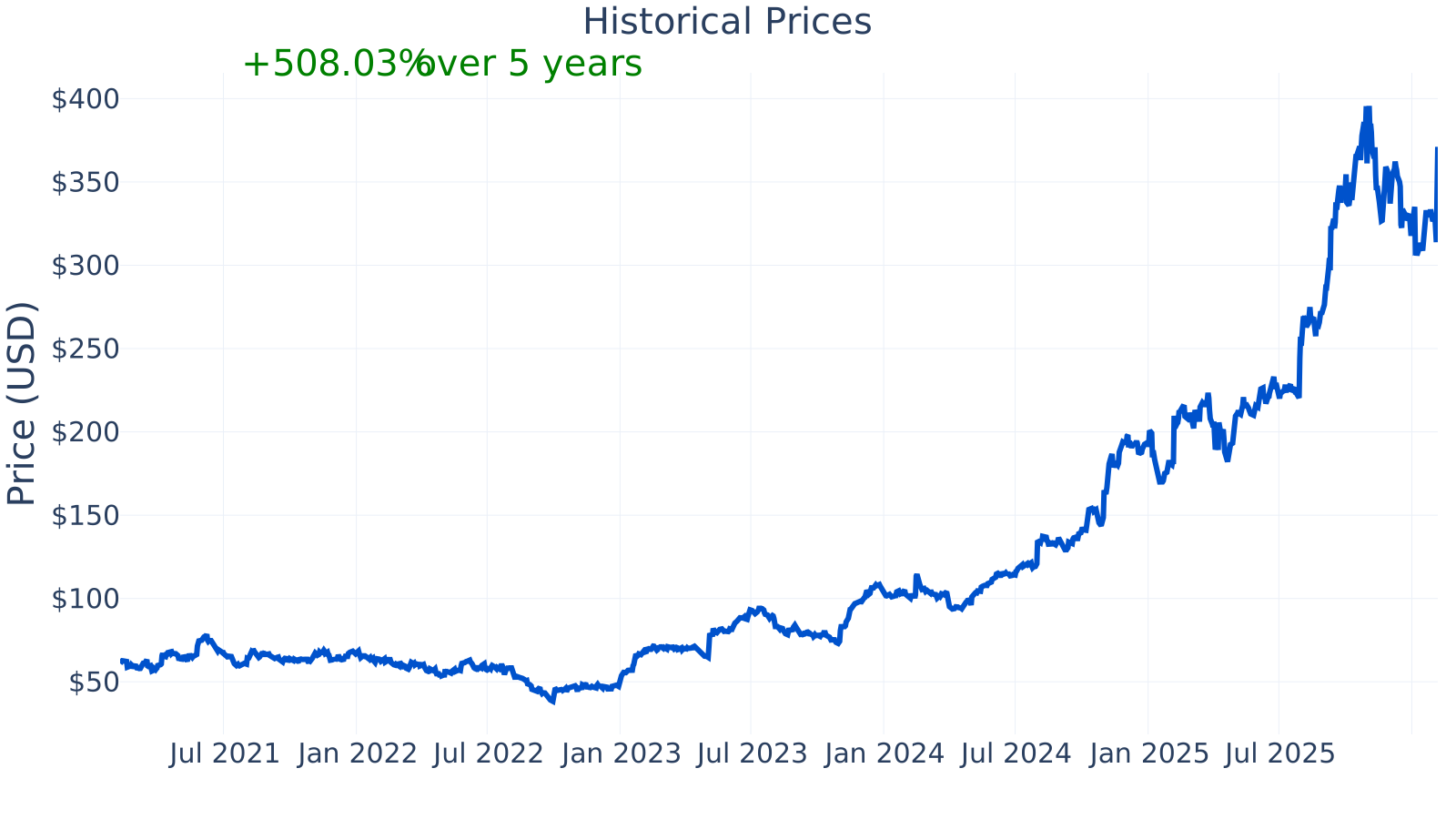
InterDigital’s market capitalization is about $9.6B, and the stock’s beta of ~1.58 suggests it has tended to move more than the broader market. The company’s P/E ratio is ~31.5, above the industry median of ~27.8 in the “Software - Application” peer set shown here.
Profitability stands out: the latest profit margin is ~48.8%, far above the listed industry median of ~6.0%. At the same time, recent year-over-year revenue growth is about -37.4% versus an industry median of ~15.8%, highlighting that revenue can be uneven from period to period. The latest debt-to-equity ratio is ~45.9%, which is higher than the industry median (~25.2%), though not extreme in absolute terms.
Growth (Medium)
InterDigital operates in the broader wireless communications ecosystem, where long-term demand is linked to the continued expansion of connectivity. Over time, each new generation of wireless standards (from 4G to 5G and beyond), plus the growth of connected devices, tends to increase the number of products that may rely on standardized technologies. Companies that contribute patented inventions to widely adopted standards can have opportunities to license that intellectual property across many manufacturers and product categories.
InterDigital’s strategy is straightforward: keep investing in research, secure patents, and license those innovations—especially where inventions are tied to widely used standards. This approach can scale well because a successful patent portfolio can be licensed broadly without requiring manufacturing capacity.
A practical catalyst for companies with this model is the timing of major license renewals and new agreements, which can cause revenue and profits to rise or fall significantly between years. Another potential catalyst is the evolution of wireless standards, where successful R&D outcomes can strengthen the portfolio used in negotiations.
The revenue growth pattern is volatile, with large up-and-down swings across quarters/years. That behavior is often consistent with a licensing business where contract timing, renewals, and one-time items can dominate the year-over-year comparison rather than smooth “unit sales” growth.
Free cash flow over the trailing twelve months is shown at about $529M in the latest metrics, while the historical series illustrates that cash generation has varied materially by period. This matters for long-term evaluation because a licensing model can produce substantial cash, but not always in a steady, predictable cadence.
Risks (High)
InterDigital’s results can be heavily influenced by a small number of large licensing agreements. When a major contract is renewed, expanded, delayed, or disputed, reported revenue and earnings can change sharply. This concentration and “lumpiness” is a key risk for anyone assessing long-term stability.
Another important risk is legal and regulatory uncertainty. Patent licensing in standardized technologies can be affected by litigation outcomes, changing court interpretations, and evolving rules around fair, reasonable, and non-discriminatory (FRAND) licensing practices. These factors can influence negotiation leverage, royalty rates, and the cost/timeline of enforcement.
InterDigital also faces technology-cycle risk. Its long-term success depends on continuing to create inventions that remain relevant to future standards and products. If future wireless or video implementations rely less on areas where the company is strong—or if competing approaches reduce the importance of certain patented methods—future licensing strength could be affected.
Leverage has moved noticeably over time, peaking above 100% in parts of 2023 before declining. The latest debt-to-equity level of roughly 46% is below those peaks but remains above the listed industry median (~26%). This suggests balance-sheet risk is not purely theoretical, even though the recent direction has been downward.
Profit margins rose substantially over the period shown, reaching around 48.8% most recently—well above the industry median (~6.5%). While strong margins can indicate operating leverage and pricing power in successful licensing years, they can also reflect the same contract-timing dynamic that makes results uneven.
On competitive advantages, InterDigital’s main “moat” is its patent portfolio and participation in standardized technologies. In standardized wireless, multiple companies can hold essential patents, so the landscape is less about a single winner and more about relative portfolio strength, negotiating position, and the ability to sustain R&D output. Key counterparties and competitors are typically other major patent holders and technology developers participating in the same standards ecosystem (often including large telecom and device-focused technology companies with significant IP portfolios).
Valuation
The company’s latest P/E ratio is about 31.5, compared with an industry median near 27.8 in the peer set shown here. Historically, the chart shows periods where InterDigital’s P/E was much lower (teens) and periods where it was higher, while the industry median appears to have generally been higher than InterDigital’s for much of the displayed window.
Interpreting valuation for a licensing-focused company requires caution because earnings can be unusually sensitive to the timing of license agreements, legal outcomes, and one-time items. In other words, a P/E ratio can look high or low depending on where the company is in its contract cycle. The elevated profit margin levels suggest strong recent profitability, while the most recent year-over-year revenue growth being negative underscores how quickly top-line performance can swing.
Conclusion
InterDigital is best understood as an intellectual-property licensing company built around wireless and related technologies. Its financial profile can be characterized by strong profitability in successful licensing periods, meaningful ongoing R&D investment, and results that can fluctuate substantially depending on the timing and terms of large agreements.
For long-term analysis, the central questions tend to be whether the company can keep producing inventions that matter to future standards, maintain licensing strength as the wireless industry evolves, and manage legal/contract concentration risks that can drive uneven revenue and earnings. The current valuation metrics reflect a company with very high margins versus peers but also with recent revenue growth volatility and a leverage level above the peer median.
Sources:
- SEC EDGAR — InterDigital, Inc. filings (Form 10-K, Form 10-Q)
- InterDigital, Inc. Investor Relations — SEC filings and earnings materials (company-hosted)
- Wikipedia — “InterDigital” (basic company background)
This article is for informational purposes only and does not constitute financial advice. Some content is AI-generated. See Disclaimer