Stock Analysis · Interface Inc (TILE)
Overview
Interface, Inc. (TILE) designs and manufactures flooring primarily for commercial spaces. Its products are typically used in offices, education buildings, healthcare facilities, hospitality, and other non-residential interiors. The company is known for modular carpet tile and also sells resilient flooring (such as luxury vinyl tile), positioning its offering around design, performance, and sustainability-focused product development.
Revenue is mainly generated by selling flooring products and related services to commercial customers, often through a mix of direct sales and channel partners. Based on company reporting in its filings, the business is commonly discussed through major product categories rather than many unrelated business lines, with revenue concentrated in:
- Modular carpet (carpet tile and broadloom carpet) — historically the core of the business
- Resilient flooring (e.g., LVT and rubber) — a significant and strategic expansion area
- Other / services — smaller items such as installation-related or ancillary offerings (as disclosed in filings)
The company’s end-demand is closely tied to commercial construction and renovation cycles, particularly in workplaces and institutional buildings.
From 2021 to 2024, total revenue increased overall (about $1.20B to about $1.32B). Over the same span, operating income and net income improved notably by 2024, alongside lower interest expense versus earlier years—suggesting a combination of improved operating performance and reduced financing costs.
Key Figures
| Metric | Value | Industry ⓘ |
|---|---|---|
| Date | Feb 08, 2026 | |
| Context | ||
| Sector | Consumer Cyclical | |
| Industry | Furnishings, Fixtures & Appliances | |
| Market Cap ⓘ | $2.02B | |
| Beta ⓘ | 1.88 | |
| Fundamental | ||
| P/E Ratio ⓘ | 18.04 | 18.82 |
| Profit Margin ⓘ | 8.27% | 4.29% |
| Revenue Growth ⓘ | 5.90% | 0.30% |
| Debt to Equity ⓘ | 62.81% | 77.79% |
| PEG ⓘ | 1.16 | |
| Free Cash Flow ⓘ | $117.48M | |
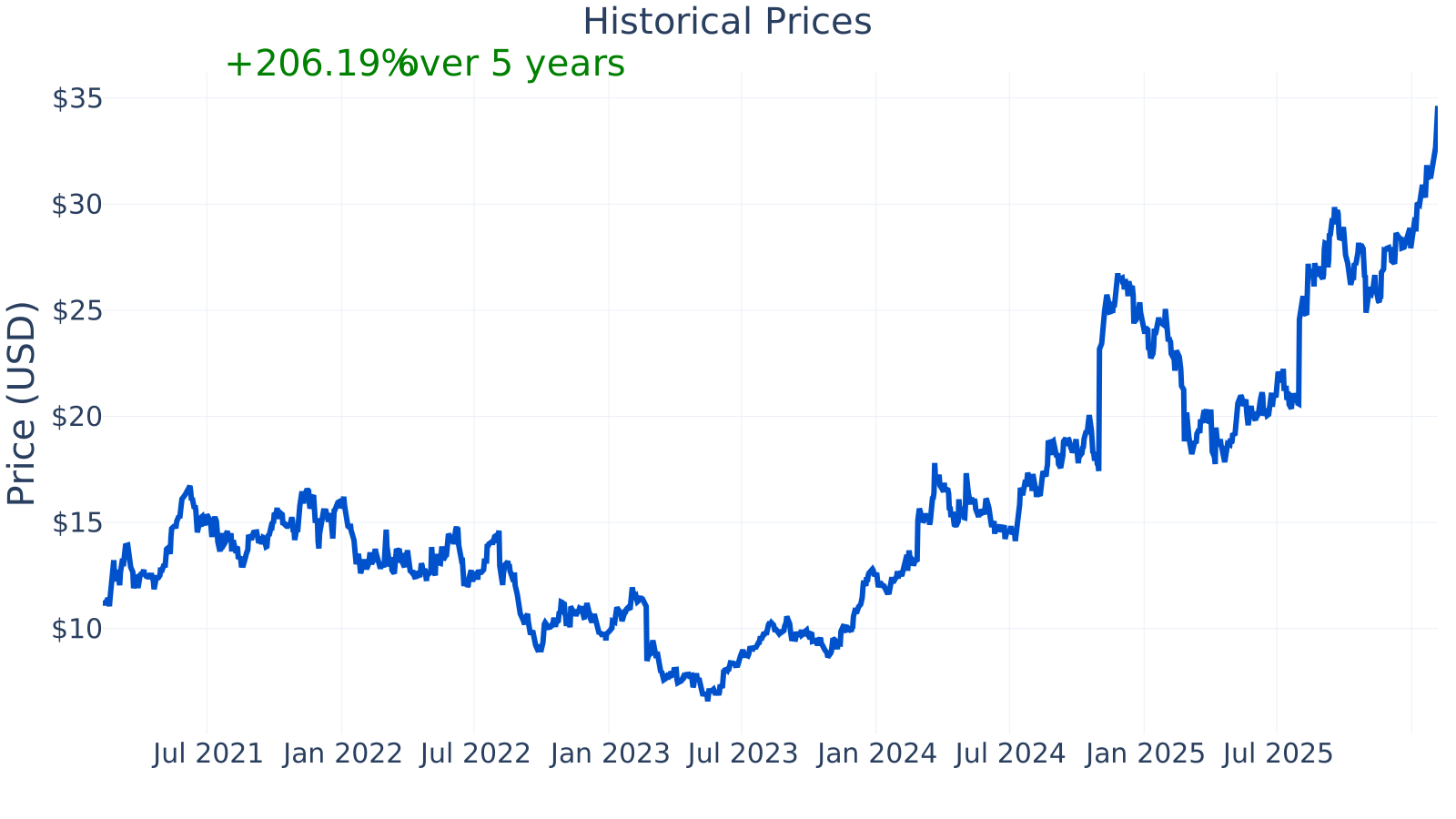
Interface’s market capitalization is about $2.21B, and the stock’s beta of ~1.88 indicates it has tended to move more than the broader market. The latest P/E ratio is ~18.0, close to the industry median (~18.8). Profitability stands out versus the peer median: the latest profit margin is ~8.3% versus an industry median of ~4.3%.
Recent topline momentum is positive: latest year-over-year revenue growth is ~5.9% versus an industry median near flat (~0.3%). Balance sheet leverage appears lower than the peer median: debt-to-equity is ~62.8% versus an industry median of ~77.8%. The company also generated about $117.5M in trailing twelve-month free cash flow.
Growth (Medium)
Interface operates in commercial flooring, a market that tends to grow over long periods with building construction, renovation activity, and product replacement cycles. Demand can be uneven year to year because it depends on business investment, real estate utilization, and large project timing. Within that context, categories such as resilient flooring and modular solutions can benefit from preferences for easier installation, maintenance, and design flexibility—factors that can support share gains even when overall construction is slow.
Strategically, Interface has emphasized expanding beyond carpet tile into resilient flooring while continuing to invest in product design and sustainability-related differentiation (as described in its annual filings). For commercial customers, environmental attributes and transparency can matter in procurement processes, which can reinforce brand positioning in certain segments.
The revenue growth trend shows a volatile pattern: strong growth in parts of 2021–2022, a softer period through much of 2023 and early 2024, followed by a return to positive growth in mid-to-late 2024 and into 2025 (mid-single-digit to high-single-digit in the most recent periods shown). This pattern is consistent with a business exposed to project cycles rather than steady subscription-like demand.
Free cash flow has also varied over time, dropping sharply around 2022 but recovering thereafter to roughly the low-$100M range in 2024–2025. For a manufacturing business, sustained free cash flow can matter because it supports reinvestment, balance sheet flexibility, and resilience during slower demand periods.
Risks (Medium)
This article is for informational purposes only and does not constitute financial advice. Some content is AI-generated. See Disclaimer


