Stock Analysis · Installed Building Products Inc (IBP)
Overview
Installed Building Products Inc. (IBP) is a U.S.-based contractor that installs insulation and other building products, primarily for residential construction. In simple terms, it works with homebuilders and property owners to put key materials into houses and apartments—most notably insulation—using a large network of local branches. The company’s operations are closely tied to construction activity (especially new housing starts) and remodeling demand.
IBP’s revenue is mainly generated by installing building products and related services across residential and, to a lesser extent, commercial projects. Based on the company’s business description in its SEC filings, its activities are commonly grouped as follows (largest to smaller, exact percentages may vary by period and are not always disclosed as fixed splits in every filing):
- Insulation installation (the core business and historically the largest contributor)
- Other building products installation (a broader set of offerings that can include items such as waterproofing, firestopping, garage doors, gutters, shower doors, shelving/mirrors, blinds, and similar installed products, depending on local branch capabilities)
- Commercial and industrial work (generally smaller than residential, but can provide diversification)
The company’s recent income structure shows a business where materials and labor are the majority of costs, while operating profit and net income are the smaller “leftover” portions after overhead, interest, and taxes.
From 2021 to 2025, total revenue increased (about $2.0B to about $3.0B), while net income also rose (about $119M to about $265M). Over the same span, selling, general, and administrative expenses moved noticeably year to year, which matters because this line item can influence how much of each revenue dollar ultimately becomes profit.
Key Figures
| Metric | Value | Industry ⓘ |
|---|---|---|
| Date | Mar 02, 2026 | |
| Context | ||
| Sector | Consumer Cyclical | |
| Industry | Residential Construction | |
| Market Cap ⓘ | $8.84B | |
| Beta ⓘ | 1.94 | |
| Fundamental | ||
| P/E Ratio ⓘ | 35.32 | 13.00 |
| Profit Margin ⓘ | 8.93% | 8.65% |
| Revenue Growth ⓘ | -0.40% | -6.05% |
| Debt to Equity ⓘ | 139.70% | 33.34% |
| PEG ⓘ | 1.20 | |
| Free Cash Flow ⓘ | $519.40M | |
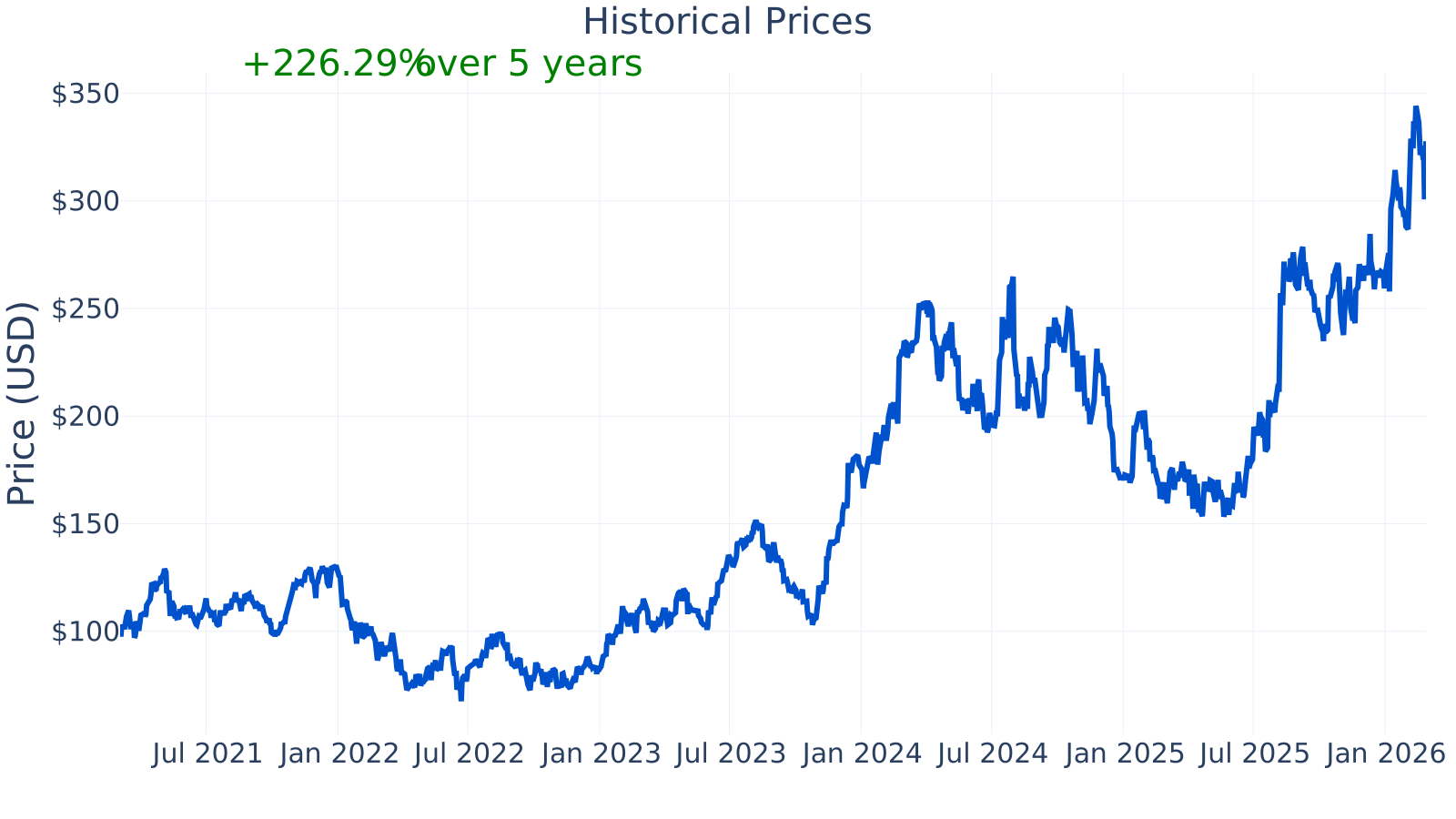
IBP’s market capitalization is about $8.8B, placing it among the larger publicly traded installation contractors. The stock’s beta of ~1.94 indicates it has historically moved more than the overall market (higher volatility). Profitability is shown by a profit margin of ~8.93%, slightly above the industry median (~8.65%). Recent year-over-year revenue growth is about -0.36%, which is close to flat and compares favorably to an industry median decline (about -6.05%). The balance sheet leverage stands out: debt-to-equity is ~140%, materially above the industry median (~33%). The P/E ratio is ~35.3, well above the industry median (~13.0). Trailing twelve-month free cash flow is about $519M, indicating meaningful cash generation (though cash flow can vary with working capital needs and the construction cycle).
Growth (Medium)
IBP operates in a cyclical industry tied to U.S. housing and construction activity. Over long periods, housing demand is influenced by population trends, household formation, housing supply shortages in certain regions, and the ongoing need to maintain and upgrade existing housing stock. However, shorter-term results can be heavily affected by mortgage rates, affordability, labor availability, and changes in builder activity.
Strategically, IBP’s model is built around scale and local coverage: many branches, relationships with national and regional builders, and a broad menu of installed products. This approach can support growth in two main ways: gaining share through service coverage and expanding offerings beyond insulation so that a single customer relationship can lead to multiple product installations on the same project.
The revenue growth pattern reflects the cycle: strong growth in 2021–2022 (often above 20% and at times above 40%), followed by slower growth and some mild declines in 2023–2025. The latest reading is close to flat year over year (around -0.36%), suggesting the company is operating in a more normalized (or slower) construction environment compared with the surge years.
Free cash flow has been positive in the periods shown, rising from about $148M (TTM in early 2021) to about $283M (TTM in early 2024), and then around $260M (TTM in early 2025) before the latest metric table shows ~$519M. For a contractor/installer, sustained free cash flow can be an important indicator of operational discipline, but it can also be influenced by timing of collections, payables, and inventory-related items.
Potential catalysts (in the factual, non-predictive sense) typically include changes in housing starts and completions, shifts in remodeling activity, and the company’s ability to expand geographically or broaden its installed product categories. Because the company is tied to construction volume, macro conditions often play a major role in reported growth.
Risks (High)
IBP’s key risks largely stem from cyclicality and operational complexity. Demand is connected to residential construction, which can decline quickly when financing costs rise or when builders reduce activity. Even if long-term housing needs remain, the path can be uneven from year to year. In addition, installation work depends on labor availability, wage rates, safety performance, and the cost and availability of building materials.
Leverage is another important risk area. Higher debt levels can amplify outcomes in both directions: it may support expansion, but it also increases the importance of consistent cash generation and exposes results to interest costs and refinancing conditions.
Debt-to-equity has trended down from very elevated levels earlier in the period (often above 170%–230%) to about 140% most recently, but it remains substantially above the industry median (roughly in the 26%–55% range over the period shown). This gap suggests IBP uses more balance-sheet leverage than many peers in its industry grouping.
Profitability is also worth monitoring in a downturn because installation contractors can see margin pressure when volumes fall or when labor and material costs shift faster than pricing.
IBP’s profit margin improved meaningfully from roughly 5.8% (2021) to around 8%–9% in later periods, ending near 8.93%. Compared with the industry median, IBP was below median earlier in the timeline but is now slightly above it. That said, margins can be cyclical and sensitive to job mix (new construction vs. repair/remodel), regional demand, and cost control.
On competitive positioning, IBP is widely recognized in its filings as a scaled operator with a large branch footprint. Scale can provide advantages in purchasing, recruiting, training, and serving multi-market builders consistently. The competitive landscape remains fragmented across many local and regional installers, alongside other large national or multi-regional participants. Major competitors typically include other insulation and specialty installation contractors and, in some categories, product-focused companies that provide installation through networks. Competitive pressure often shows up through pricing, the ability to staff crews reliably, and the capacity to serve large builders across multiple geographies.
Valuation
Valuation is often discussed using multiples such as the price-to-earnings (P/E) ratio, which compares the stock price to the company’s earnings. For cyclical businesses, P/E ratios can swing substantially depending on where the company is in the cycle (earnings may be temporarily high or low).
IBP’s latest P/E ratio is about 35.3, which is materially higher than the industry median of about 13.0. Historically in the period shown, IBP’s P/E has frequently remained above the industry median as well, sometimes by a wide margin. A higher multiple can be consistent with expectations of steadier execution, stronger margins, or better long-term compounding, but it also means the stock price is more sensitive to disappointments (for example, if earnings soften in a housing slowdown).
Given IBP’s combination of (1) cyclical end markets, (2) meaningful free cash flow generation, (3) margins that improved versus earlier years, and (4) higher-than-peer leverage, the current valuation level implies the market is placing a relatively high value on the company’s earnings compared with the broader peer set.
Conclusion
Installed Building Products is a scaled installation contractor with a core focus on insulation and a broader set of installed building products, making its results closely linked to U.S. residential construction conditions. Over the last several years, revenue and net income have increased in absolute terms, and profit margins have improved compared with earlier periods. Free cash flow has been positive and, in the most recent trailing period provided, substantial.
At the same time, the company operates in a cyclical industry and carries higher leverage than the median peer in its industry grouping. The stock’s valuation (as reflected by the P/E ratio) is well above the industry median, which increases sensitivity to changes in earnings expectations. Overall, the long-term picture depends on how effectively IBP sustains profitability and cash generation across housing cycles while managing balance-sheet risk.
Sources:
- SEC EDGAR — Installed Building Products, Inc. — Annual Report (Form 10-K)
- SEC EDGAR — Installed Building Products, Inc. — Quarterly Report (Form 10-Q)
- Installed Building Products, Inc. — Investor Relations — SEC Filings
- Wikipedia — “Installed Building Products”
This article is for informational purposes only and does not constitute financial advice. Some content is AI-generated. See Disclaimer


