Stock Analysis · Innodata Inc (INOD)
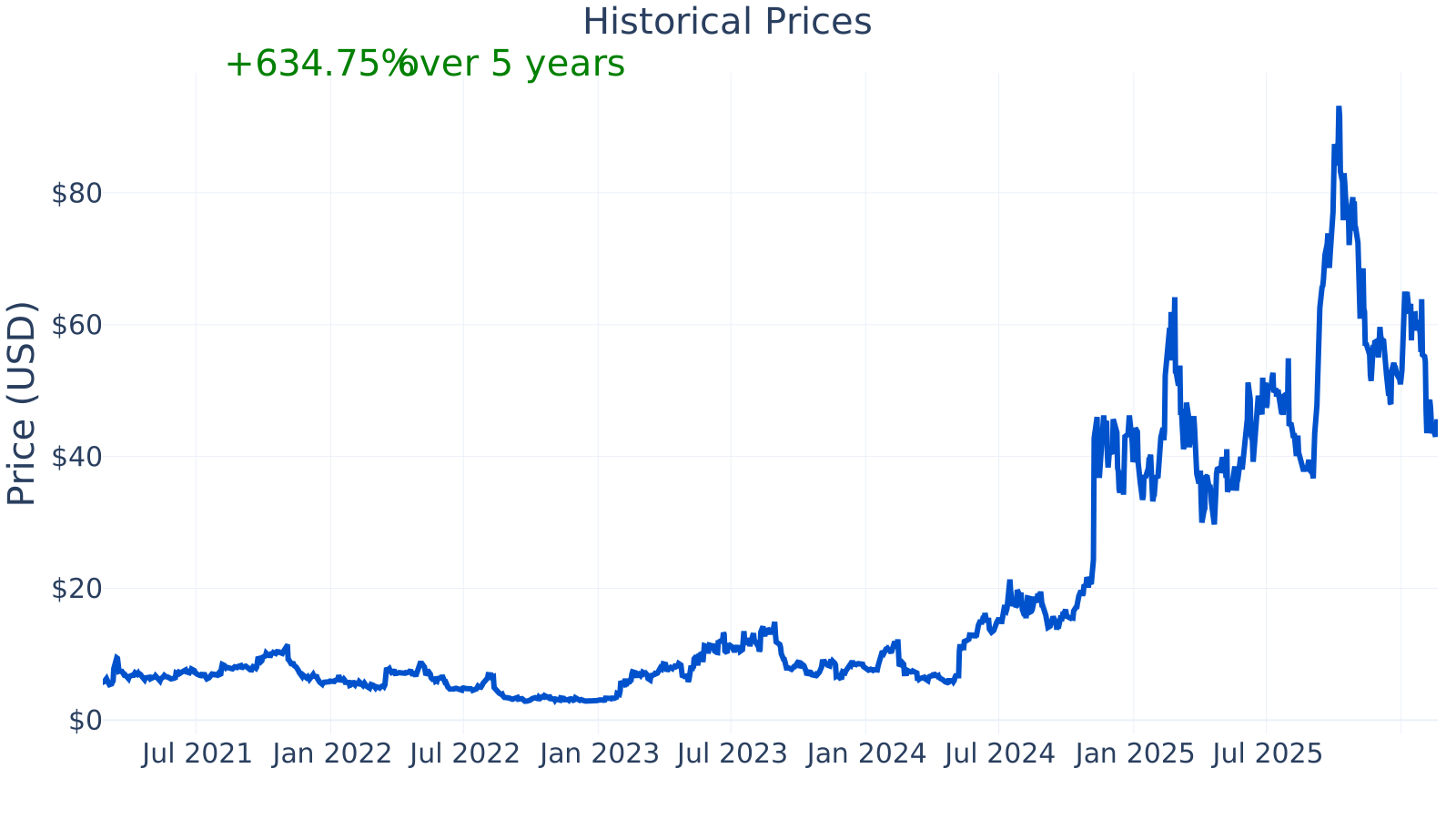
Overview
Innodata Inc. (INOD) is a technology services company that helps other organizations handle large volumes of digital content and information. In simple terms, it provides outsourced work and specialized services so customers can organize, enrich, and use their information more effectively—often tied to digital transformation initiatives and automation.
Based on the company’s public filings, Innodata’s business is commonly described around services such as content and data-related operations, including work that supports modern AI and analytics workflows (for example, preparing and structuring information so it can be used in software systems). Like many services businesses, results can depend heavily on a relatively small number of large customer programs and the pace at which those programs ramp up or wind down.
Public segment-level revenue split (with precise percentages) is not included in the information provided here. In its SEC filings, Innodata typically explains revenue in terms of service offerings and/or customer programs rather than consumer products sold at a set price.
The income statement flow shows a major step-up in scale in 2024: total revenue increased materially (from about $86.8M in 2023 to about $170.5M in 2024). Over the same period, operating income moved from roughly break-even ($0.3M in 2023) to strongly positive (about $24.5M in 2024), with net income also turning meaningfully positive (about $28.7M in 2024). This suggests improved operating leverage as the company grew.
Key Figures
| Metric | Value | Industry ⓘ |
|---|---|---|
| Date | Feb 23, 2026 | |
| Context | ||
| Sector | Technology | |
| Industry | Information Technology Services | |
| Market Cap ⓘ | $1.43B | |
| Beta ⓘ | 2.42 | |
| Fundamental | ||
| P/E Ratio ⓘ | 44.38 | 19.56 |
| Profit Margin ⓘ | 14.11% | 4.91% |
| Revenue Growth ⓘ | 19.80% | 5.70% |
| Debt to Equity ⓘ | 4.81% | 78.25% |
| PEG ⓘ | N/A | |
| Free Cash Flow ⓘ | $40.70M | |
At the latest snapshot, Innodata’s market capitalization is about $1.43B. The stock’s beta of about 2.42 indicates historically higher volatility than the broader market. Profit margin is about 14.11%, which is notably above the industry median shown (about 4.91%). Year-over-year revenue growth is about 19.8%, also above the industry median shown (about 5.7%). Debt-to-equity is about 4.81%, far below the industry median shown (about 78.25%), indicating comparatively low balance-sheet leverage. Trailing twelve-month free cash flow is about $40.7M.
Growth (Medium)
Innodata operates within information technology services, an area supported by long-running trends such as digitization, outsourcing of specialized operational work, and broader use of automation. When customers increase spending on modernizing systems and making their information usable for software, services providers can benefit—though spending can also slow if customers reduce discretionary projects.
A key question for long-term growth is whether Innodata can consistently expand large customer programs while maintaining quality, delivery timelines, and profitability. The company’s recent results (discussed below) suggest that scaling can improve margins, but services businesses can face uneven demand and periodic resets in program size.
The year-over-year revenue growth pattern shows a sharp acceleration through 2024 into early 2025 (including several quarters with very high growth rates), followed by a notable slowdown by the most recent point shown (around 19.8%). This kind of swing can happen when the business is lapping unusually strong expansion periods or when customer program growth normalizes after a rapid ramp.
Free cash flow over the trailing twelve months improved significantly over time: it was negative in 2022 and 2023, turned positive in 2024, and rose to about $30.4M by the 12 months ended 2025-03-31 (with the latest metric snapshot showing about $40.7M). For a services company, sustained positive free cash flow can be an important signal that earnings are translating into cash, though the level can still fluctuate with working capital needs and program timing.
Risks (High)
A primary risk is customer concentration and program volatility. In many outsourced services models, a small number of large clients can represent a meaningful share of revenue; if a major program is reduced, delayed, not renewed, or moved to another provider, results can change quickly. This can contribute to uneven quarterly and annual performance.
Competition is another material factor. Innodata operates in markets with many capable vendors, ranging from large IT services firms to specialized providers. Depending on the specific work scope, competitors can include large global outsourcing and consulting firms as well as niche firms focused on content operations and information processing. In these markets, scale, price, quality, security/compliance capabilities, and execution track record often determine who wins contracts. Innodata’s competitive positioning may be strongest where it can demonstrate domain expertise and reliable delivery for complex, high-volume work, but it is not typically described in filings as the clear “category leader” across the entire industry.
Debt-to-equity has trended down substantially over time, reaching roughly 4.81% at the latest point shown, versus an industry median shown near 61.61% for the same period. Lower leverage can reduce financial risk (for example, less exposure to rising interest rates and refinancing pressure), but it does not eliminate operational risks tied to demand and execution.
Profitability has improved dramatically compared with 2022–2023. The profit margin moved from deeply negative territory in 2022 and most of 2023 to strongly positive levels in late 2024 and 2025, reaching mid-to-high teens in several quarters (about 14.11% at the latest point shown). This is also above the industry median shown (around 5%). A key risk is durability: in a project- and program-based services business, margins can compress if pricing tightens, labor costs rise, utilization falls, or the mix shifts toward lower-margin work.
Finally, the stock’s higher volatility (as reflected in the beta) adds market risk: even if company fundamentals remain stable, the share price has historically been more sensitive to market swings and changes in sentiment.
Valuation
Innodata’s latest P/E ratio is about 44.38, compared with an industry median shown around 19.56. That means the stock is priced at a higher multiple of earnings than the typical peer in its industry group, at least based on this snapshot.
The historical P/E pattern shown is also uneven, with very high readings in some periods (and blanks in others where the P/E is not meaningful due to losses). This is common for companies transitioning from losses or near break-even results to profitability: as earnings change quickly, the P/E can swing sharply. In practical terms, a higher P/E can be consistent with the market expecting faster growth or more durable margins, but it also leaves less room for disappointment if growth slows or profitability normalizes.
Conclusion
Innodata’s recent fundamentals show a company that scaled rapidly and improved profitability meaningfully, alongside a shift toward stronger free cash flow and low financial leverage. These are important characteristics for understanding the business’s current position.
At the same time, the operating profile includes notable uncertainty: revenue growth has been volatile, the business can be sensitive to the trajectory of large customer programs, and competition in IT services can pressure pricing and margins. The valuation metrics shown also indicate the stock trades at a higher earnings multiple than the industry median, which can amplify sensitivity to changes in growth or profitability expectations.
Sources:
- SEC EDGAR — Innodata Inc. filings (Form 10-K, Form 10-Q)
- Innodata Inc. Investor Relations — Press releases and shareholder materials
- Wikipedia — “Innodata” (basic company background)
This article is for informational purposes only and does not constitute financial advice. Some content is AI-generated. See Disclaimer


