Stock Analysis · Infosys Ltd (INFY)
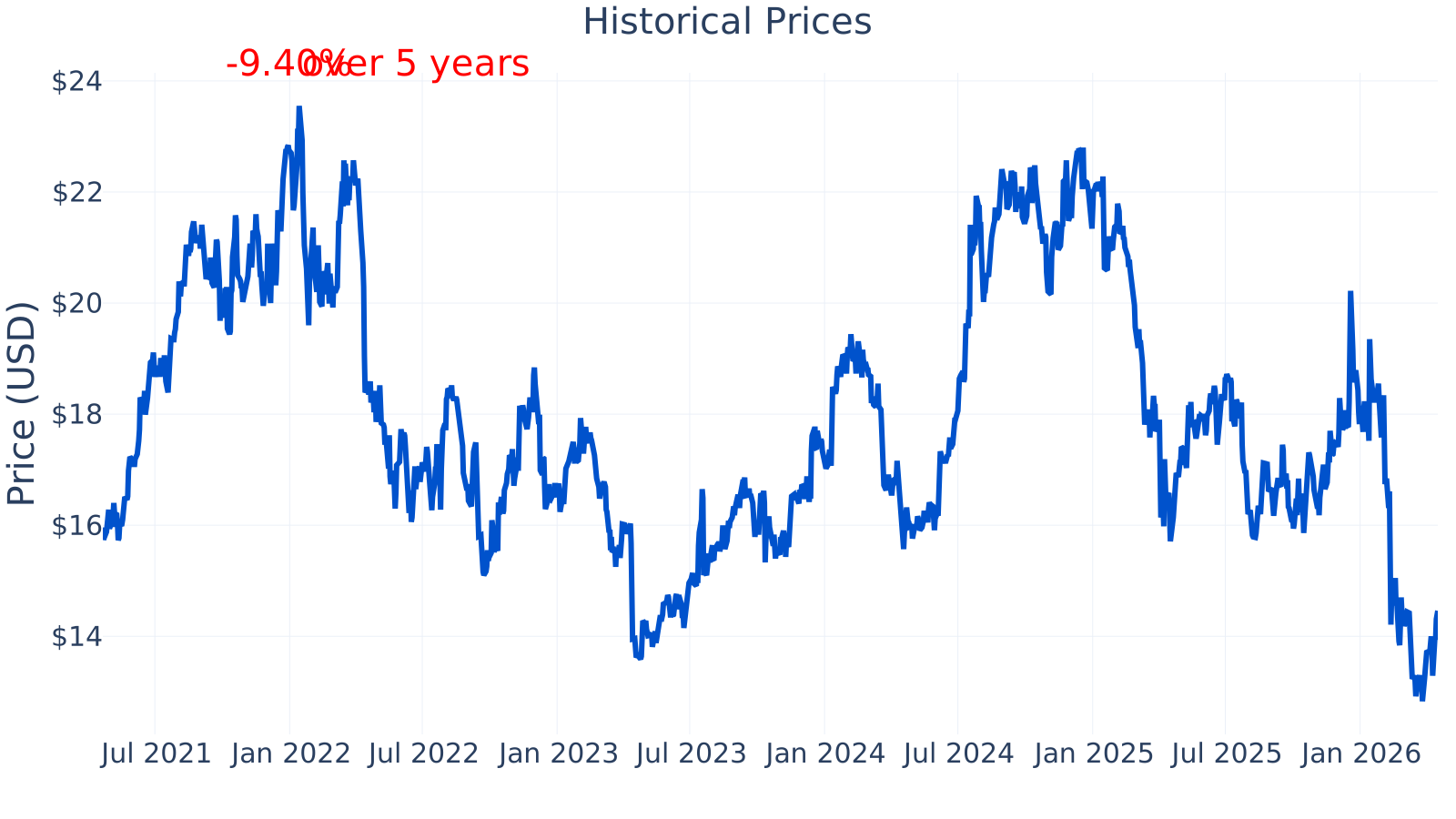
Overview
Infosys Ltd is a global information technology (IT) services company. In simple terms, it helps large organizations design, build, run, and modernize software and digital systems used to operate their businesses. This includes work such as migrating older systems to cloud platforms, improving cybersecurity, building data and analytics capabilities, and managing ongoing application support.
Infosys primarily earns revenue by delivering IT services to enterprise customers under long-term relationships and multi-year contracts. While the exact mix can change year to year, revenue is typically generated from a combination of consulting, software development and maintenance, system integration, outsourcing/managed services, and newer digital offerings (such as cloud and AI-related services).
When looking at how the business “flows,” a large share of revenue is spent on delivering services (largely employee and subcontractor costs), with the remainder covering operating expenses (such as sales and administration) and leaving a portion as operating profit and net income.
Across the years shown, total revenue rises overall (from about $16.3B to about $19.3B), while net income remains in a relatively steady band (roughly around $3.0B–$3.2B). That pattern is consistent with a mature IT services model where scale helps, but pricing and wage costs can keep profitability from expanding rapidly.
Key Figures
| Metric | Value | Industry ⓘ |
|---|---|---|
| Date | Apr 20, 2026 | |
| Context | ||
| Sector | Technology | |
| Industry | Information Technology Services | |
| Market Cap ⓘ | $58.51B | |
| Beta ⓘ | 0.20 | |
| Fundamental | ||
| P/E Ratio ⓘ | 18.78 | 18.40 |
| Profit Margin ⓘ | 16.15% | 5.35% |
| Revenue Growth ⓘ | 3.20% | 7.00% |
| Debt to Equity ⓘ | 10.59% | 52.83% |
| PEG ⓘ | 2.49 | |
| Free Cash Flow ⓘ | $3.80B | |
Infosys has a market capitalization of about $58.5B and a low beta (~0.20), which indicates the stock has historically moved less than the broader market. The P/E ratio is about 18.8, close to the industry median (~18.4). Profit margin is about 16.2%, which is notably higher than the industry median (~5.4%), suggesting stronger profitability than many peers in the same broad industry grouping. Year-over-year revenue growth is about 3.2%, below the industry median (~7.0%), pointing to slower recent top-line expansion. Debt-to-equity is about 10.6% versus an industry median around 52.8%, indicating comparatively low balance-sheet leverage. Trailing twelve-month free cash flow is about $3.8B, reflecting meaningful cash generation.
Growth (Medium)
Infosys operates in global IT services—an area supported by long-term trends such as cloud adoption, cybersecurity needs, data modernization, and the continuing push by enterprises to digitize processes and control costs through outsourcing. These themes can provide ongoing demand, even though spending can be cyclical when customers slow budgets during uncertain economic periods.
A key question for long-term growth is not whether companies need technology (they do), but how quickly large clients increase discretionary projects and how effectively Infosys wins and expands multi-year relationships versus other major service providers. In mature IT services, growth often depends on a mix of new client wins, expanding work with existing clients, and shifting toward higher-value offerings (for example, cloud transformation and AI-enabled delivery).
The year-over-year revenue growth trend shows a clear slowdown from very high growth rates earlier in the period (above 20%) to low single digits more recently (around 3%). This can be consistent with normalization after a strong demand cycle and a more cautious environment for enterprise IT spending. For a long-term view, the important point is whether growth stabilizes and re-accelerates with the next cycle of modernization programs.
Free cash flow over the periods shown fluctuates but is positive and, most recently, higher than earlier points (rising to about $4.15B by 2025-03-31 before showing about $3.8B as the latest trailing twelve-month figure). Consistent cash generation matters for resilience because it can support ongoing investment, dividends (if declared), and buybacks (if executed), while also helping the company navigate slower demand periods.
Risks (Medium)
Infosys’ biggest risks tend to come from the nature of IT services. Demand is closely tied to enterprise technology budgets; when customers delay projects, revenue growth can slow. Pricing pressure is another common challenge because many services are competitively bid, and large clients can negotiate aggressively. Since labor is a major cost, wage inflation and the ability to hire and retain skilled employees can also affect profitability.
Competition is strong. Infosys operates alongside other large global IT services and consulting firms. Key competitors commonly include Tata Consultancy Services (TCS), Wipro, HCLTech, Cognizant, Accenture, IBM (consulting/services), and Capgemini. In this landscape, long-term differentiation often comes from execution quality, customer relationships, delivery scale, domain expertise in specific industries, and the ability to move work toward higher-value transformation programs rather than lower-margin commoditized tasks.
One measurable strength versus many companies is leverage. Lower debt can reduce financial risk during downturns and provides flexibility if business conditions change.
The debt-to-equity ratio remains low across the timeline and is far below the industry median throughout (most recently about 10.6% versus an industry median near 64.8% at the latest point). This suggests the company relies less on borrowing than many peers, which can help limit pressure from interest costs and refinancing needs.
Profitability is another area to watch because it reflects pricing, delivery efficiency, and cost control. Even when revenue growth slows, stable margins can indicate an ability to manage costs and maintain service quality.
Profit margin trends gradually drift down from roughly 19% to around 16% over the period shown, but remain far above the industry median at each point. That combination—some margin compression but still a large gap versus the median—suggests Infosys has maintained relatively strong profitability compared with many peers, even as industry conditions changed.
Valuation
Valuation is often summarized using the price-to-earnings (P/E) ratio, which compares the stock price to the company’s earnings. A higher P/E can be justified by higher expected growth, lower risk, or stronger business quality; a lower P/E can reflect slower growth expectations, higher uncertainty, or weaker profitability.
Over the period shown, Infosys’ P/E ratio moves from higher levels (around the high-20s to low-30s earlier) to the low-to-mid 20s more recently, ending near ~23.7. Compared with the industry median series shown, Infosys’ P/E has often been similar to or below the median in many periods, with occasional times above it. The latest P/E (about 18.8 in the key figures snapshot) is close to the industry median (~18.4), which indicates the market is currently valuing Infosys roughly in line with its peer group on this measure.
With that context, the valuation picture looks closely tied to two counterbalancing fundamentals discussed earlier: slower recent revenue growth (which can limit multiple expansion) versus higher-than-median profitability and low leverage (which can support steadier earnings quality). The PEG ratio shown (~2.49) also implies that, relative to expected growth assumptions embedded in that metric, the price is not “cheap” purely on a growth-adjusted basis, though PEG should be treated cautiously because it depends heavily on growth estimates.
Conclusion
Infosys is a large, established IT services provider with meaningful scale, strong cash generation, and profitability that has remained well above the median of its industry group. Balance-sheet leverage appears low relative to peers, which can reduce financial strain during weaker cycles.
At the same time, recent revenue growth has slowed to low single digits, underscoring that business performance can be sensitive to enterprise spending cycles and competitive pricing pressure. The valuation metrics presented place Infosys broadly in line with industry norms on P/E, suggesting the market is not assigning an unusually high or unusually low earnings multiple relative to peers at this time.
Sources:
- Infosys Ltd — Annual Report (Investor Relations) — “Annual Report”
- SEC EDGAR — Infosys Ltd filings — “Form 20-F (Annual Report)”
- Infosys Investor Relations — “Quarterly / Annual Financial Results and Press Releases”
- Wikipedia — “Infosys”
This article is for informational purposes only and does not constitute financial advice. Some content is AI-generated. See Disclaimer


