Stock Analysis · Impinj Inc (PI)
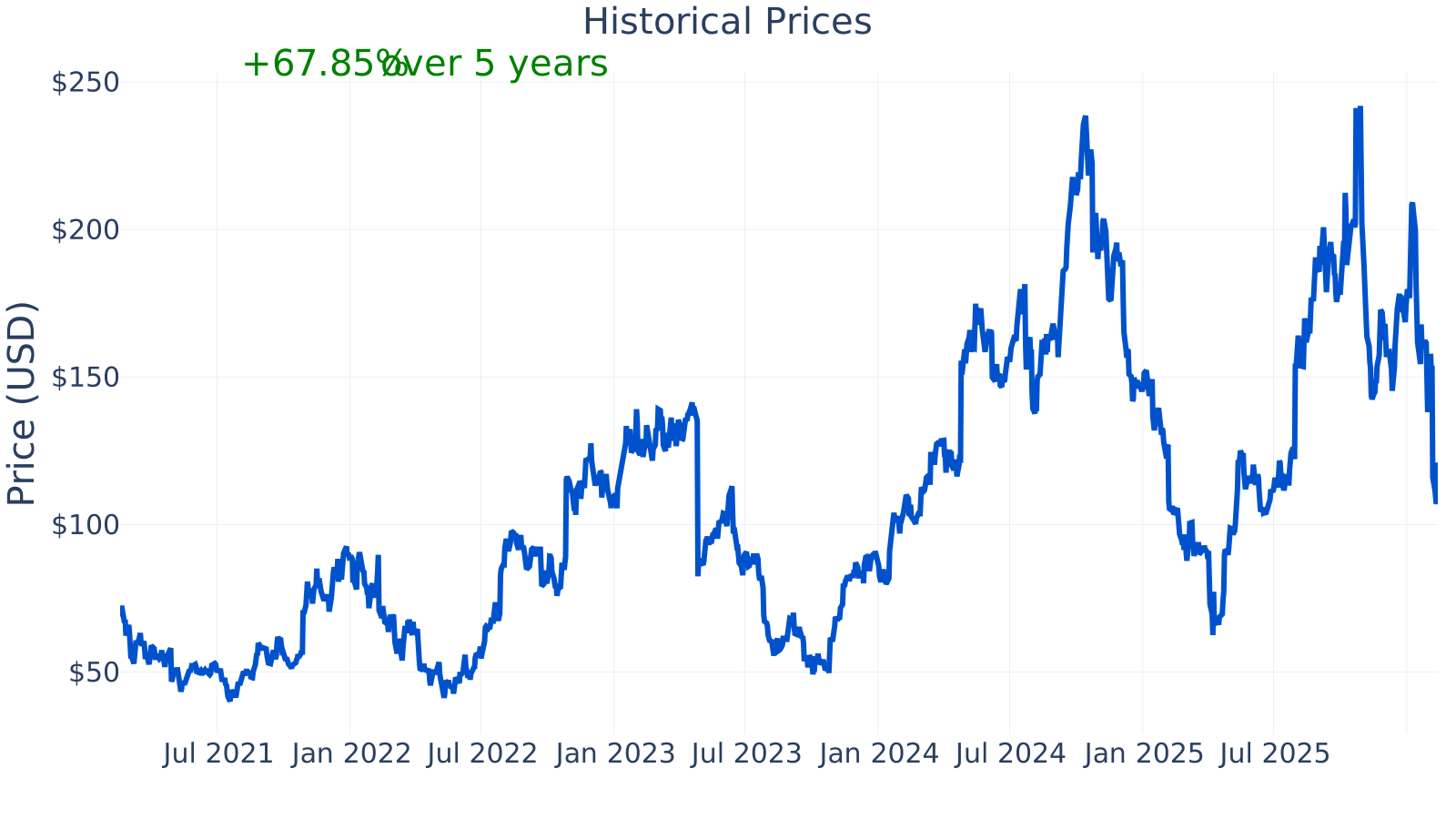
Overview
Impinj, Inc. (PI) is a semiconductor and systems company focused on making everyday items easier to identify, track, and manage using RAIN RFID technology. In simple terms, its products help businesses “digitize” physical goods—such as apparel, packages, medical supplies, or industrial components—so they can be found and counted quickly without direct line-of-sight scanning (unlike traditional barcodes).
The company’s core business is selling components and solutions used across the RAIN RFID ecosystem. This typically includes endpoint chips (placed in RFID tags), reader chips/modules (used inside devices that detect tags), and related software/services that help customers deploy and manage RFID systems. The end markets are often supply chain and logistics, retail inventory visibility, and other environments where fast, automated item tracking can reduce labor and errors.
In its financial reporting, Impinj commonly groups revenue into two broad categories:
- Endpoint ICs (chips used in RFID tags attached to items)
- Reader ICs (chips used in RFID readers and gateways that detect tags)
Percentages by category can shift over time depending on customer demand and product cycles; the company’s filings are the reliable reference for the latest mix and any additional details such as geographic/customer concentration.
Across the years shown, total revenue increased from about $190M (2021) to about $366M (2024), then was roughly flat around $361M (2025). Profitability also moved significantly: net income was negative in 2021–2023, turned positive in 2024, and returned slightly negative in 2025. Research and development spending stayed substantial (about $64M in 2021 rising to over $100M by 2025), highlighting an ongoing focus on new products and platform improvements.
Key Figures
| Metric | Value | Industry ⓘ |
|---|---|---|
| Date | Feb 16, 2026 | |
| Context | ||
| Sector | Technology | |
| Industry | Semiconductors | |
| Market Cap ⓘ | $3.66B | |
| Beta ⓘ | 1.54 | |
| Fundamental | ||
| P/E Ratio ⓘ | N/A | 45.38 |
| Profit Margin ⓘ | -3.00% | 10.84% |
| Revenue Growth ⓘ | 1.40% | 15.50% |
| Debt to Equity ⓘ | 156.16% | 25.62% |
| PEG ⓘ | N/A | |
| Free Cash Flow ⓘ | $45.88M | |
Impinj’s market capitalization is about $3.66B. The stock’s beta of ~1.54 indicates it has historically moved more than the broader market, which can translate into larger price swings in both directions.
On profitability, the latest profit margin shown is about -3.0%, below the semiconductor industry median of about 10.8%. Growth also looks muted in the most recent year-over-year snapshot: revenue growth is about 1.4% versus an industry median around 15.5%.
Balance-sheet leverage stands out: debt-to-equity is ~156%, much higher than the industry median near 25.6%. At the same time, trailing twelve-month free cash flow is positive at about $45.9M, which can help support operations and investment without relying solely on external financing.
Growth (Medium)
Impinj operates in a part of the technology market tied to automation and “item-level visibility.” The long-term direction of many large organizations—retailers, logistics providers, and manufacturers—has been toward better real-time inventory accuracy and faster processing. RAIN RFID is one approach used to achieve that, especially where scanning items one-by-one is too slow or too error-prone.
The company’s strategy is closely linked to expanding adoption of RAIN RFID across more categories and use cases, and to increasing content/value per deployment through improved chips and platform capabilities. Continued investment in research and development (visible in the income breakdown) supports that strategy, but it also means the business needs sufficient scale and gross profit to cover operating costs consistently.
Revenue growth has been volatile. It was very strong in parts of 2021–2023 (with multiple quarters showing large year-over-year increases), then turned negative across several quarters in 2023–2024, rebounded in mid-to-late 2024, and cooled again to low single digits by late 2025 (around 1.4% most recently). This pattern suggests demand can be cyclical and influenced by customer inventory corrections, broader semiconductor cycles, or the timing of large deployments.
Free cash flow improved meaningfully over time: it was negative in 2021–2023, turned positive in 2024 (about $20.1M), and increased further by 2025 (about $44.3M to $45.9M range depending on the endpoint). Positive free cash flow can be an important building block for long-term resilience, particularly for a company that is still working toward steadier profitability.
Risks (High)
A key risk is that profitability has not been consistently positive. While 2024 showed a meaningful improvement (including positive net income in the yearly breakdown), the latest profit margin snapshot returns to slightly negative. Businesses that alternate between profits and losses can face higher sensitivity to pricing, demand shifts, and operating expense discipline.
The profit margin trend improved dramatically from very negative levels in 2021–2022 (roughly -26% to -42% in earlier quarters) to briefly positive territory in parts of 2024 (peaking above 11% in late 2024), before slipping back to about -3% most recently. Compared with the semiconductor industry median (often mid-to-high single digits to low double digits in the periods shown), Impinj’s profitability has been more variable.
Another major consideration is leverage and capital structure.
Debt-to-equity is elevated (about 156% most recently) relative to the industry median (about 21%–36% across the periods shown). It has improved from extremely high levels seen in parts of 2022–2023, but it remains high versus peers. Higher leverage can reduce flexibility during downturns, especially in cyclical technology markets.
Competition risk is also material. Impinj participates in an ecosystem with multiple semiconductor vendors and solution providers. Competition can show up through pricing pressure, alternative chips for tags/readers, or customers designing systems with different architectures. Impinj’s potential competitive advantages are typically tied to specialized RFID expertise, product performance, and ecosystem relationships, but the durability of those advantages depends on continued innovation and customer adoption.
Main competitors and alternatives can include:
- Semiconductor providers offering RFID-related chips (tag/reader ICs) used in similar deployments
- RFID reader and infrastructure vendors that integrate chips into finished hardware and compete on total system performance/cost
- Alternative identification technologies (e.g., barcode-based systems or other wireless identification approaches) depending on use case and cost constraints
Because many customers buy through broader solution stacks, Impinj’s competitive position is influenced not only by its own products but also by how well the overall RAIN RFID ecosystem fits customer needs and budgets.
Valuation
Price-to-earnings (P/E) comparisons are less straightforward here because Impinj’s earnings have been inconsistent across the timeline. The P/E series shown includes many periods where the company P/E is not meaningful (displayed as 0), which typically happens when earnings are negative or otherwise not suitable for a standard P/E calculation.
When the P/E is meaningful, it has been high at times (for example, above 200 in late 2024 and around 74 in early 2025), compared with an industry median often in the teens to 40s range across the same periods (latest industry median shown is about 45.4). A high P/E can reflect expectations for strong future profit growth, but it can also create sensitivity if growth slows, margins compress, or profits do not scale as expected.
Given the combination of (1) uneven revenue growth lately, (2) profit margin volatility, and (3) above-industry leverage, valuation interpretation tends to hinge on whether the company can deliver sustained profitability and steadier growth through cycles, rather than on a single-period earnings multiple.
Conclusion
Impinj is focused on a clear theme: enabling large-scale item identification and tracking through RAIN RFID, with revenue largely tied to endpoint and reader chip products used across that ecosystem. Over the past several years, the business expanded revenue meaningfully from 2021 to 2024, then showed a flatter profile in 2025.
The long-term narrative is supported by ongoing demand for supply chain automation and inventory visibility, and by the company’s continued investment in research and development. At the same time, the financial profile shows notable variability: profit margins have swung from deeply negative to solidly positive and back to slightly negative, and leverage remains high compared with industry norms even though it has improved from prior extremes. Free cash flow has recently been positive, which is a constructive sign, but the durability of that improvement remains a key point to monitor alongside margins and revenue growth.
Sources:
- SEC EDGAR — Impinj, Inc. Form 10-K (Annual Report)
- SEC EDGAR — Impinj, Inc. Form 10-Q (Quarterly Reports)
- Impinj, Inc. Investor Relations — Quarterly and annual earnings releases (press releases)
- Impinj, Inc. Investor Relations — Earnings call materials / transcripts hosted by the company (when available)
- Wikipedia — “Impinj” (basic company background)
This article is for informational purposes only and does not constitute financial advice. Some content is AI-generated. See Disclaimer


