Stock Analysis · IPG Photonics Corporation (IPGP)
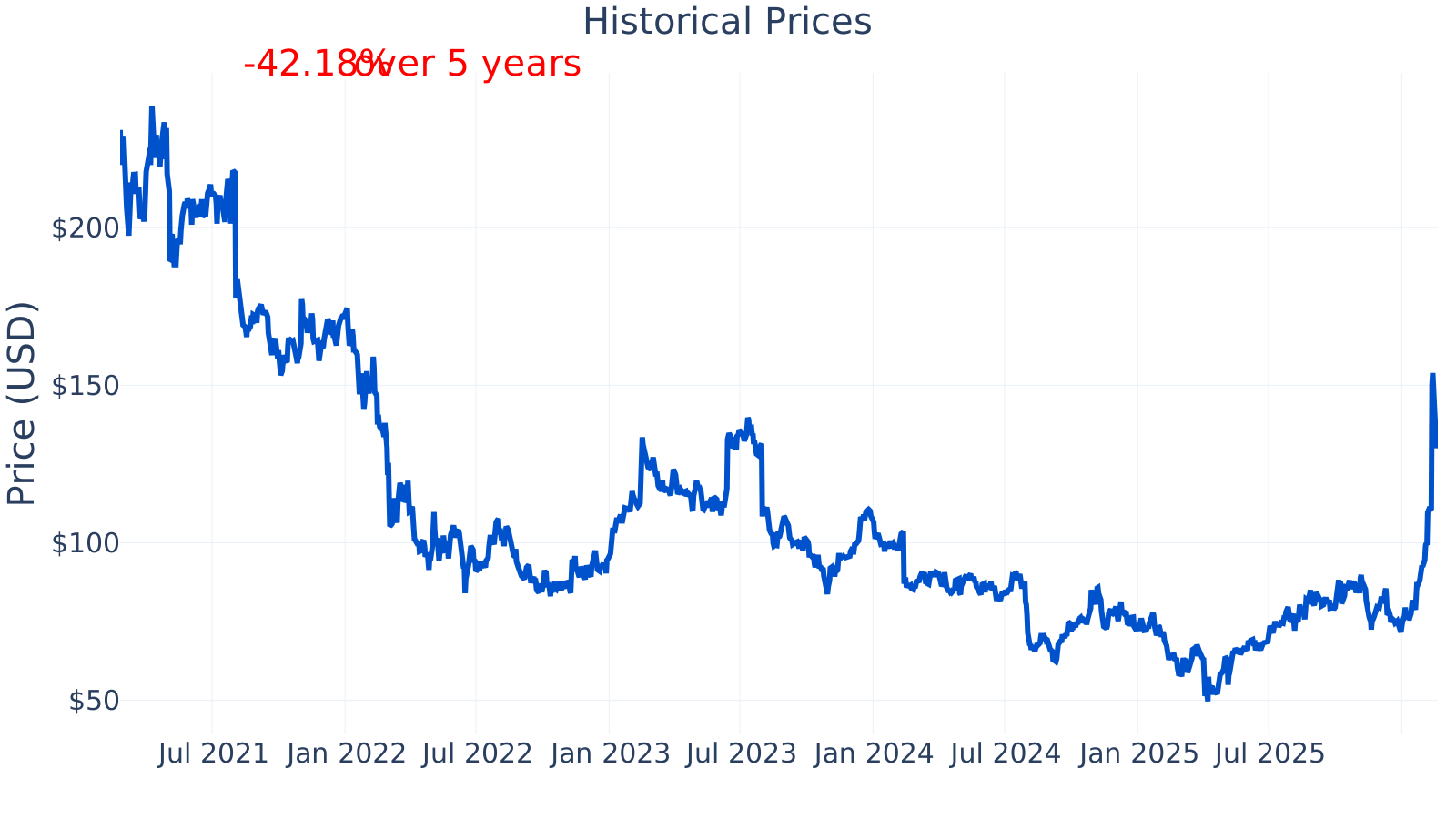
Overview
IPG Photonics Corporation (IPGP) designs and manufactures high-power fiber lasers and related laser systems. In simple terms, its products create very concentrated beams of light that industrial customers use as precise “tools” to cut, weld, mark, and process materials. The company sells both the laser sources (the core “engine”) and complete systems and components used in manufacturing environments.
IPG’s business is closely tied to industrial production and automation. Demand typically rises when manufacturers expand capacity or upgrade equipment, and it can slow when factory investment pauses. The company highlights a vertically integrated model (building many key components in-house), which can matter for cost control, product performance, and supply stability.
Main revenue streams are generally organized around:
- Laser sources (fiber lasers used in cutting, welding, and other industrial processes)
- Laser systems (more complete, application-ready machines built around lasers)
- Components and accessories (parts such as beam delivery, amplifiers, and other related items)
The exact percentages by category can vary by year and are typically detailed in the company’s annual report (Form 10‑K) under revenue disaggregation and segment discussion.
Over the 2021–2025 period shown, total revenue trends down overall (from about $1.46B in 2021 to about $1.00B in 2025), while spending on operating costs is less steady. Research and development remains a meaningful, recurring expense each year, and net income swings sharply, including a loss in 2024, followed by a return to a small profit in 2025.
Key Figures
| Metric | Value | Industry ⓘ |
|---|---|---|
| Date | Feb 23, 2026 | |
| Context | ||
| Sector | Technology | |
| Industry | Semiconductor Equipment & Materials | |
| Market Cap ⓘ | $5.63B | |
| Beta ⓘ | 1.03 | |
| Fundamental | ||
| P/E Ratio ⓘ | 183.04 | 49.76 |
| Profit Margin ⓘ | 3.10% | 7.37% |
| Revenue Growth ⓘ | 17.10% | 7.20% |
| Debt to Equity ⓘ | 0.82% | 20.49% |
| PEG ⓘ | 2.52 | |
| Free Cash Flow ⓘ | -$3.45M | |
At the latest point shown, IPG Photonics has a market capitalization of about $5.6B and a beta near 1.03, indicating price moves that have been roughly similar to the broader market on average. The company’s P/E ratio is ~183, which is far above the industry median (~50), while its profit margin is ~3.1%, below the industry median (~7.4%). On the other hand, year-over-year revenue growth is ~17.1%, above the industry median (~7.2%). Balance sheet leverage appears very low with debt-to-equity near 0.8% versus an industry median around 20.5%. Free cash flow over the trailing twelve months is slightly negative (about -$3.5M).
Growth (Medium)
IPG operates in industrial photonics, which is linked to long-term themes such as factory automation, precision manufacturing, and the shift toward more efficient production methods. Fiber lasers have been widely adopted in many metal-processing tasks because they can offer high precision and efficiency, but end-market demand still tends to follow capital spending cycles in manufacturing.
From a strategy perspective, IPG’s growth efforts typically center on broadening laser-based applications (for example, expanding beyond core cutting into welding and other processes), improving total cost of ownership for customers (energy efficiency, uptime, maintenance), and selling more complete solutions rather than only components. These approaches can support longer-run demand if laser-based processing continues to replace or upgrade older manufacturing methods.
The pattern shown is cyclical: strong positive growth in 2021, then a prolonged period of negative year-over-year comparisons through much of 2022–2024, followed by improvement and a return to positive growth by late 2025 (about +17%). This kind of swing often reflects industrial order cycles rather than smooth, steady expansion.
Free cash flow remains positive in most periods shown (hundreds of millions in earlier years), but it declines over time and becomes slightly negative in the most recent trailing period displayed. For an equipment-oriented industrial technology company, free cash flow can be sensitive to profit margins, inventory changes, and capital expenditures, so the direction here suggests reduced cash generation compared with earlier years.
Potential catalysts (in a neutral, factual sense) are typically tied to a rebound in industrial capital spending, increased adoption of advanced welding and other laser applications, and improved operating efficiency (for example, better absorption of fixed costs when volumes rise). The company’s filings also commonly discuss product development as a way to enter or expand application areas, which can matter if those areas scale.
Risks (High)
The largest practical risk for IPG is that results can be highly sensitive to manufacturing investment cycles. When customers delay factory upgrades or reduce production capacity spending, laser orders can weaken quickly. This can pressure revenue, profitability, and cash generation, especially if fixed costs (facilities, engineering, support) do not fall as fast as sales.
Competition is another key issue. Industrial lasers and laser systems are sold in global markets where customers compare performance, reliability, service, and total cost. IPG has historically been viewed as a major player in fiber lasers, but competition includes other laser and industrial technology providers such as TRUMPF, Coherent, and nLIGHT, as well as additional specialized firms and lower-cost manufacturers in some segments. Competitive pressure can show up as pricing challenges, the need for higher R&D spending, or slower market share gains.
Financial leverage appears very low and consistently below the industry median across the timeline. A debt-to-equity level under 1% (versus an industry median that is often around the high teens to low twenties percent range) can reduce refinancing risk and interest burden, but it does not remove operational risk from weaker demand or margin compression.
Profitability is the most visible risk signal in the period shown. Profit margins were solid through 2021–2022 (roughly mid-to-high teens), then deteriorated sharply, turning negative during 2024 and much of 2025, before recovering to a low single-digit positive level by the end of 2025 (about 3.1%). Compared with the industry median near 7%, that indicates recent underperformance in profitability, which can matter because valuation and long-term compounding are often sensitive to sustained margins.
Additional risks commonly described in company filings for global manufacturers include customer concentration (if a small number of large buyers represent a meaningful share of sales), supply chain and manufacturing execution (quality, yields, lead times), foreign currency effects, and geopolitical/regulatory constraints that can affect cross-border sales or operations.
Valuation
The latest P/E ratio shown for IPG is about 183, well above the industry median of about 50. A high P/E can occur when earnings are temporarily depressed (making the denominator small), when the market expects a strong earnings recovery, or when investors assign a premium for perceived quality and long-term potential. In IPG’s case, the recent margin compression and periods of losses help explain why the P/E can look unusually elevated or distorted at certain points.
Over time, the chart indicates IPG’s P/E has moved widely, at times dropping below the industry median (for example, around early-to-mid 2024) and at other times rising far above it. Because recent profitability has been volatile, a single-point P/E can be a less stable measure than it would be for a company with steady earnings. In this context, valuation interpretation tends to depend heavily on whether margins and earnings normalize, and how durable any recovery proves to be.
Conclusion
IPG Photonics is an industrial technology company focused on fiber lasers and laser-based manufacturing solutions. The business participates in long-term automation and precision-manufacturing trends, but its results have shown clear cyclicality, with revenue declining from 2021 levels and profitability weakening sharply before stabilizing at a low level most recently.
From a fundamentals perspective, the company’s balance sheet leverage appears very low, which can be a stabilizing factor. At the same time, recent profit margins and free cash flow trends indicate that operational performance has been under pressure. The valuation picture is mixed: the current P/E appears high versus the industry median, but that metric is strongly affected by unusually low or volatile earnings. Overall, the long-term picture hinges on how effectively IPG can restore and sustain healthier margins while participating in future industrial demand cycles.
Sources:
- SEC EDGAR — IPG Photonics Corporation filings (Form 10‑K, Form 10‑Q)
- IPG Photonics Corporation — Investor Relations materials (Annual Report and shareholder information)
- Wikipedia — “IPG Photonics” (basic company background)
This article is for informational purposes only and does not constitute financial advice. Some content is AI-generated. See Disclaimer


