Stock Analysis · IPG Photonics Corporation (IPGP)
Overview
IPG Photonics Corporation (IPGP) designs and manufactures high-power fiber lasers and related laser systems. In simple terms, its products create very concentrated beams of light that industrial customers use as precise “tools” to cut, weld, mark, and process materials. The company sells both the laser sources (the core “engine”) and complete systems and components used in manufacturing environments.
IPG’s business is closely tied to industrial production and automation. Demand typically rises when manufacturers expand capacity or upgrade equipment, and it can slow when factory investment pauses. The company highlights a vertically integrated model (building many key components in-house), which can matter for cost control, product performance, and supply stability.
Main revenue streams are generally organized around:
- Laser sources (fiber lasers used in cutting, welding, and other industrial processes)
- Laser systems (more complete, application-ready machines built around lasers)
- Components and accessories (parts such as beam delivery, amplifiers, and other related items)
The exact percentages by category can vary by year and are typically detailed in the company’s annual report (Form 10‑K) under revenue disaggregation and segment discussion.
Over the 2021–2025 period shown, total revenue trends down overall (from about $1.46B in 2021 to about $1.00B in 2025), while spending on operating costs is less steady. Research and development remains a meaningful, recurring expense each year, and net income swings sharply, including a loss in 2024, followed by a return to a small profit in 2025.
Key Figures
| Metric | Value | Industry ⓘ |
|---|---|---|
| Date | Feb 23, 2026 | |
| Context | ||
| Sector | Technology | |
| Industry | Semiconductor Equipment & Materials | |
| Market Cap ⓘ | $5.63B | |
| Beta ⓘ | 1.03 | |
| Fundamental | ||
| P/E Ratio ⓘ | 183.04 | 49.76 |
| Profit Margin ⓘ | 3.10% | 7.37% |
| Revenue Growth ⓘ | 17.10% | 7.20% |
| Debt to Equity ⓘ | 0.82% | 20.49% |
| PEG ⓘ | 2.52 | |
| Free Cash Flow ⓘ | -$3.45M | |
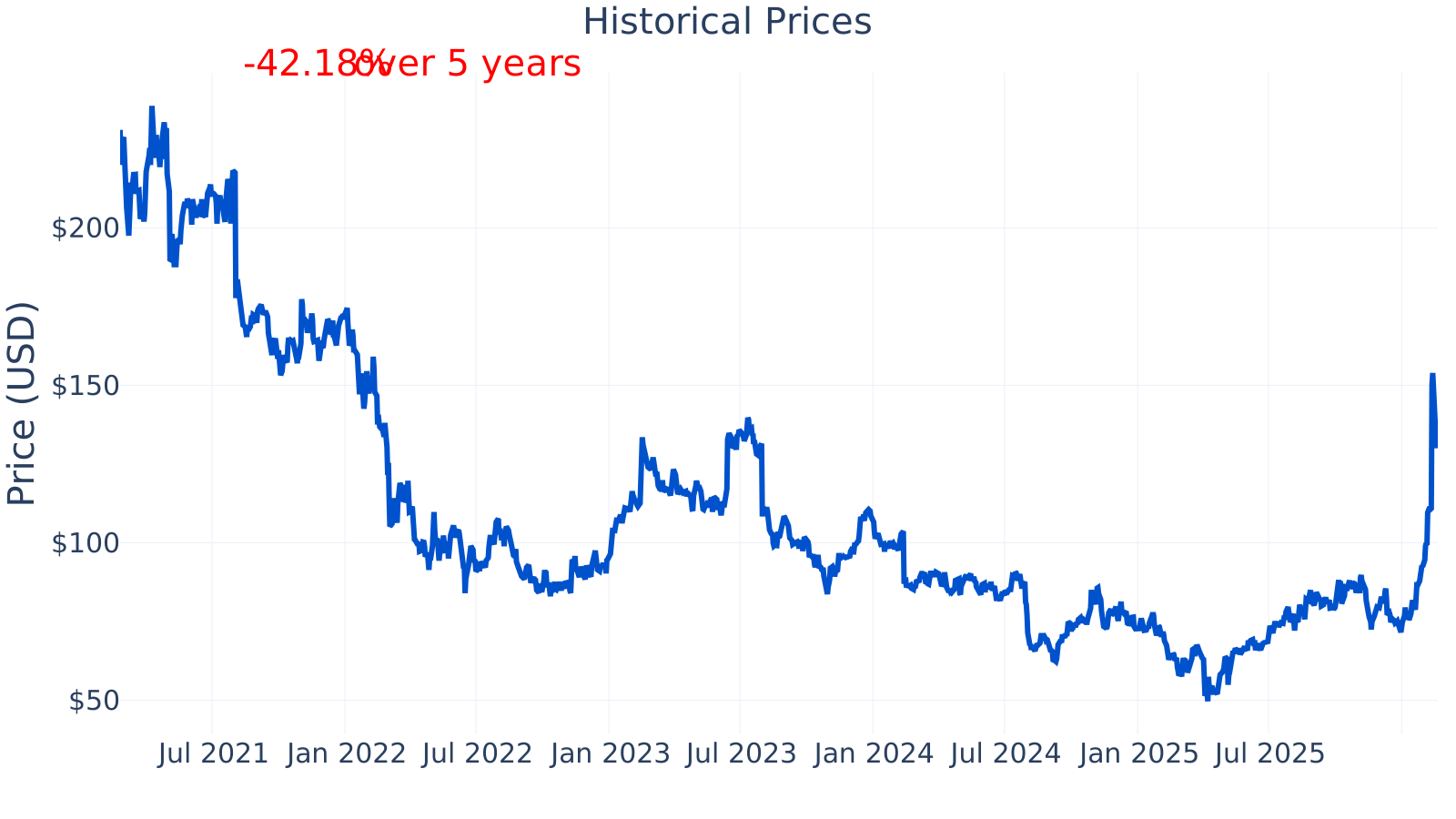
At the latest point shown, IPG Photonics has a market capitalization of about $5.6B and a beta near 1.03, indicating price moves that have been roughly similar to the broader market on average. The company’s P/E ratio is ~183, which is far above the industry median (~50), while its profit margin is ~3.1%, below the industry median (~7.4%). On the other hand, year-over-year revenue growth is ~17.1%, above the industry median (~7.2%). Balance sheet leverage appears very low with debt-to-equity near 0.8% versus an industry median around 20.5%. Free cash flow over the trailing twelve months is slightly negative (about -$3.5M).
Growth (Medium)
IPG operates in industrial photonics, which is linked to long-term themes such as factory automation, precision manufacturing, and the shift toward more efficient production methods. Fiber lasers have been widely adopted in many metal-processing tasks because they can offer high precision and efficiency, but end-market demand still tends to follow capital spending cycles in manufacturing.
From a strategy perspective, IPG’s growth efforts typically center on broadening laser-based applications (for example, expanding beyond core cutting into welding and other processes), improving total cost of ownership for customers (energy efficiency, uptime, maintenance), and selling more complete solutions rather than only components. These approaches can support longer-run demand if laser-based processing continues to replace or upgrade older manufacturing methods.
The pattern shown is cyclical: strong positive growth in 2021, then a prolonged period of negative year-over-year comparisons through much of 2022–2024, followed by improvement and a return to positive growth by late 2025 (about +17%). This kind of swing often reflects industrial order cycles rather than smooth, steady expansion.
Free cash flow remains positive in most periods shown (hundreds of millions in earlier years), but it declines over time and becomes slightly negative in the most recent trailing period displayed. For an equipment-oriented industrial technology company, free cash flow can be sensitive to profit margins, inventory changes, and capital expenditures, so the direction here suggests reduced cash generation compared with earlier years.
Potential catalysts (in a neutral, factual sense) are typically tied to a rebound in industrial capital spending, increased adoption of advanced welding and other laser applications, and improved operating efficiency (for example, better absorption of fixed costs when volumes rise). The company’s filings also commonly discuss product development as a way to enter or expand application areas, which can matter if those areas scale.
Risks (High)
This article is for informational purposes only and does not constitute financial advice. Some content is AI-generated. See Disclaimer