Stock Analysis · IDT Corporation (IDT)
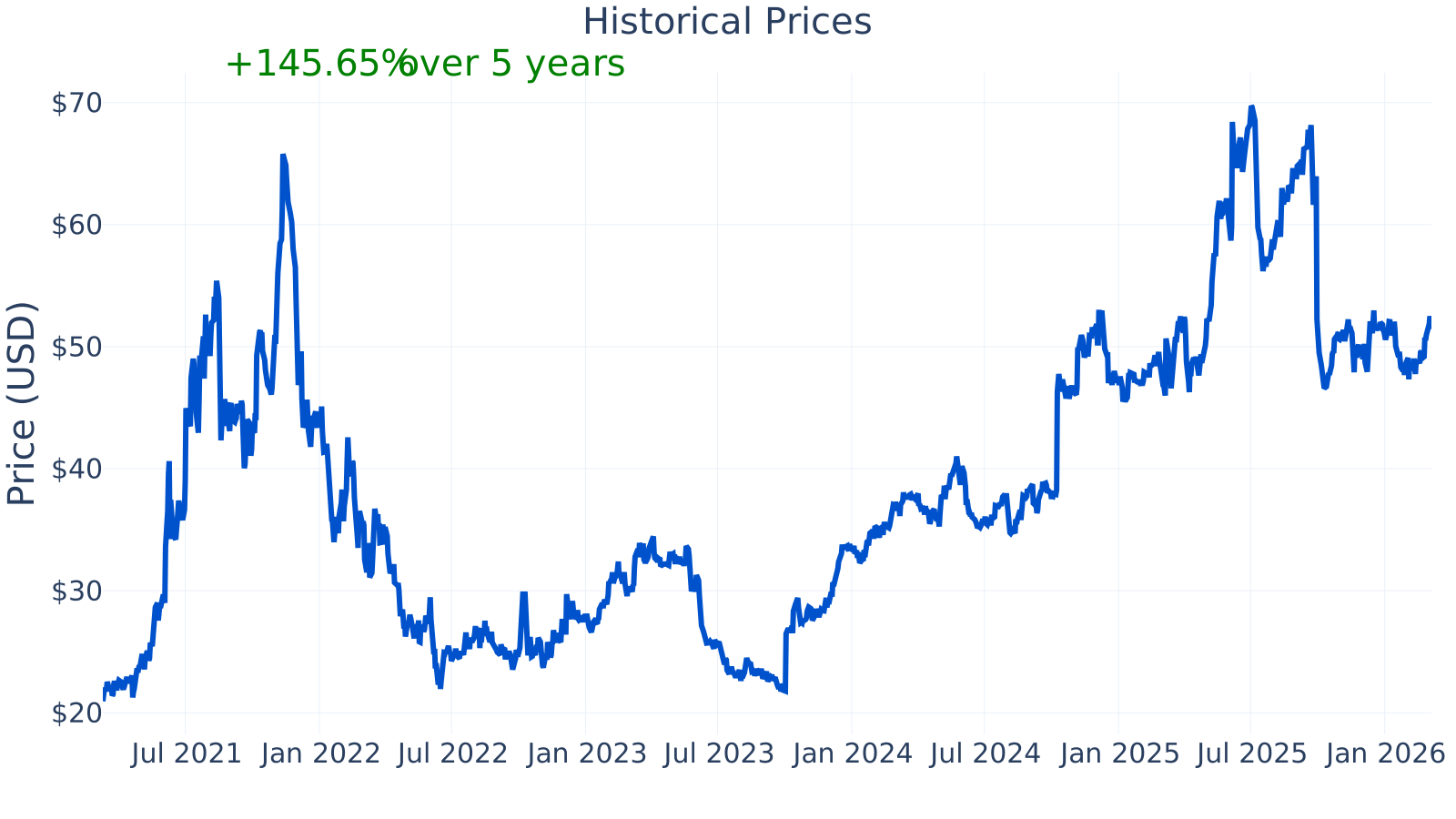
Overview
IDT Corporation is a telecommunications and communications-services company. Its businesses focus on helping people and organizations communicate and transact, including international calling and messaging, mobile top-up and payment-related services, and other telecom offerings. The company operates through multiple subsidiaries/brands, and it also has interests in other businesses that can affect results over time.
In broad terms, IDT’s revenue is primarily generated by communication services where customers pay for usage (for example, calling minutes or messaging) and by transaction-based services (for example, mobile top-up and related payments). The mix can shift over time as usage patterns, pricing, and product emphasis change.
Main revenue sources (high-level, based on how telecom service companies like IDT typically report their lines of business in SEC filings; percentages may vary by period and are not included here because they depend on the specific fiscal-year segment breakdown in filings):
- International communication services (calling/messaging-related services)
- Mobile top-up and other transaction-based services (often tied to international customers and cross-border usage)
- Other telecom-related services and corporate/other items (smaller and more variable)
Over the past several fiscal years shown, total revenue trended lower from FY2021 to FY2024 and then stabilized/improved slightly in FY2025. At the same time, gross profit and operating income improved versus FY2023–FY2024 levels, which suggests that the company’s profitability was supported not only by revenue, but also by cost structure and/or product mix.
Key Figures
| Metric | Value | Industry ⓘ |
|---|---|---|
| Date | Mar 09, 2026 | |
| Context | ||
| Sector | Communication Services | |
| Industry | Telecom Services | |
| Market Cap ⓘ | $1.29B | |
| Beta ⓘ | 0.77 | |
| Fundamental | ||
| P/E Ratio ⓘ | 17.10 | 15.61 |
| Profit Margin ⓘ | 6.18% | 6.34% |
| Revenue Growth ⓘ | 2.50% | 2.25% |
| Debt to Equity ⓘ | 0.82% | 119.24% |
| PEG ⓘ | 1.42 | |
| Free Cash Flow ⓘ | $95.44M | |
IDT’s market capitalization is about $1.29B. The stock’s beta of ~0.77 indicates it has historically moved less than the broader market on average (though that can change, and smaller companies can still be volatile). The company’s P/E ratio is ~17.1, slightly above the industry median (~15.6). Profit margin is about 6.18%, close to the industry median (~6.34%). Year-over-year revenue growth is about 2.5%, slightly above the industry median (~2.25%). A notable balance-sheet point is very low debt-to-equity (~0.8%) versus a much higher industry median (~119%), indicating comparatively limited leverage. Trailing twelve-month free cash flow is about $95.4M.
Growth (Medium)
IDT operates in parts of the communications market that tend to be mature overall (telecom services), but with pockets of continued activity tied to international connectivity, cross-border communication needs, and transaction-based services such as mobile top-up. Industry growth is often shaped by competition, pricing pressure, and changing customer behavior (for example, consumers shifting from traditional calling to app-based communication). That mix can cap growth in some legacy areas while supporting growth in adjacent services.
A practical way to view IDT’s recent growth profile is that revenue momentum weakened for a period and then improved recently. This kind of pattern can occur when a company is cycling through pricing changes, product mix shifts, or competitive dynamics, while trying to expand offerings that can grow faster than legacy products.
The year-over-year revenue growth trend shows an extended stretch of negative growth (through much of 2022–early 2024), followed by a return to modestly positive growth. The most recent reading is about 4.26% year-over-year, which is a meaningful improvement compared with the earlier negative period, but still points to a business that is currently growing at a moderate pace rather than at high rates.
Free cash flow (cash generated after operating needs and capital spending) rose over the period shown, from roughly $35.7M (FY2022) to about $38.6M (FY2025) in the annual points provided, while the latest trailing figure is about $95.4M. If sustained, stronger cash generation can give a company more flexibility for reinvestment, acquisitions, debt reduction, or other corporate purposes, but the key question for long-term evaluation is whether that level is repeatable across cycles.
Risks (Medium)
IDT’s risks are closely tied to competitive pressure and changing communication habits. In international calling and related services, competition can be intense and pricing can move quickly. Consumer behavior also continues shifting toward internet-based communication platforms, which can reduce demand for some traditional telecom offerings and force providers to adapt their product mix.
Financial leverage appears to be a relative strength: the latest debt-to-equity is about 0.8%, far below the industry median (about 119%). The trend over time shows the ratio is usually low, with a notable temporary spike in one period before returning to very low levels. Lower leverage can reduce refinancing risk and interest-cost pressure, though it does not remove operational and competitive risks.
Profitability has fluctuated. Profit margin dipped to low single digits at points (around 2022), then improved meaningfully, with several recent periods around the mid-to-high single digits. The latest margin shown is about 6.52%, slightly below the industry median (~7.77%) for that same point, indicating performance broadly in line with peers rather than dramatically above them.
Competitive positioning depends on the specific product line. IDT is not a nationwide “big carrier” in the way large U.S. telecom operators are; instead, it competes in more specialized niches such as international calling, messaging, and top-up/transaction services. Competitors can include:
- Large telecom carriers (indirect competition through bundled plans and international add-ons)
- App-based communication platforms (substitutes that can reduce traditional calling usage)
- Other international calling, messaging, and mobile top-up providers competing primarily on price, coverage, and distribution
Where IDT can differentiate is typically through distribution relationships, pricing execution, service reliability, and the ability to bundle or cross-sell adjacent services. Whether those factors create durable advantages depends on how easily competitors can replicate them and how quickly customer preferences evolve.
Valuation
IDT’s current P/E ratio is about 17.1, compared with an industry median around 15.6. Historically, the company’s P/E has moved across a range, at times below and at times above industry medians, reflecting shifting expectations about earnings stability and growth. A P/E in the high teens generally implies the market is assigning value to ongoing profitability, with some expectation of continued earnings power rather than a distressed or deeply cyclical profile.
Whether the price level is “expensive” or “cheap” cannot be determined from P/E alone. For a company with modest recent revenue growth but improving margins and strong cash flow, valuation often hinges on (1) whether revenue growth can stay positive, (2) whether margins and cash generation are sustainable, and (3) how much competitive pressure limits long-term pricing power. The relatively low leverage reduces one category of risk, but business-line disruption and competitive dynamics remain key drivers of what multiples the market is willing to assign over time.
Conclusion
IDT is a communications-services company with a business mix that includes international communication and transaction-oriented services. The recent profile shows modestly positive revenue growth after a period of declines, improving profitability compared with earlier lows, and strong free cash flow, alongside a notably low-debt balance sheet relative to peers.
The main open questions for long-term evaluation are less about near-term solvency (given low leverage) and more about business durability: the pace of change in communication habits, the intensity of price competition in international services, and whether IDT’s product mix can keep shifting toward offerings that can grow and defend margins. In that context, the current earnings multiple in the high teens appears consistent with a business that is profitable and cash-generative, but still exposed to competitive and industry-structure risks.
Sources:
- SEC EDGAR — IDT Corporation Form 10-K (Annual Report)
- SEC EDGAR — IDT Corporation Form 10-Q (Quarterly Report)
- IDT Corporation — Investor Relations materials and press releases (company website)
- Wikipedia — “IDT Corporation” (basic company background)
This article is for informational purposes only and does not constitute financial advice. Some content is AI-generated. See Disclaimer


