Stock Analysis · IDT Corporation (IDT)
Overview
IDT Corporation is a communications company that operates several consumer and business services, with a history in telecom. Across its businesses, IDT focuses on enabling people and organizations to connect, pay, and communicate—often serving customers who value simple, low-friction services (for example, international calling and related communications offerings) as well as other communications-adjacent products.
In its SEC filings, IDT reports results through operating segments. Revenue is generated primarily from communications services (including international calling and related products) and other segment activities described in the company’s annual report. Segment mix can change over time as products mature and as IDT invests in or exits initiatives.
Main revenue sources are best understood through the company’s reported segments (listed from largest to smaller based on typical historical emphasis in filings; exact percentages can vary by fiscal year):
- Consumer communications (including international calling and related services)
- Business-to-business communications / platforms (connectivity and related offerings)
- Other segment activities as reported in filings (may include newer initiatives and corporate items depending on the period)
The visual below summarizes how revenue turns into profit over time (sales, major costs, operating expenses, and bottom-line earnings).
Over the periods shown, total revenue trends downward from about $1.45B (FY 2021) to about $1.23B (FY 2025), while operating income and net income improved versus some earlier years. That pattern is consistent with a company working to improve efficiency and profitability even without strong top-line expansion.
Key Figures
| Metric | Value | Industry ⓘ |
|---|---|---|
| Date | Feb 08, 2026 | |
| Context | ||
| Sector | Communication Services | |
| Industry | Telecom Services | |
| Market Cap ⓘ | $1.29B | |
| Beta ⓘ | 0.77 | |
| Fundamental | ||
| P/E Ratio ⓘ | 17.10 | 15.18 |
| Profit Margin ⓘ | 6.18% | 6.18% |
| Revenue Growth ⓘ | 2.50% | 2.10% |
| Debt to Equity ⓘ | 0.28% | 113.97% |
| PEG ⓘ | N/A | |
| Free Cash Flow ⓘ | $95.44M | |
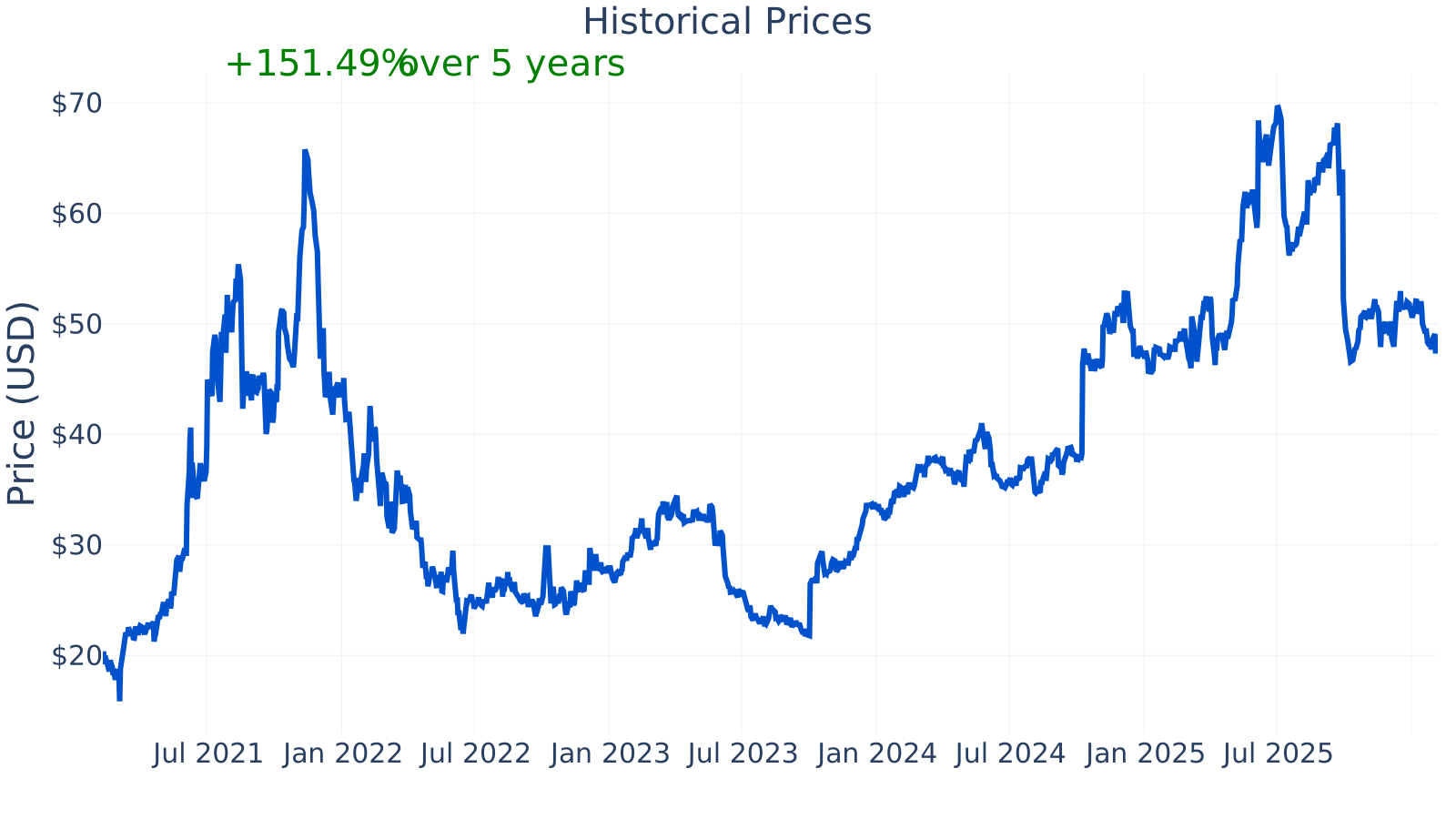
IDT’s market capitalization is about $1.29B and the stock’s beta (~0.77) suggests it has historically moved less than the overall market on average (though this can change). The company’s P/E ratio (~17.1) is modestly above the industry median (~15.2) based on the peer set shown.
Profitability is currently near the industry median, with a profit margin of ~6.18%. Recent year-over-year revenue growth is ~2.5%, slightly above the industry median (~2.1%). One of the most notable balance-sheet items is leverage: debt-to-equity is ~0.28% versus an industry median above 100%, indicating very low debt relative to equity.
Free cash flow over the trailing twelve months is about $95.4M, which matters for long-term durability because it represents cash generated after operating needs and capital spending (and can support reinvestment, debt reduction, or other corporate uses).
Growth (Medium)
IDT operates in the broad communications services landscape, which tends to be mature overall. Parts of this space can still grow—especially where offerings are digital, software-driven, or tied to ongoing changes in how people communicate and pay—but traditional voice and calling-related products can face long-term pressure from internet-based alternatives and intense price competition.
The year-over-year revenue growth profile shows a long stretch of negative comparisons through much of 2022 and 2023, followed by stabilization and a return to modest growth in 2024–2025 (ending around +4.26% in the most recent point shown). For a long-term view, this suggests that the company’s recent operating period has been more about improving execution and regaining steadier demand rather than delivering rapid expansion.
Free cash flow has been positive in each period shown and generally improved versus earlier points (from roughly $35.7M in early 2022 to roughly $38.6M in early 2025, with the latest trailing-twelve-month figure in the table at $95.4M). Sustained cash generation can act as a practical “growth enabler” because it can fund product development and operational investment without relying heavily on borrowing.
Potential catalysts for improved long-term results typically depend on (1) sustained stabilization in core communications revenue, (2) successful scaling of newer or higher-margin initiatives reported within its segments, and (3) continued cost discipline that protects margins even if pricing remains competitive.
Risks (Medium)
This article is for informational purposes only and does not constitute financial advice. Some content is AI-generated. See Disclaimer


