Stock Analysis · IAC Inc (IAC)
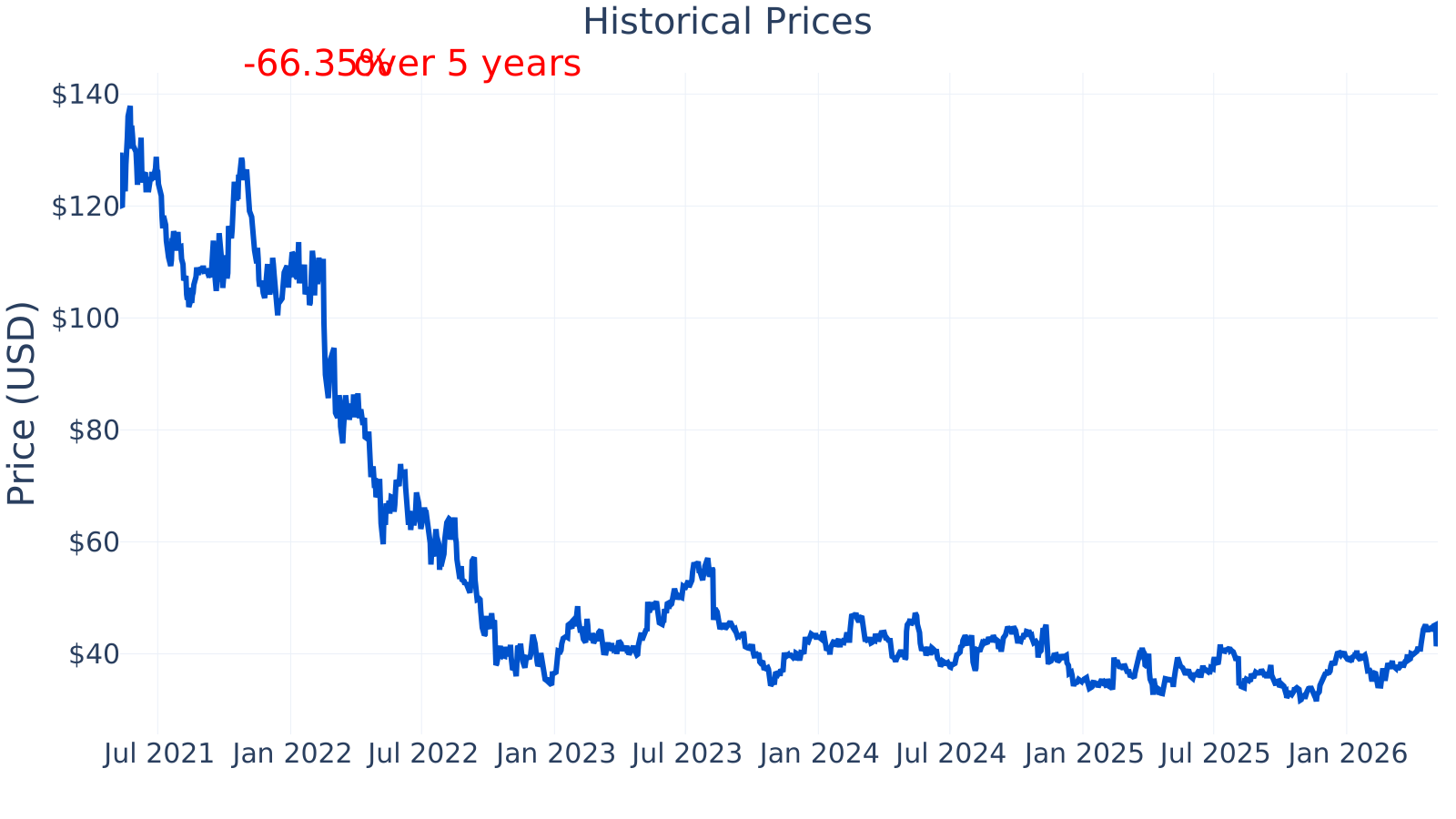
Overview
IAC Inc is a holding company that builds, operates, and invests in consumer internet and digital service businesses. Over time, IAC has been known for owning and incubating a portfolio of brands, sometimes spinning businesses out or separating them as they mature. This structure means the company’s financial results can change meaningfully depending on what is currently owned, what has been sold, and which businesses are being scaled.
In general terms, IAC’s revenue comes from subscription-based and transaction-based consumer services, plus advertising in some products. The company reports revenue by operating segments in its SEC filings; the mix can shift as the portfolio evolves.
Main revenue sources (typical for IAC’s business model, with exact splits depending on the latest reported segments):
- Subscriptions (recurring payments for access to premium features or services)
- Transaction revenue (fees tied to user actions such as purchases, bookings, or referrals)
- Advertising and marketing revenue (monetization of audience and traffic, where applicable)
Across recent years, total revenue has moved lower from earlier levels (for example, about $5.24B in 2022 to about $2.39B in 2025), while profitability has also swung between profitable and loss-making years. This pattern is consistent with a portfolio business where ownership changes, restructuring, and investment cycles can heavily influence reported results.
Key Figures
| Metric | Value | Industry ⓘ |
|---|---|---|
| Date | May 08, 2026 | |
| Context | ||
| Sector | Communication Services | |
| Industry | Internet Content & Information | |
| Market Cap ⓘ | $3.21B | |
| Beta ⓘ | 1.07 | |
| Fundamental | ||
| P/E Ratio ⓘ | 26.45 | 16.25 |
| Profit Margin ⓘ | 1.75% | 9.94% |
| Revenue Growth ⓘ | -12.20% | 6.40% |
| Debt to Equity ⓘ | 31.22% | 10.97% |
| PEG ⓘ | 12.91 | |
| Free Cash Flow ⓘ | $59.61M | |
IAC’s latest market capitalization is about $3.2B, and its beta of ~1.07 suggests price movements have been broadly similar to the overall market. The company’s P/E ratio is ~26.5, above the industry median (~16.2), while profit margin is ~1.8%, well below the industry median (~9.9%). The latest year-over-year revenue growth is about -12.2% versus an industry median of roughly +6.4%. Debt-to-equity is about 31% compared with an industry median near 11%. Trailing twelve-month free cash flow is about $59.6M.
Growth (Medium)
IAC operates in internet-based consumer services, which is a broad area that has long-term demand tailwinds: people continue shifting discovery, shopping, and subscription spending toward digital products. That said, within “internet content & information,” growth can be uneven because user acquisition costs, platform algorithm changes, and competition can quickly reshape which products win.
A key part of IAC’s strategy is portfolio management: incubating and scaling businesses, investing behind product development and marketing, and reshaping the mix over time. For future growth, the main question is whether the current set of businesses can return to sustained revenue expansion while also improving margins (rather than relying on one-time portfolio actions).
Revenue growth has been negative for an extended stretch after strong growth in 2021–2022. The most recent reading shows revenue down about 25.9% year over year (latest quarter shown), and the latest metric snapshot shows about -12.2%. This indicates that, at least recently, the company has been operating in a contraction phase rather than an expansion phase.
Free cash flow improved sharply from negative levels in 2022–2023 to positive in 2024–2025, but the latest trailing twelve-month value is about $59.6M, down from a higher level around $258.1M previously. In plain terms, cash generation has been positive recently, but it has also been volatile—something long-term shareholders often monitor closely for businesses that reinvest heavily.
Risks (High)
IAC’s biggest risk is that results can be highly variable because the company’s portfolio changes and because many consumer internet models depend on sustained user growth and efficient marketing spend. When customer acquisition becomes more expensive or engagement weakens, revenue can fall quickly, while costs (product development, staff, and marketing infrastructure) can be slow to adjust.
Debt-to-equity is about 31%, above the industry median near 11%. While this is not necessarily extreme by itself, a higher leverage profile can reduce flexibility during periods of weaker operating performance, especially when cash flow is inconsistent.
Profitability has fluctuated significantly over time, including multiple periods with negative margins. The latest profit margin shown is about 4.9%, which is below the industry median (about 8.8% at the same time point on the chart). This gap suggests IAC has recently converted a smaller share of revenue into profit than many peers, which can matter if the company needs to fund growth internally.
Competitive positioning is another key risk area. IAC’s businesses generally compete with larger, well-capitalized internet platforms and focused specialists. Depending on the specific category, competitors may include:
- Large consumer platforms that can bundle services, cross-promote, and spend heavily on product and marketing
- Category specialists that focus on a single product area and may innovate faster in that niche
Because IAC is a portfolio of brands rather than one single dominant platform, its competitive advantages tend to come from execution, product quality, brand strength in specific niches, and disciplined capital allocation—not necessarily from being the overall market leader across the broader internet sector.
Valuation
Based on the latest metrics, IAC’s P/E ratio (~26.5) is above the industry median (~16.2). A higher P/E can be justified when a company has durable growth and strong profitability, but IAC’s recent picture shows declining revenue and a low net profit margin versus peers. That combination typically increases the importance of forward-looking factors that do not appear directly in a simple P/E comparison (such as the timing of a turnaround, expected margin improvement, or portfolio changes).
For context, the historical P/E line for IAC is intermittent because P/E can become not meaningful when earnings are very low or negative (which aligns with IAC’s periods of losses). In those periods, valuation often gets discussed in alternative ways (for example, based on cash flow, asset values, or segment-level performance), which requires careful reading of the company’s filings and segment reporting.
Conclusion
IAC is a consumer internet holding company with a portfolio approach, which can create opportunities for reinvention but also makes results less predictable than a single-product operating company. Recent financial signals show revenue pressure, uneven profitability, and volatile free cash flow, while leverage appears higher than the industry median. At the same time, the company remains positioned in digital categories with long-run demand, and its structure allows management to reshape the business mix over time.
From a long-term, fundamentals-focused perspective, the main factual points to track over time are whether revenue returns to sustained growth, whether margins move closer to (or above) peer levels, and whether free cash flow becomes consistently positive while maintaining balance sheet flexibility.
Sources:
- IAC Inc — Annual Report (Form 10-K) (SEC EDGAR)
- IAC Inc — Quarterly Reports (Form 10-Q) (SEC EDGAR)
- IAC Inc — Current Reports (Form 8-K) and Investor Relations press releases (company filings and IR site)
- Wikipedia — “IAC (company)” (basic company background)
This article is for informational purposes only and does not constitute financial advice. Some content is AI-generated. See Disclaimer


