Stock Analysis · Hyatt Hotels Corporation (H)
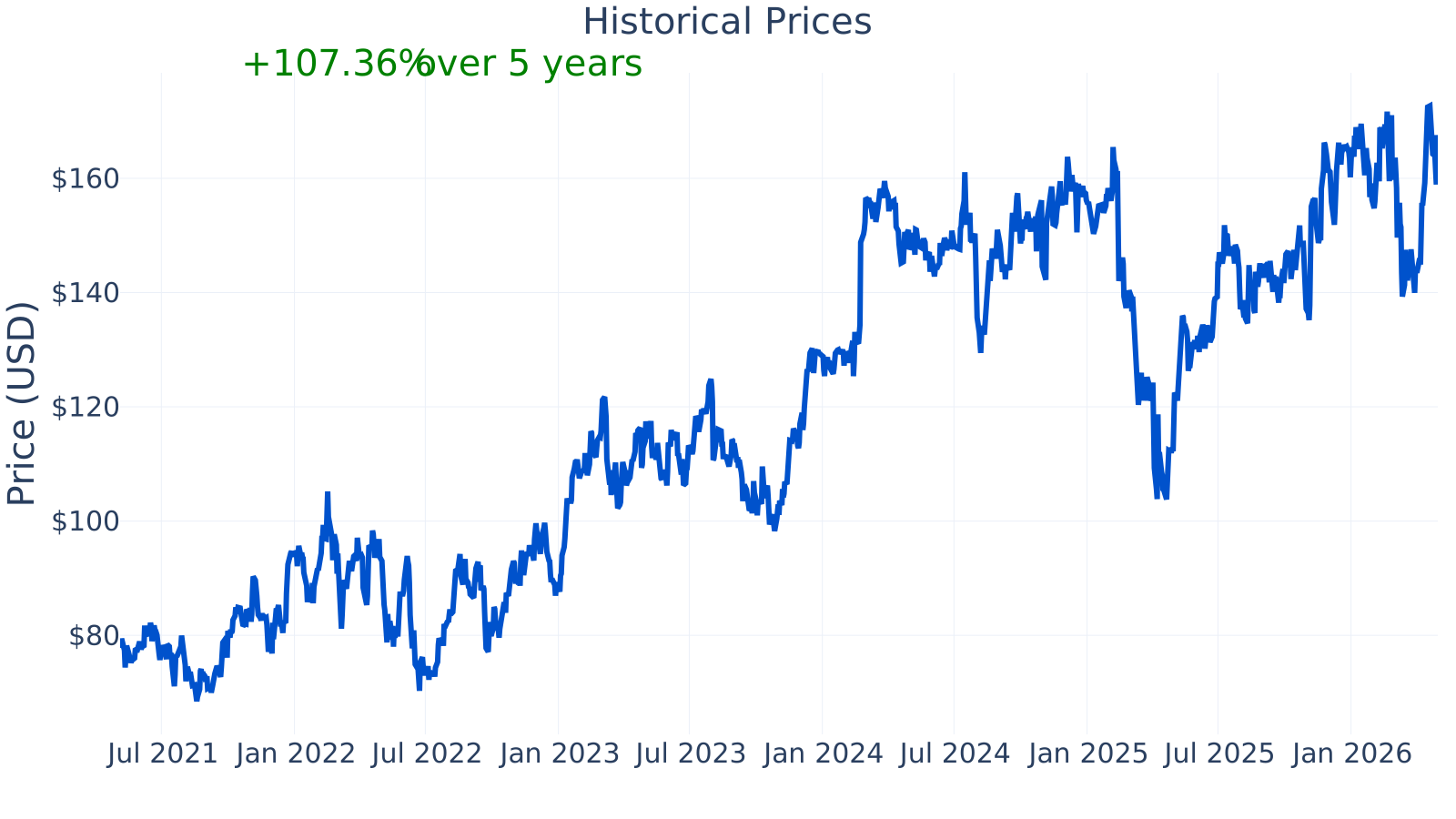
Overview
Hyatt Hotels Corporation is a global hospitality company best known for operating, managing, franchising, and owning hotels and resorts under multiple brands. In simple terms, Hyatt makes money in two main ways: (1) running hotels and collecting room and food-and-beverage revenue, and (2) collecting recurring fees for managing or franchising hotels that are owned by other parties. This “asset-light” approach (more management and franchise, less ownership) is commonly used in large hotel groups because it can reduce the amount of capital needed to grow.
Hyatt’s business is typically described through these major activities (listed broadly from larger, more recurring fee-like streams to more operational streams, exact percentages depending on the year and reporting):
- Management, franchise, and other fees (fees tied to operating hotels for owners, brand licensing, and related services)
- Owned and leased hotel operations (room revenue and on-property spending at hotels Hyatt owns or leases)
- Other hospitality-related revenue (which may include items such as reimbursement revenue, co-branded credit card and loyalty-related economics, or other lines depending on reporting)
Because Hyatt operates with a mix of owned/leased hotels and fee-based managed/franchised hotels, results can vary year to year based on travel demand, hotel openings, asset sales/acquisitions, and financing costs.
Across recent years shown, total revenue expanded meaningfully from 2021 to 2023, softened in 2024, and then jumped in 2025. At the same time, net income swung from a loss (2021) to profits (2022–2024) and back to a small loss (2025), showing that reported earnings can be volatile even when operating income stays positive.
Key Figures
| Metric | Value | Industry ⓘ |
|---|---|---|
| Date | May 04, 2026 | |
| Context | ||
| Sector | Consumer Cyclical | |
| Industry | Lodging | |
| Market Cap ⓘ | $15.50B | |
| Beta ⓘ | 1.28 | |
| Fundamental | ||
| P/E Ratio ⓘ | N/A | 29.60 |
| Profit Margin ⓘ | -0.99% | 16.56% |
| Revenue Growth ⓘ | -3.50% | 6.30% |
| Debt to Equity ⓘ | 139.84% | 42.44% |
| PEG ⓘ | 0.79 | |
| Free Cash Flow ⓘ | $63.00M | |
Hyatt’s market capitalization is about $15.5 billion, placing it among the larger publicly traded hotel companies. The stock’s beta of ~1.28 suggests it has tended to move more than the broader market (higher ups and downs).
On profitability, the most recent profit margin is about -1.0%, versus an industry median near 16.6%, indicating weaker recent bottom-line results than many peers. Recent year-over-year revenue growth is about -3.5% compared with an industry median around 6.3%, pointing to a softer near-term top-line trend.
Leverage is notable: debt-to-equity is about 140% versus an industry median near 42%. Free cash flow over the last twelve months is about $63 million, which is positive but materially lower than the levels shown in prior years.
Growth (Medium)
The lodging industry is closely tied to long-term travel demand (business and leisure), which tends to expand over time but can drop sharply during recessions or shocks. For Hyatt, future growth is often linked to adding hotels to its system (especially under management and franchise agreements), strengthening brand portfolio positioning, and growing its loyalty ecosystem—because a larger network and stronger loyalty can support higher occupancy and pricing power over time.
A practical way to think about Hyatt’s growth setup is the balance between scale and cyclicality. Scale can increase through hotel signings and brand expansion, while cyclicality shows up in occupancy and room rates that can change quickly with the economy.
The year-over-year revenue growth pattern shown is uneven: very strong growth earlier in the period, followed by a stretch of declines (notably through parts of 2024 and early 2025), then a sharp rebound in late 2025 and early 2026. This kind of pattern is common in travel-related businesses, where reported revenue can be influenced by both demand and portfolio changes (for example, shifting between owned assets and fee-based hotels).
Free cash flow peaked earlier in the timeline (hundreds of millions of dollars) and then declined to roughly $63 million most recently. For long-term company building, free cash flow matters because it supports debt reduction, reinvestment, and flexibility during downturns. A sustained rebound in cash generation would typically be an important confirmation of operating strength.
Risks (High)
Hyatt operates in a sector that is inherently sensitive to the economic cycle. Demand can fall due to recessions, reduced corporate travel, geopolitical events, or other disruptions, and hotels have high fixed costs that can pressure profitability when occupancy drops. In addition, competition is intense: customers can compare prices instantly, and hotel owners can choose among brands when signing management or franchise agreements.
Competitive advantages in large hotel groups often come from brand strength, distribution (being easy to book across channels), loyalty programs, and the ability to attract hotel owners seeking a proven operator/brand. Hyatt is a major global player, but it competes against larger-scale peers with broad brand portfolios and significant loyalty ecosystems. Key competitors include Marriott International, Hilton Worldwide, InterContinental Hotels Group (IHG), and Wyndham Hotels & Resorts. Relative positioning often depends on segment focus (luxury vs. midscale), regional footprint, and the pace of hotel signings.
Hyatt’s debt-to-equity trend rises to about 140% most recently. Higher leverage can amplify outcomes: it can help during strong periods, but it can also increase risk when demand weakens or refinancing becomes more expensive.
Profitability has also been volatile. After improving into solidly positive levels during parts of 2023–2024, the margin turns slightly negative again in late 2025 and early 2026. Compared with the industry median (generally positive across the period shown), this recent underperformance highlights sensitivity to costs, financing, and other items that can move net income sharply.
Valuation
Hotel companies are often valued using earnings-based metrics, but those metrics can be difficult to interpret when profits swing. That matters for Hyatt because its profit margin has recently been near or below zero, which can make traditional valuation ratios less stable or less informative.
When the P/E ratio is visible in the timeline, Hyatt’s P/E varies widely (from the teens to much higher spikes), sometimes above and sometimes below the lodging industry median (which is mostly in the ~20–30 range). The periods where the P/E is not shown can occur when earnings are very low or negative, making the ratio less meaningful. In this context, valuation tends to be most interpretable when earnings and cash flow are more stable, and less interpretable when results are being driven by one-time items or sharp cycle changes.
Conclusion
Hyatt is a major global hospitality company with well-known brands and a business model that combines fee-based management/franchise activities with owned and leased hotel operations. Over the period shown, the company demonstrates the typical characteristics of lodging: meaningful recovery phases and expansion in some years, paired with volatility in reported earnings and margins.
From a long-term perspective, the key facts to weigh are the industry’s cyclical nature, the company’s ability to grow its hotel system and recurring fee streams, and the recent signals from fundamentals: softer year-over-year revenue, sharply lower trailing free cash flow, and higher leverage than the industry median. Valuation indicators based on earnings also fluctuate significantly, which makes context—profit stability and cash generation—especially important when interpreting multiples.
Sources:
- U.S. Securities and Exchange Commission (SEC) EDGAR — Hyatt Hotels Corporation filings (Form 10-K, Form 10-Q, Form 8-K)
- Hyatt Hotels Corporation Investor Relations — SEC filings and investor materials (company-hosted)
- Wikipedia — “Hyatt” (basic company background)
This article is for informational purposes only and does not constitute financial advice. Some content is AI-generated. See Disclaimer


