Stock Analysis · Hyatt Hotels Corporation (H)
Overview
Hyatt Hotels Corporation is a global hospitality company best known for operating and franchising hotels and resorts under multiple brands. In simple terms, Hyatt makes money in two main ways: (1) running certain hotels day-to-day (collecting room revenue and other on-property spending) and (2) earning fees for letting other owners operate hotels under the Hyatt brand (management and franchise fees), plus revenue from its loyalty program and other services.
Hyatt’s business model includes both “asset-light” activities (earning fees while others own the real estate) and “owned/leased” hotel operations (where Hyatt has more direct exposure to hotel performance). For long-term shareholders, the asset-light portion is often watched closely because it can be less capital-intensive, while owned/leased hotels can add more ups and downs because results move with travel demand and operating costs.
Based on company reporting in its filings, revenue is typically discussed through operating segments rather than a simple product list. The major sources generally include:
- Owned and leased hotels (hotel rooms, food & beverage, and other on-property revenue at properties Hyatt owns or leases)
- Management and franchise fees (fees paid by third-party hotel owners for Hyatt to manage hotels or license Hyatt brands)
- Loyalty and other (including certain loyalty program economics and other business lines disclosed by the company)
Because the exact percentages by source can change year to year and depend on how Hyatt reports in each filing period, the most reliable breakdown is the company’s segment disclosures in its annual report (Form 10-K).
Over the years shown, total revenue rises materially from 2021 to 2025, but profitability is uneven: operating income and net income move between positive and negative depending on the period. This pattern is consistent with a travel-related business that can be highly sensitive to demand, pricing, and costs, and can also be affected by one-time items that flow through reported earnings.
Key Figures
| Metric | Value | Industry ⓘ |
|---|---|---|
| Date | Feb 16, 2026 | |
| Context | ||
| Sector | Consumer Cyclical | |
| Industry | Lodging | |
| Market Cap ⓘ | $15.79B | |
| Beta ⓘ | 1.23 | |
| Fundamental | ||
| P/E Ratio ⓘ | N/A | 30.54 |
| Profit Margin ⓘ | -1.50% | 15.95% |
| Revenue Growth ⓘ | 17.50% | 8.50% |
| Debt to Equity ⓘ | 0.16% | 0.16% |
| PEG ⓘ | 0.79 | |
| Free Cash Flow ⓘ | $57.00M | |
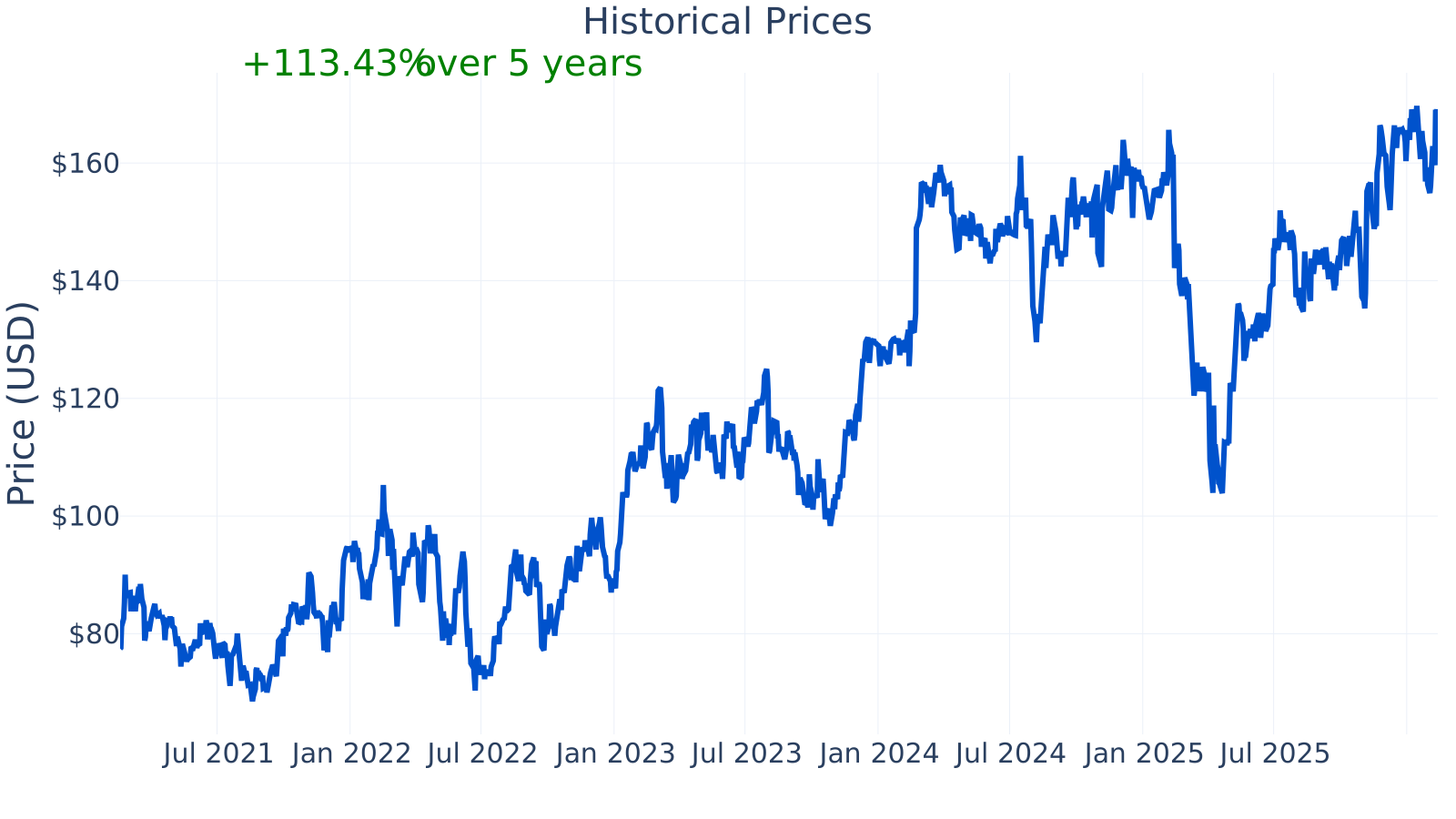
Hyatt’s market capitalization is about $15.8B, and the stock shows a beta of ~1.23, which indicates it has tended to move more than the broader market. The latest profit margin is about -1.0% versus an industry median near 11.0%, which highlights that recent profitability (at least as captured by this metric) has lagged peers. At the same time, the latest year-over-year revenue growth is ~17.5% versus an industry median near 8.5%, suggesting faster recent top-line growth than the typical lodging peer.
Free cash flow over the trailing twelve months is shown at roughly $57M, and the PEG ratio (~0.79) is below 1, a metric some market participants use to compare valuation to expected growth (though it depends heavily on the growth assumptions behind it).
Growth (Medium)
Hyatt operates in the lodging industry, which is closely tied to travel demand. Over long periods, hotel demand typically benefits from economic growth, business travel needs, conferences and events, and leisure travel trends. That said, the industry can be cyclical: performance often weakens in recessions or periods of reduced travel activity.
A key strategic theme for large hotel brands has been expanding through management and franchise agreements rather than owning most of the buildings. This approach can allow a company to add hotels and brands with less balance sheet intensity than buying real estate outright, while still earning fees tied to hotel revenue. Hyatt discusses its portfolio and segment approach in its SEC filings, and investors often track the mix between fee-based earnings and owned/leased hotel results.
The year-over-year revenue growth pattern is volatile. After very large growth rates during the post-pandemic rebound period, growth later moderates and even turns negative in several quarters, before returning to positive territory. The latest annual revenue growth shown is about 17.5%, above the industry median of about 8.5%, but the prior swings show that growth has not been smooth.
Free cash flow improves substantially from a negative level in 2021 to strongly positive levels in 2022–2024, then declines in 2025 (still positive in the series shown for March 2025 at about $384M, while the latest table value shows a lower trailing figure of about $57M). For a hotel company, free cash flow can be influenced by operating performance, renovation spending, and portfolio changes, so it’s typically evaluated alongside management discussion in the 10-K/10-Q.
Risks (High)
This article is for informational purposes only and does not constitute financial advice. Some content is AI-generated. See Disclaimer