Stock Analysis · HubSpot Inc (HUBS)
Overview
HubSpot Inc. is a software company focused on helping organizations—especially small and mid-sized businesses—manage customer-facing work in one place. Its platform is commonly used for marketing (attracting visitors and generating leads), sales (tracking deals and customer interactions), customer service (support and ticketing), and content management (building and managing websites). HubSpot sells these tools as cloud-based subscriptions, typically with multiple “Hubs” that can be bundled together, plus optional add-ons.
From a business model perspective, HubSpot primarily earns recurring revenue from subscriptions. As customers expand usage (more users, more features, higher tiers), revenue can grow without needing a proportional increase in delivery costs—typical for many software companies—though sales, marketing, and product investment can be significant.
Based on HubSpot’s reporting in its filings, revenue is largely organized into two categories:
- Subscription revenue (the core software platform and paid seats/features)
- Professional services and other (implementation, onboarding, training, and related services)
HubSpot generally describes subscription revenue as the large majority of total revenue, with professional services representing a smaller portion (exact percentages can vary by period).
Over the last few years, total revenue increased substantially (from about $1.30B in 2021 to about $3.13B in 2025). During that time, operating expenses also grew, with a notable share directed toward research and development—consistent with a strategy centered on expanding product capabilities.
Key Figures
| Metric | Value | Industry ⓘ |
|---|---|---|
| Date | Feb 23, 2026 | |
| Context | ||
| Sector | Technology | |
| Industry | Software - Application | |
| Market Cap ⓘ | $12.31B | |
| Beta ⓘ | 1.39 | |
| Fundamental | ||
| P/E Ratio ⓘ | 271.51 | 25.48 |
| Profit Margin ⓘ | 1.47% | 7.23% |
| Revenue Growth ⓘ | 20.40% | 15.70% |
| Debt to Equity ⓘ | 23.47% | 25.08% |
| PEG ⓘ | 0.42 | |
| Free Cash Flow ⓘ | $677.29M | |
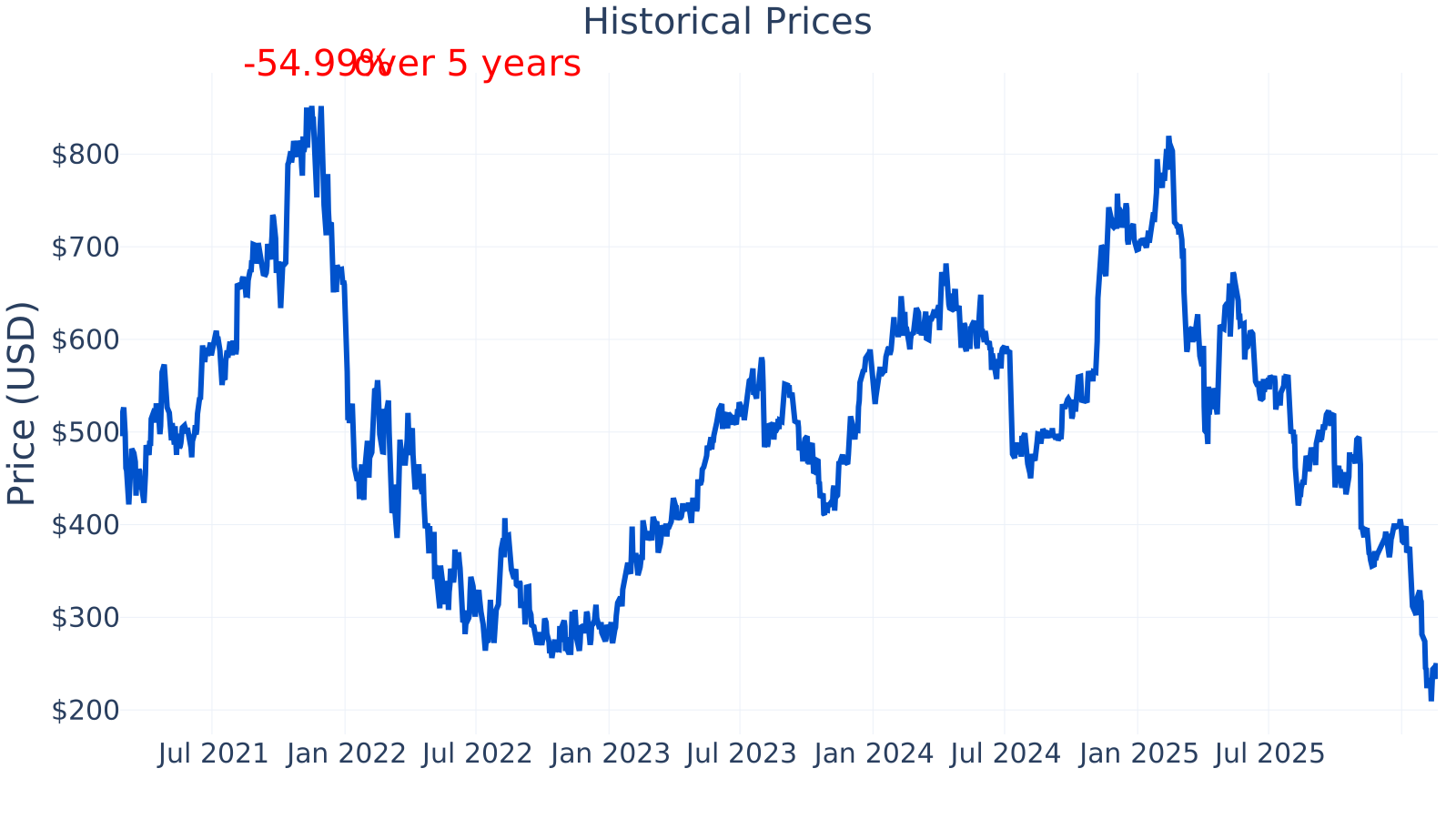
HubSpot’s market capitalization is about $12.3B, and the stock’s beta (~1.39) suggests it has tended to move more than the overall market. The company’s profit margin is about 1.47%, below the industry median shown here (~7.23%), indicating profitability is present but still relatively thin versus many peers. Revenue growth is still solid: about 20.4% year over year, above the industry median in this table (~15.7%). Leverage appears moderate with debt-to-equity around 23%, close to the industry median (~25%). The trailing free cash flow displayed here is about $677M.
Growth (medium)
HubSpot operates in customer relationship management (CRM) and go-to-market software, a broad area that has benefited from long-term shifts toward cloud-based tools and more measurable, data-driven marketing and sales processes. A key structural tailwind is that many businesses continue to consolidate workflows into fewer platforms to reduce complexity (separate tools for email marketing, pipeline management, support, and website management can be costly and fragmented).
HubSpot’s strategy centers on offering an integrated “suite” that can start small and expand over time. This approach can support growth through (1) adding new customers, and (2) increasing revenue per customer as organizations adopt more hubs, higher tiers, and add-ons. Continued investment in product development is part of this plan, particularly as software vendors incorporate automation and AI-driven features to improve productivity.
Revenue growth has decelerated from very high rates in 2021 (often above 40–50% year over year) to a more moderate pace around the mid-teens to low-20% range more recently, including about 20% in the latest period shown. This pattern can be consistent with a business scaling to a larger revenue base, though it also means future outcomes may depend more heavily on execution, competitive differentiation, and continued expansion within existing customers.
Free cash flow improved meaningfully over time in the periods shown, rising from roughly $74M (TTM) in early 2021 to about $609M (TTM) by early 2025, with the latest table indicating about $677M. For many software companies, expanding free cash flow can help fund product development and go-to-market efforts while reducing reliance on external financing.
Risks (medium-high)
This article is for informational purposes only and does not constitute financial advice. Some content is AI-generated. See Disclaimer