Stock Analysis · Hovnanian Enterprises Inc. PFD DEP1/1000A (HOVNP)
Overview
Hovnanian Enterprises, Inc. is a U.S. homebuilder. Its core business is building and selling new single-family homes, townhomes, and condominiums in multiple states, generally serving first-time, move-up, and active-lifestyle buyers. In addition to selling homes, the company also participates in parts of the housing “ecosystem,” such as providing mortgage services to support homebuyers (often through affiliated arrangements described in its filings).
For a homebuilder, revenue tends to be concentrated in home sales, with smaller contributions from closely related activities. Based on how homebuilders typically report in their annual filings, the main revenue sources are generally:
- Home sales (homebuilding operations) — typically the vast majority of revenue
- Land sales / lot-related activity — can vary by year depending on strategy
- Financial services (mortgage-related) — usually a smaller share, but can support sales pace
Looking at the company’s multi-year income flow, total revenue has been around the ~$2.8B–$3.0B range in recent fiscal years, while profitability has fluctuated meaningfully. One notable change is that the gap between revenue and direct costs (gross profit) narrowed in the most recent year shown, which helps explain the drop in bottom-line results.
Across fiscal 2021–2025, total revenue stayed in a relatively tight band (roughly $2.76B to $3.00B). However, net income fell sharply by fiscal 2025 (about $63.9M) compared with fiscal 2024 (about $242.0M). The compression appears consistent with lower gross profit in fiscal 2025 (about $420.7M vs. about $601.8M in fiscal 2024) alongside operating expenses that did not fall in the same proportion.
Key Figures
| Metric | Value | Industry ⓘ |
|---|---|---|
| Date | Feb 27, 2026 | |
| Context | ||
| Sector | Consumer Cyclical | |
| Industry | Homebuilding & Construction Supplies | |
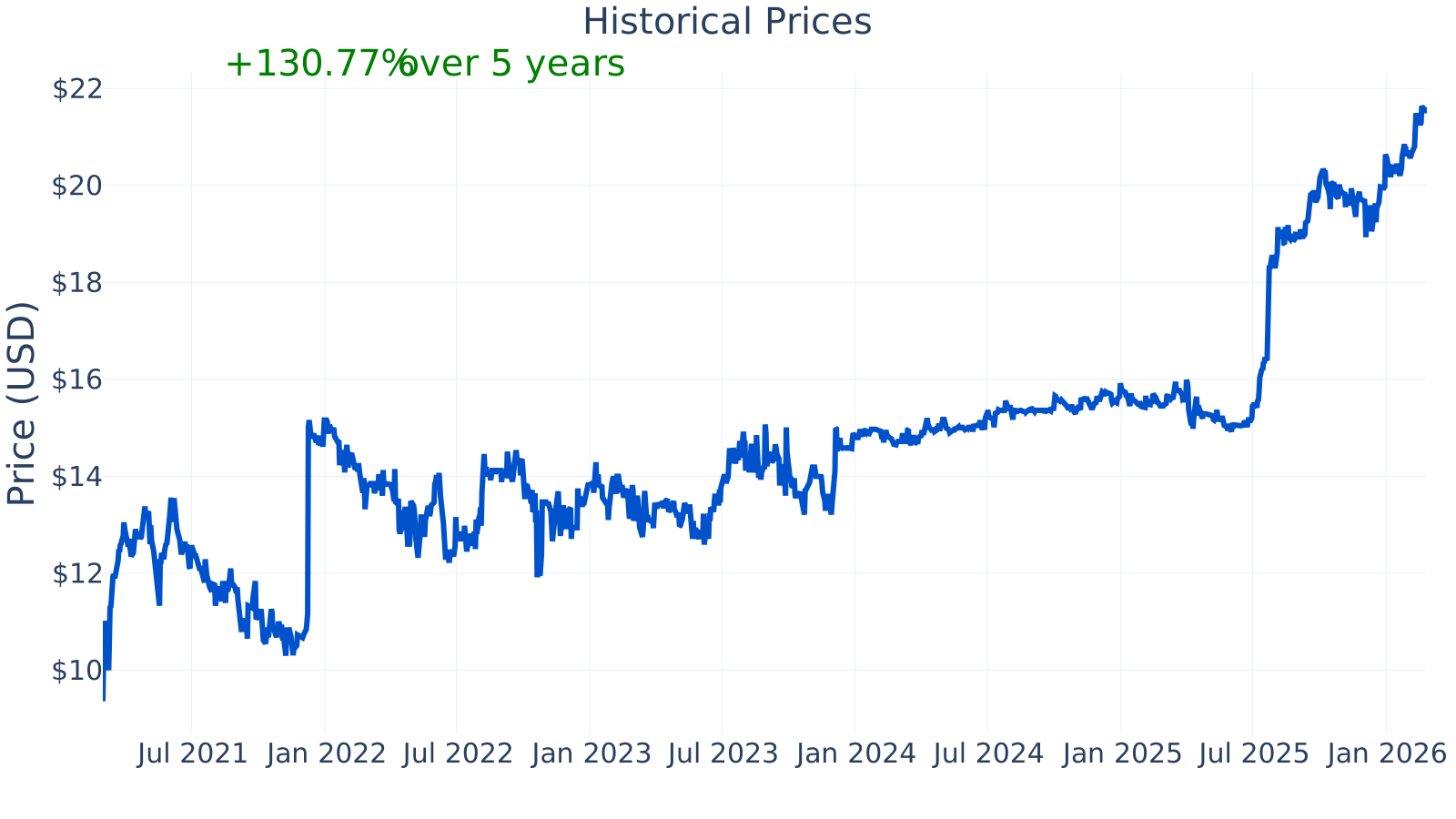
| Market Cap ⓘ | $3.18B | |
| Beta ⓘ | N/A | |
| Fundamental | ||
| P/E Ratio ⓘ | N/A | |
| Profit Margin ⓘ | N/A | |
| Revenue Growth ⓘ | N/A | |
| Debt to Equity ⓘ | 117.15% | |
| PEG ⓘ | N/A | |
| Free Cash Flow ⓘ | $166.18M | |
The latest snapshot shows a market capitalization of about $3.18B and trailing twelve-month free cash flow of about $166.2M. Leverage is meaningful, with debt-to-equity around 117%. Some fields are not available in the table (for example beta, P/E, and PEG), and “profit margin” and “revenue growth YoY” appear as 0 in the table despite other parts of the financial history indicating non-zero values in earlier periods.
Growth (Medium)
Homebuilding is a large, long-running industry tied to population trends, household formation, employment, wages, and—most importantly—mortgage rates and housing affordability. Demand can be strong over long periods, but it typically moves in cycles. That means long-term growth is possible, yet the path is rarely smooth year to year.
A practical way to think about Hovnanian’s growth profile is that it is heavily linked to (1) how many homes it can deliver (community count, lots controlled, construction capacity), and (2) the margin it can earn per home (pricing power versus build costs and incentives). When market conditions tighten, builders sometimes protect sales pace with incentives or adjust product mix, which can reduce margins even if revenue stays stable.
The year-over-year growth shown earlier in the timeline was positive (about 31% and 10% in the periods displayed). Even so, for homebuilders, growth rates can change quickly as interest rates and affordability shift. A stable revenue line does not always mean stable economics if profitability per home changes.
Free cash flow is especially important in homebuilding because the business requires ongoing investment in land and development. The latest trailing twelve-month figure shown is about $166.2M, indicating the company generated cash after operating needs and capital spending during that period. In this sector, free cash flow can swing materially depending on how fast homes close, how much land is purchased and developed, and how inventory levels change.
Risks (High)
Hovnanian operates in a cyclical business with several major risks that can affect results quickly. The most prominent risk is interest-rate and affordability sensitivity: higher mortgage rates can reduce the pool of qualified buyers, increase cancellation risk, and pressure selling prices or increase incentives. Build costs (labor, materials) and land costs can also change quickly, and the company may not always be able to pass those costs through to buyers.
Leverage is another key consideration. Homebuilders often use debt, but higher leverage can reduce flexibility during downturns (for example, if sales slow or margins compress). The longer-term trend shown indicates leverage has improved dramatically versus earlier periods, but it remains notable.
Debt-to-equity declined substantially from very high levels earlier in the timeline (over 2,100% and 1,200% in 2021) to roughly 112%–124% in 2025, with the most recent point around 117%. That direction suggests a stronger balance-sheet position than in the past, but the company still uses a meaningful amount of debt relative to equity.
Profitability volatility is also central to the risk profile. Even when revenue is relatively steady, margins can compress due to pricing pressure, incentives, unfavorable mix, or cost inflation. This matters because small changes in margin can have an outsized impact on earnings.
The profit margin shown was above 21% in earlier periods and around 21%–22% in early 2025, but it dropped sharply later in 2025 to roughly 3.9% and then about 2.1%. That kind of swing highlights how quickly conditions (or cost/price dynamics) can change for a homebuilder.
On competitive positioning, U.S. homebuilding is crowded and largely regional. Builders compete on location, product fit, execution speed, customer service, and access to lots. Hovnanian is not generally described as the largest national leader by volume compared with the biggest public builders. Large competitors often include companies such as D.R. Horton, Lennar, PulteGroup, Toll Brothers, NVR, and Taylor Morrison (among others). Scale can help competitors with purchasing power, land pipelines, and operating efficiency, while regional focus can sometimes help smaller builders compete effectively in targeted markets. The industry’s competitive advantages are often more about local land positions and execution than about durable technology-like “moats.”
Valuation
Valuation for a homebuilder is commonly discussed using earnings multiples (like P/E), book value metrics, and cash-flow context, but those metrics can be hard to interpret during cyclical peaks and troughs because earnings can swing significantly.
The P/E values shown are unusually low for much of the history displayed (generally well below 1 for several years), then rise to around 1.19 and 2.18 at the end of the series. Regardless of the reason, the key point for long-term context is that the company’s profitability has been volatile recently (as indicated by the margin compression). When margins and earnings are moving quickly, any earnings-based multiple can change rapidly even if the stock price does not move as much.
In plain terms, whether the current price is “expensive” or “cheap” cannot be concluded from a single metric in isolation for a cyclical business. A more grounded approach is to connect valuation to (1) normalized profitability across a full housing cycle, (2) balance-sheet resilience given the debt level, and (3) the company’s ability to consistently generate cash after land and construction needs.
Conclusion
Hovnanian Enterprises is a cyclical U.S. homebuilder whose results are closely tied to mortgage rates, housing affordability, and the balance between home prices and construction/land costs. Over recent years shown, revenue has been relatively stable around the ~$2.8B–$3.0B level, while profitability has been much less stable, with a sharp decline in profit margin in the most recent period displayed. The balance sheet appears improved compared with earlier points in the timeline, but leverage remains meaningful.
For long-term context, the key items to track over time are the company’s sustained margin level (not just revenue), its ability to generate free cash flow across different market conditions, and its leverage position heading into weaker parts of the housing cycle. Competitive pressure from much larger builders and the inherently cyclical nature of housing remain central features of the business environment.
Sources:
- SEC EDGAR — Hovnanian Enterprises, Inc. Annual Report (Form 10-K)
- SEC EDGAR — Hovnanian Enterprises, Inc. Quarterly Report (Form 10-Q)
- SEC EDGAR — Hovnanian Enterprises, Inc. Current Report (Form 8-K)
- Hovnanian Enterprises, Inc. Investor Relations — SEC Filings
- Wikipedia — “Hovnanian Enterprises”
This article is for informational purposes only and does not constitute financial advice. Some content is AI-generated. See Disclaimer