Stock Analysis · Hilton Worldwide Holdings Inc (HLT)
Overview
Hilton Worldwide Holdings Inc is a global lodging company best known for operating hotel brands (such as Hilton, DoubleTree, and Hampton) and a large loyalty program (Hilton Honors). Rather than owning most of its hotels, Hilton largely runs an “asset-light” model: many properties are owned by third-party hotel owners, while Hilton earns fees for managing hotels, franchising its brands, and providing reservation and loyalty services. This approach can allow the company to expand its footprint with less direct real-estate investment than a hotel owner-operator model.
Hilton’s revenue is typically driven by fee-based streams tied to hotel room demand and pricing, plus other brand-related services. In broad terms (based on how Hilton describes its business in its annual filings), the main sources of revenue are:
- Franchise and licensing fees (fees paid by hotel owners to use Hilton brands and systems)
- Management fees (fees for operating hotels on behalf of owners)
- Owned/leased hotel revenue (a smaller portion of the business relative to the fee streams)
- Other revenues (including ancillary program and service-related items)
One way to read Hilton’s business is that it is tied to travel activity (leisure and business), but it also benefits from the long-lived nature of hotel brands and contracts: once a hotel is built and affiliated with a major brand, the relationship can last many years, supporting recurring fee revenue if the brand remains competitive.
Across the period shown, total revenue rises from about $5.8B (2021) to about $12.0B (2025). Operating income also increases over time, while interest expense remains a meaningful recurring cost. Net income is positive in each year shown, with some year-to-year movement that can reflect travel demand, pricing, and financing costs.
Key Figures
| Metric | Value | Industry ⓘ |
|---|---|---|
| Date | Feb 23, 2026 | |
| Context | ||
| Sector | Consumer Cyclical | |
| Industry | Lodging | |
| Market Cap ⓘ | $73.44B | |
| Beta ⓘ | 1.11 | |
| Fundamental | ||
| P/E Ratio ⓘ | 51.54 | 30.60 |
| Profit Margin ⓘ | 29.41% | 14.61% |
| Revenue Growth ⓘ | 7.00% | 7.00% |
| Debt to Equity ⓘ | -290.81% | 44.41% |
| PEG ⓘ | 1.43 | |
| Free Cash Flow ⓘ | $1.99B | |
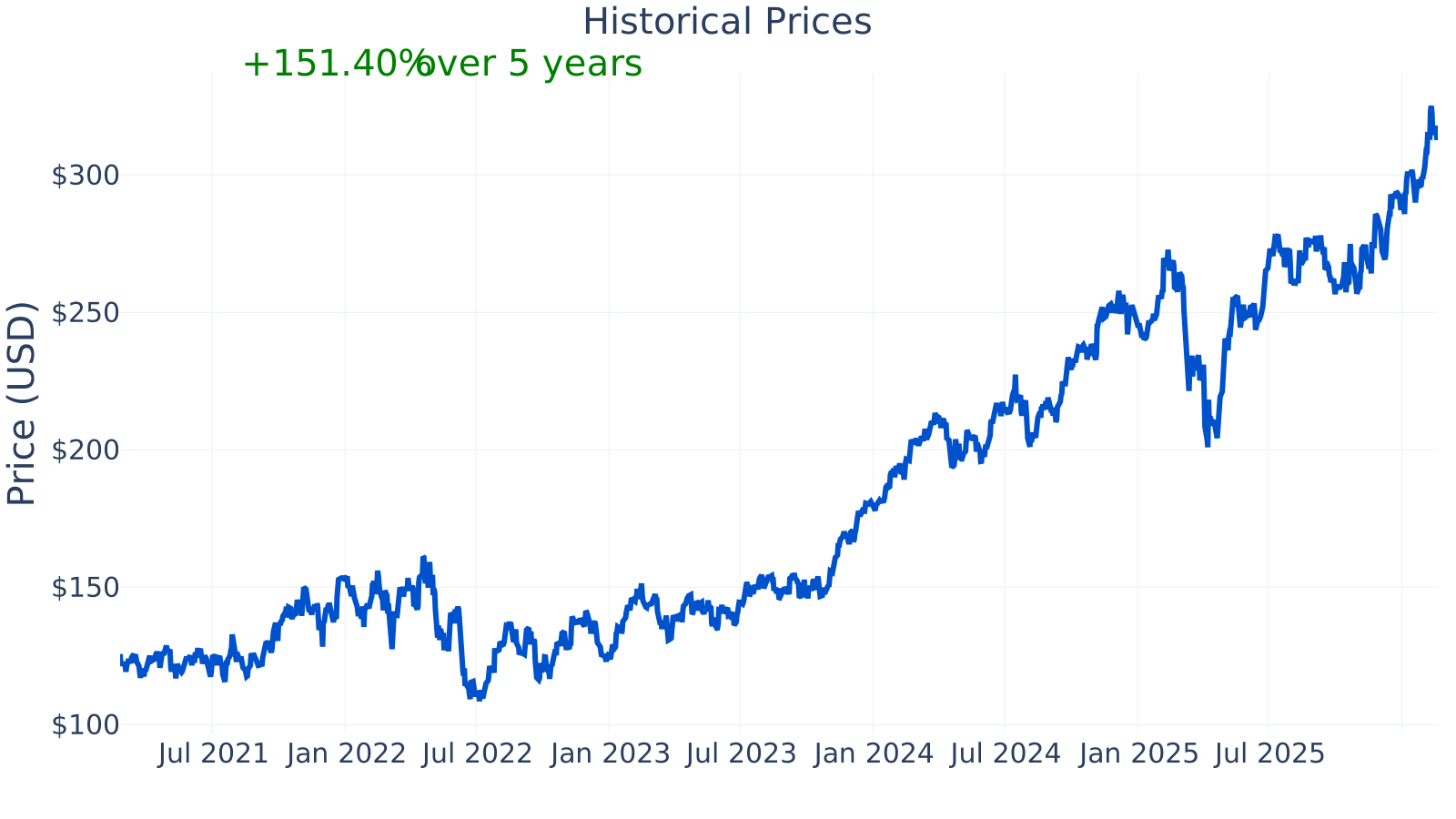
Hilton’s market capitalization is about $73.4B, and its beta of 1.11 suggests the stock has tended to move slightly more than the overall market on average. The current P/E ratio is ~51.5 versus an industry median of ~30.6, indicating the market is valuing Hilton at a higher earnings multiple than many lodging peers. The profit margin is ~29.4% versus an industry median of ~14.6%, which points to stronger profitability than the median peer at this point in time. Year-over-year revenue growth is ~7%, in line with the industry median. The debt-to-equity figure is negative, which commonly happens when a company has negative shareholders’ equity; in that situation, the ratio can be difficult to interpret as a traditional “leverage” measure. Free cash flow over the trailing twelve months is about $2.0B.
Growth (Medium)
Lodging is a long-term growth industry when viewed over full economic cycles, supported by population growth, rising middle-class travel in many regions, and the ongoing role of travel in commerce and events. At the same time, it is a cyclical business: demand typically weakens during recessions and strengthens during expansions. For a brand-led company like Hilton, growth often comes less from building hotels itself and more from expanding the number of hotels under its brands, growing the loyalty member base, and improving technology and distribution to capture bookings.
Hilton’s asset-light structure is designed to support future growth by encouraging third-party owners and developers to build and affiliate properties under Hilton brands. This can increase fee streams without requiring Hilton to deploy as much capital as a property-owning model. Over time, a larger network can also reinforce customer recognition and loyalty program usage, which may support repeat stays and direct bookings.
The year-over-year revenue growth shown is extremely high during the post-pandemic rebound period and then moderates into more typical single-digit rates more recently (ending around ~11% in the last data point shown). This pattern is consistent with a business that experienced an unusual recovery surge and then returned toward steadier growth.
Free cash flow increases from roughly $0.33B (2021) to roughly $1.9B (2025). For a fee-driven model, free cash flow can be an important indicator of business strength because it reflects cash generated after operating needs and capital spending. Sustained free cash flow can support debt service, reinvestment, and shareholder returns (though specific uses depend on management decisions and market conditions).
Risks (Medium)
The most important risk is that lodging demand is economically sensitive. If corporate travel budgets tighten, consumers reduce discretionary spending, or a recession hits key markets, hotel occupancy and room pricing can weaken. Because Hilton earns many fees tied to hotel revenues, lower hotel performance can reduce Hilton’s fee income even if the company does not own the building.
Competition is another key risk. Hilton competes with other major hotel brand groups and also with alternative accommodations. Large competitors include Marriott International, Hyatt Hotels, IHG Hotels & Resorts, and Wyndham Hotels & Resorts. In practice, the competitive battle is fought on brand strength, owner economics (why a hotel owner chooses one flag over another), loyalty program effectiveness, distribution/technology, and the ability to fill rooms at attractive rates. Hilton is one of the global leaders in branded lodging, which can be a competitive advantage when negotiating with owners, attracting guests, and driving loyalty enrollment.
Financial structure can also matter. Hilton’s debt and equity profile requires careful reading because a negative debt-to-equity ratio often indicates negative equity, which can result from share repurchases, accounting items, and leverage over time. Negative equity does not automatically imply near-term financial stress, but it can reduce balance-sheet flexibility and makes some simple ratios less comparable across companies.
The debt-to-equity series is negative throughout the period shown, which is consistent with negative shareholders’ equity; in this situation, the ratio is not a clean “higher is worse” measure. A more practical takeaway is that balance-sheet analysis should focus on items such as total debt, maturities, liquidity, and interest cost sensitivity, rather than relying on this single ratio.
Profitability can shift with the cycle, and fees can be pressured if hotel owners negotiate harder terms, development slows, or brand economics weaken. Execution risk also exists in technology, cybersecurity, and the loyalty ecosystem, where outages or data incidents could harm brand trust and booking performance.
Profit margin improves sharply after the early-pandemic period and sits around ~12.1% at the latest point shown, slightly above the industry median of ~11.0%. The longer history shows that profitability can move meaningfully over time, which matches the cyclical nature of travel demand and the impact of pricing and cost structure.
Valuation
The P/E ratio shown for Hilton is often above the lodging industry median across the period displayed, with the latest value around ~51.5 versus an industry median near ~30.6. A higher P/E can reflect expectations for stronger growth, higher-quality earnings, more durable fee streams, or better competitive positioning. It can also mean the market price leaves less room for disappointment if growth slows, margins compress, or a downturn reduces travel demand.
Because lodging is cyclical, valuation can change quickly with earnings expectations. Interpreting whether the price level is “high” or “low” typically requires looking beyond the P/E alone, including the durability of cash flows, the timing of the travel cycle, and the company’s balance-sheet and capital return policies.
Conclusion
Hilton is a global lodging leader built around well-known brands and an asset-light model that emphasizes fee income rather than owning most hotel real estate. The business profile can support scalability, and the recent period shown includes rising revenue and growing free cash flow, alongside profitability that is competitive versus the industry median.
The main trade-offs are the industry’s economic sensitivity and the importance of maintaining brand strength in a highly competitive market. Valuation metrics indicate Hilton has often traded at a higher earnings multiple than the industry median, which can embed higher expectations for execution and resilience. Overall, the long-term picture depends on Hilton’s ability to keep expanding its network and loyalty ecosystem while navigating travel cycles and maintaining financial flexibility.
Sources:
- SEC EDGAR — Hilton Worldwide Holdings Inc filings (Form 10-K, Form 10-Q)
- Hilton Worldwide Holdings Inc Investor Relations — Annual Report materials and shareholder information
- Hilton Worldwide Holdings Inc Investor Relations — Earnings call materials / transcripts (company-hosted, public)
- Wikipedia — “Hilton Worldwide” (company background and history)
This article is for informational purposes only and does not constitute financial advice. Some content is AI-generated. See Disclaimer


