Stock Analysis · Hilton Grand Vacations Inc (HGV)
Overview
Hilton Grand Vacations Inc. (HGV) is a vacation ownership company. In simple terms, it sells and manages “timeshare-style” vacation products, where customers buy the right to use resorts and vacation accommodations over time. HGV also finances a portion of those customer purchases (similar to a loan), and it operates resorts and member programs that generate recurring fees.
Because of that setup, HGV’s business tends to mix (1) one-time sales activity and (2) more recurring income streams tied to an installed base of owners/members. The company’s results can therefore be influenced by travel demand, consumer credit conditions, and the cost of funding its financing operations.
Main sources of revenue are typically described in company filings as a combination of vacation ownership sales and recurring fees/other income. In broad terms, the revenue mix generally includes:
- Vacation ownership product sales (selling intervals/points and related items)
- Financing revenue (interest income on notes receivable from customers)
- Resort and club management / membership fees (recurring fees for managing properties and member programs)
- Other revenue (ancillary services and rental-related activity)
From the 2021–2025 income flow shown above, total revenue expanded from about $2.34B (2021) to about $5.05B (2025). Over the same period, interest expense increased notably (for example, from about $105M (2021) to about $311M (2025)), which matters for a business model that uses debt and financing structures as part of operations.
Key Figures
| Metric | Value | Industry ⓘ |
|---|---|---|
| Date | Mar 02, 2026 | |
| Context | ||
| Sector | Consumer Cyclical | |
| Industry | Resorts & Casinos | |
| Market Cap ⓘ | $3.96B | |
| Beta ⓘ | 1.47 | |
| Fundamental | ||
| P/E Ratio ⓘ | 81.75 | 19.47 |
| Profit Margin ⓘ | 1.80% | 4.08% |
| Revenue Growth ⓘ | 3.70% | 4.10% |
| Debt to Equity ⓘ | 525.78% | 370.89% |
| PEG ⓘ | N/A | |
| Free Cash Flow ⓘ | $231.00M | |
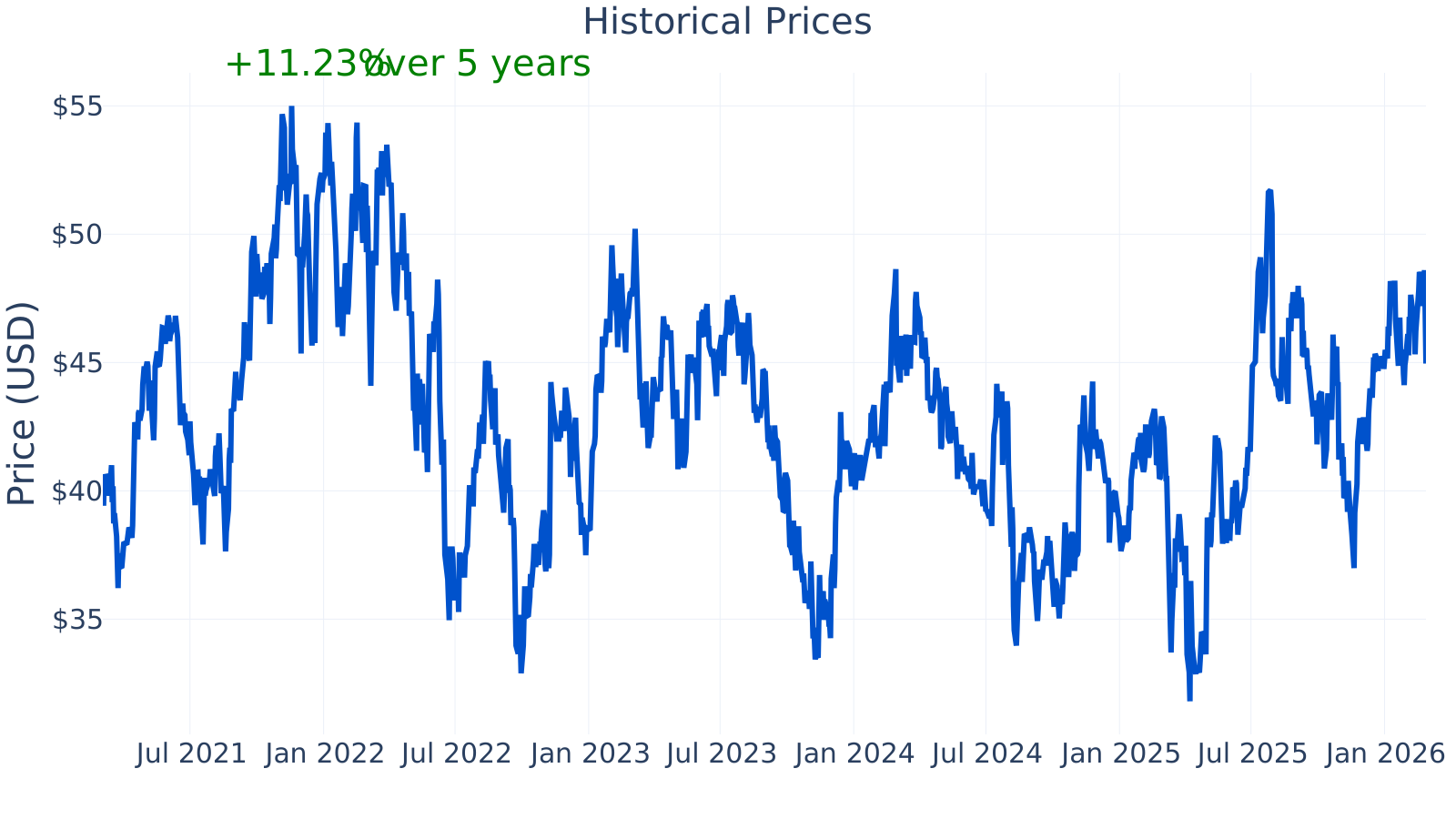
HGV’s market capitalization is about $4.0B, which places it among mid-sized public companies. The stock’s beta (~1.47) suggests it has historically moved more than the broader market on average (higher volatility). Profitability is currently thin based on the latest profit margin shown (~1.8% vs. an industry median of ~4.1%), while revenue growth year-over-year is modest (~3.7% vs. an industry median of ~4.1%). Leverage is elevated with debt-to-equity around 526% (industry median around 371%), and trailing twelve-month free cash flow is about $231M.
Growth (Medium)
HGV operates in the broader leisure travel ecosystem, where long-term demand is supported by consumer interest in experiences and vacation spending. That said, the vacation ownership niche is not purely “travel volume”—it is also a sales-and-financing model, which can be sensitive to consumer confidence and credit availability. When financing becomes more expensive or consumers become cautious, closing new sales can become harder and the cost structure can feel heavier.
The year-over-year revenue growth pattern shows that growth can be uneven. There were periods of very high growth earlier in the timeline (consistent with a rebound effect), followed by more normalized, lower growth rates more recently, including quarters near flat to slightly negative growth and a return to low-single-digit growth (for example, about 3.8% at the latest point shown). This kind of profile is typical for businesses tied to discretionary spending and large-ticket consumer purchases.
Free cash flow over the trailing twelve months remains positive, but it has moved around over time (for example, roughly $419M at one point in 2023 versus roughly $208M–$218M around 2024–2025, and about $231M most recently). For long-term business durability, investors often watch whether free cash flow is consistently positive across cycles, since this can support reinvestment, debt reduction, and flexibility during weaker demand periods.
Potential catalysts for growth in this type of company generally come from expanding the owner/member base, improving marketing efficiency, increasing recurring fee revenue per member, and managing financing (both credit quality and funding costs). In addition, scale can matter: a larger resort network and brand reach may help generate tours/leads and repeat usage, although execution and consumer credit conditions remain key variables.
Risks (High)
A core risk for HGV is that vacation ownership is a discretionary purchase that often relies on consumer financing. Demand can weaken during economic slowdowns, and higher interest rates can pressure both affordability for customers and the company’s own funding and interest expense. In addition, because part of the model involves lending to customers, credit performance (delinquencies, defaults, and loan loss provisioning) can affect profitability.
Leverage is a central feature to monitor. The debt-to-equity ratio has increased materially over time in the period shown, reaching about 526% most recently. This is also above the industry median shown (about 371%). Higher leverage can amplify outcomes: it can support growth and returns in strong periods, but it can also increase sensitivity to refinancing conditions and interest rate changes.
Profit margins have also shifted over time. After reaching healthier levels earlier in the timeline (often in the high single digits), margins trended down through much of 2024–2025, with a low point around ~1.8% before improving to about ~5.0% at the last point shown. Compared with the industry median in many periods, HGV’s margin has often been lower recently, which can signal higher costs, heavier interest burden, or business mix effects.
Competitive positioning is another consideration. HGV competes with other vacation ownership and resort-focused companies, and the market includes established players with sizable member bases and resort footprints. Competition often centers on brand strength, sales/marketing effectiveness, resort quality/locations, and the perceived value of membership/points programs. Competitive advantages in this space typically include scale, strong customer relationships and repeat usage, efficient marketing channels, and the ability to finance purchases at acceptable risk. Without relying on a single factor, HGV’s long-term positioning depends on maintaining demand, controlling costs, and managing credit and funding prudently.
Valuation
The latest P/E ratio shown for HGV is about 81.7, compared with an industry median of about 19.5. Historically in the timeline shown, HGV’s P/E spent long periods closer to the teens and 20s before rising sharply more recently (for example, reaching the mid-40s by late 2025 in the chart). A higher P/E can occur when the share price rises, when earnings fall, or both; in cyclical businesses, earnings swings can make P/E ratios harder to interpret at a single point in time.
Given that recent profit margin has been relatively low at points in 2025 and leverage is elevated, valuation multiples may be especially sensitive to changes in earnings. In practice, many investors evaluate additional measures alongside P/E for companies like HGV, such as free cash flow trends, net leverage, and the stability of recurring fee income versus one-time sales.
Conclusion
Hilton Grand Vacations is a consumer cyclical business focused on vacation ownership, combining product sales with recurring fees and a meaningful financing component. Over the past several years, revenue increased substantially in absolute dollars, while interest expense and leverage became important variables to monitor. Recent growth appears more modest than during earlier rebound periods, and profitability has shown periods of compression with some recovery at the latest point shown.
From a long-term perspective, the key swing factors typically include resilience of consumer demand for vacation ownership, credit performance in the customer loan portfolio, and the company’s ability to manage funding costs and leverage through different economic environments. Valuation indicators shown (notably a relatively high current P/E versus the industry median) suggest that earnings level and stability can significantly influence how the stock is priced at any given time.
Sources:
- SEC EDGAR — Hilton Grand Vacations, Inc. Form 10-K (Annual Report)
- SEC EDGAR — Hilton Grand Vacations, Inc. Form 10-Q (Quarterly Reports)
- Hilton Grand Vacations Investor Relations — Press Releases and Reports
- Hilton Grand Vacations Investor Relations — Earnings Call Materials / Transcripts (company-hosted where available)
- Wikipedia — “Hilton Grand Vacations” (basic background only)
This article is for informational purposes only and does not constitute financial advice. Some content is AI-generated. See Disclaimer


