Stock Analysis · Hewlett Packard Enterprise Co (HPE)
Overview
Hewlett Packard Enterprise (HPE) is an enterprise technology company focused on helping organizations run and modernize their IT. In simple terms, it sells and supports the hardware, software, and services that companies use to store data, connect devices, run business applications, and operate “private cloud” environments (cloud-like computing inside a company’s own data centers or dedicated facilities). HPE also offers consumption-based options (often described as “as-a-service”), where customers pay based on usage rather than buying everything upfront.
HPE organizes its business around a few main areas that typically include: servers and computing systems, data storage, networking equipment, and IT services/software that help manage and automate these environments. Revenue is largely generated from selling equipment (systems) and from ongoing support contracts and services tied to that installed base. Exact revenue mix and segment definitions can change over time, so the most reliable breakdown is the segment reporting in HPE’s annual report (Form 10-K).
Typical revenue streams (from largest to smaller, based on HPE’s segment reporting structure in filings) include:
- Compute / Servers (selling enterprise servers and related infrastructure)
- Intelligent Edge / Networking (networking products and services, including Aruba-branded offerings)
- Storage (data storage systems and software)
- HPC & AI (high-performance computing systems and related solutions)
- Financial Services (leasing/financing and lifecycle services that support hardware deployments)
At a high level, HPE’s business model mixes one-time product sales with recurring revenue from support, subscriptions/software, and services—an important point for long-term stability because recurring portions tend to be less volatile than purely one-time equipment shipments.
Across the periods shown, total revenue trends upward overall (from about $27.9B in FY2021 to about $34.3B in FY2025). Profitability, however, fluctuates meaningfully: operating income is positive in several years but turns negative in FY2025 in the figures shown, and net income drops sharply in FY2025 despite higher revenue. That combination suggests either unusually high costs/expenses, one-time items, or margin pressure that would need context from the annual report notes and management discussion.
Key Figures
| Metric | Value | Industry ⓘ |
|---|---|---|
| Date | Feb 07, 2026 | |
| Context | ||
| Sector | Technology | |
| Industry | Communication Equipment | |
| Market Cap ⓘ | $31.51B | |
| Beta ⓘ | 1.32 | |
| Fundamental | ||
| P/E Ratio ⓘ | N/A | 39.43 |
| Profit Margin ⓘ | 0.17% | 4.65% |
| Revenue Growth ⓘ | 14.40% | 14.10% |
| Debt to Equity ⓘ | 90.59% | 59.08% |
| PEG ⓘ | 0.91 | |
| Free Cash Flow ⓘ | $2.28B | |
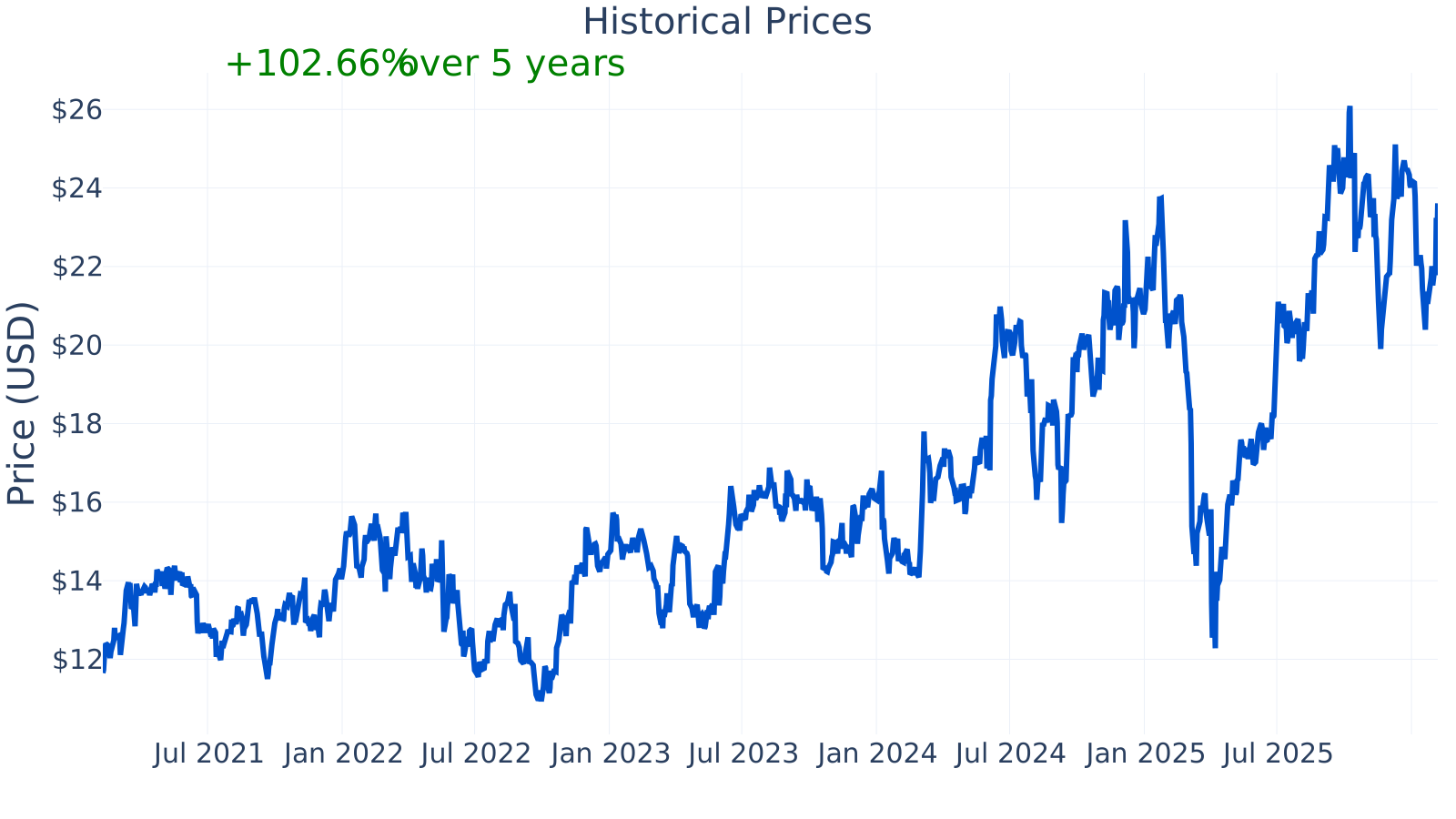
HPE’s market capitalization is about $31.5B, and its beta (~1.32) suggests the stock has historically moved more than the broader market (higher volatility). The latest year-over-year revenue growth is ~14.4%, roughly in line with the industry median (~14.1%) in the peer set provided. Profit margin is shown as ~0.17%, which is well below the industry median (~4.65%), indicating the most recent period had unusually low bottom-line profitability. Leverage is higher than the peer median: debt-to-equity ~90.6% versus an industry median ~59.1%. Free cash flow over the trailing twelve months is about $2.28B, which matters because cash generation helps fund investment, debt service, and shareholder returns.
Growth (Medium)
HPE operates in long-running, structurally important areas of enterprise IT: data centers, networking, hybrid cloud, cybersecurity-adjacent infrastructure needs, and (increasingly) AI-related computing. These categories tend to benefit from ongoing digitization and the steady growth of data creation. That said, they are also competitive and cyclical: customer spending can rise and fall with budgets, interest rates, and broader economic conditions.
A key strategic direction for HPE has been aligning more of its offerings with recurring and consumption-based models (often positioned as hybrid cloud “as-a-service”), alongside continued investment in higher-performance systems used for AI and large-scale computing. If executed well, this can improve revenue visibility over time and deepen customer relationships, because software, services, and support can become embedded in day-to-day operations.
The year-over-year revenue growth rate is not steady across the timeline shown: there are periods of contraction (notably in parts of 2024) followed by a return to stronger growth through late 2024 and 2025 (mid-to-high teens in several quarters, reaching roughly 19.9% at one point). This pattern suggests HPE’s growth can be sensitive to product cycles and enterprise spending timing rather than moving in a smooth line.
Free cash flow also shows variability: it drops sharply around early 2023 (about $0.55B) and then rebounds (about $2.63B in early 2024), followed by a lower level in early 2025 (about $1.65B). For long-term context, this kind of swing can reflect working capital movements (inventory and receivables), changes in profitability, and the timing of large customer deals—common in hardware and infrastructure-heavy businesses.
Possible catalysts (in a descriptive, non-predictive sense) include: rising enterprise demand for AI-capable infrastructure, refresh cycles in servers and networking, and continued adoption of hybrid approaches where companies combine public cloud with on-premises/private environments. Whether these translate into sustained growth depends on pricing, product competitiveness, and margin discipline.
Risks (High)
This article is for informational purposes only and does not constitute financial advice. Some content is AI-generated. See Disclaimer