Stock Analysis · Jack Henry & Associates Inc (JKHY)
Overview
Jack Henry & Associates, Inc. (JKHY) is a U.S. technology company that provides software and technology services mainly to banks and credit unions. In simple terms, it helps financial institutions run day-to-day operations (such as core banking processing), manage digital banking channels, support payments, and handle data-related services that keep accounts, transactions, and customer interactions working reliably.
Its business model is largely built around long-term customer relationships. Financial institutions typically rely on these systems for many years because switching core systems can be complex, time-consuming, and risky. That dynamic often supports recurring revenue through ongoing service arrangements, processing, and software usage over time.
In its reporting, Jack Henry organizes revenue into broad categories rather than a consumer-style product list. The main sources generally include:
- Processing (running core systems and transaction processing on behalf of customers)
- Services and Support (implementation, support, training, and related services)
- Licenses (software licenses, where applicable)
Exact percentages by category can vary by fiscal year and are disclosed in the company’s annual report.
Over the period shown, total revenue increased (from about $1.76B to about $2.38B). Operating income and net income also rose, and interest expense remained relatively small compared with operating income, which is consistent with a business that is not heavily reliant on borrowing to operate.
Key Figures
| Metric | Value | Industry ⓘ |
|---|---|---|
| Date | Feb 16, 2026 | |
| Context | ||
| Sector | Technology | |
| Industry | Information Technology Services | |
| Market Cap ⓘ | $11.35B | |
| Beta ⓘ | 0.71 | |
| Fundamental | ||
| P/E Ratio ⓘ | 22.49 | 19.24 |
| Profit Margin ⓘ | 20.59% | 4.91% |
| Revenue Growth ⓘ | 7.90% | 5.85% |
| Debt to Equity ⓘ | 4.88% | 58.47% |
| PEG ⓘ | 2.45 | |
| Free Cash Flow ⓘ | $654.23M | |
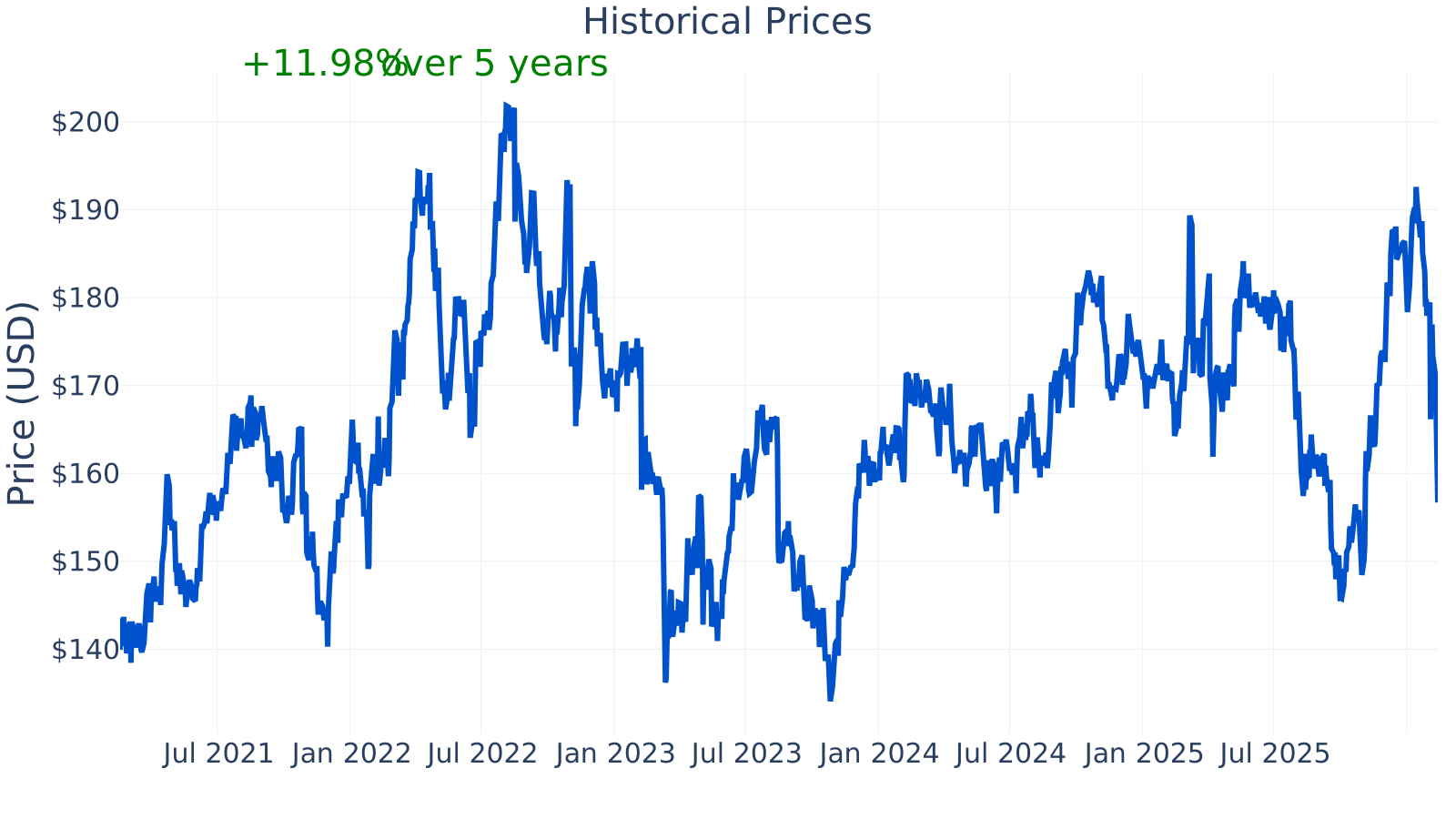
Jack Henry’s market capitalization is about $11.35B, and its beta of ~0.71 indicates the stock has historically moved less than the broader market on average. The company’s profit margin is ~20.6%, which is notably higher than the industry median (~4.9%), suggesting stronger profitability than many peers in the same broad industry grouping. Recent year-over-year revenue growth is ~7.9% (vs. ~5.9% industry median). Debt appears modest with debt-to-equity around ~4.9% (vs. ~58.5% industry median). Trailing twelve-month free cash flow is about $654M, which matters because cash generation helps fund investment in the business and shareholder returns without depending as much on external financing.
Growth (Medium)
Jack Henry operates in a part of the financial technology ecosystem that is shaped by long-running trends: ongoing digitization of banking, rising customer expectations for mobile and online features, security needs, and increasing complexity in payments and data connectivity. Community and mid-sized financial institutions, which are a core customer base for Jack Henry, still need modern technology to compete, comply with regulations, and serve customers efficiently.
The company’s strategy generally centers on deepening relationships with existing customers (adding more products and services over time) and continuing to modernize its technology stack. Because core systems sit at the center of a bank or credit union’s operations, customer retention can be meaningful, and incremental product adoption can be a steady growth driver when executed well.
The year-over-year revenue growth shown is mostly in the mid-single-digit to low-double-digit range, with the latest point around 7.9%. That pattern is consistent with a mature business that can still expand through a combination of new wins, additional modules, and ongoing processing and support revenue.
Free cash flow has fluctuated over time (including a weaker point around 2023) but trends higher in the most recent periods shown, reaching roughly $481M (as of 2025-03-31 on the chart) and about $654M on a trailing twelve-month basis in the latest metrics. For long-term business durability, consistently converting earnings into cash is important because it can support reinvestment, acquisitions, and capital returns.
Risks (Medium)
A key risk for Jack Henry is that its customers operate in a heavily regulated, security-sensitive environment. Problems such as service outages, implementation delays, cybersecurity incidents, or failures in third-party dependencies can damage reputation and create financial and legal exposure. In addition, while core banking relationships can be sticky, contract renewals and competitive bids still matter; winning and retaining customers depends on product quality, pricing, and execution.
Competition is another central risk. Jack Henry competes with other core banking and financial institution technology providers, including large, well-resourced vendors. Competitive pressure can show up through pricing, incentives to switch platforms, or faster innovation cycles in digital experiences and integration tooling. The company’s competitive advantages are typically associated with specialization in serving banks and credit unions, embedded long-term relationships, and the operational complexity involved in switching core systems. However, leadership depends on the specific segment (banks vs. credit unions, size tiers, and product lines), and competitive positioning can vary across those niches.
Financial risk from leverage appears limited in the figures shown:
Debt-to-equity trends low versus the industry median across the timeline, ending around 4.9% (compared with an industry median near 58.5%). Lower leverage can reduce sensitivity to interest rates and refinancing conditions, though it does not eliminate operating or competitive risks.
Profitability is a relative strength, but margins can still be pressured by wage inflation, cloud and hosting costs, product investment needs, or customer pricing dynamics:
The profit margin rises over time to about 20.6%, while the industry median in the chart remains much lower. This gap suggests strong cost control and/or favorable economics of the company’s product and service mix, but it can narrow if costs rise faster than revenue or if competitive pricing intensifies.
Valuation
Valuation is often discussed using the price-to-earnings (P/E) ratio, which compares the stock price to the company’s earnings. A higher P/E can imply the market expects steadier growth, lower risk, or higher quality earnings, but it can also mean expectations are already high.
The latest P/E is about 22.5, compared with an industry median around 19.2 in the latest metrics. Historically in the chart, Jack Henry’s P/E was notably higher earlier in the period (often above 30) and has moved downward into the mid-20s. In context, the valuation appears to reflect a business that is profitable and relatively stable (as suggested by margins and beta), with moderate growth rather than very high growth. The PEG ratio of ~2.45 (which relates valuation to growth) indicates the valuation is not low relative to growth expectations, though PEG is sensitive to the assumptions used to estimate growth.
Conclusion
Jack Henry & Associates is a specialized provider of technology that supports banks and credit unions, with a business model that commonly benefits from long-lived customer relationships and recurring service activity. The company shows strong profitability compared with its broad industry grouping and low leverage, alongside mid-single-digit to low-double-digit revenue growth and meaningful free cash flow generation.
The main areas to watch over time are competitive dynamics in core banking and digital services, execution quality (including system reliability and cybersecurity), and whether ongoing product investment continues translating into sustainable growth. On valuation, the P/E level is above the industry median in the latest metrics, which suggests the market is assigning a quality premium relative to some peers, while still implying expectations that are more consistent with steady growth than rapid expansion.
Sources:
- SEC EDGAR — Jack Henry & Associates, Inc. Form 10-K (Annual Report)
- SEC EDGAR — Jack Henry & Associates, Inc. Form 10-Q (Quarterly Report)
- Jack Henry & Associates Investor Relations — SEC Filings
- Jack Henry & Associates Investor Relations — Press Releases
- Wikipedia — “Jack Henry & Associates”
This article is for informational purposes only and does not constitute financial advice. Some content is AI-generated. See Disclaimer