Stock Analysis · Harmonic Inc (HLIT)
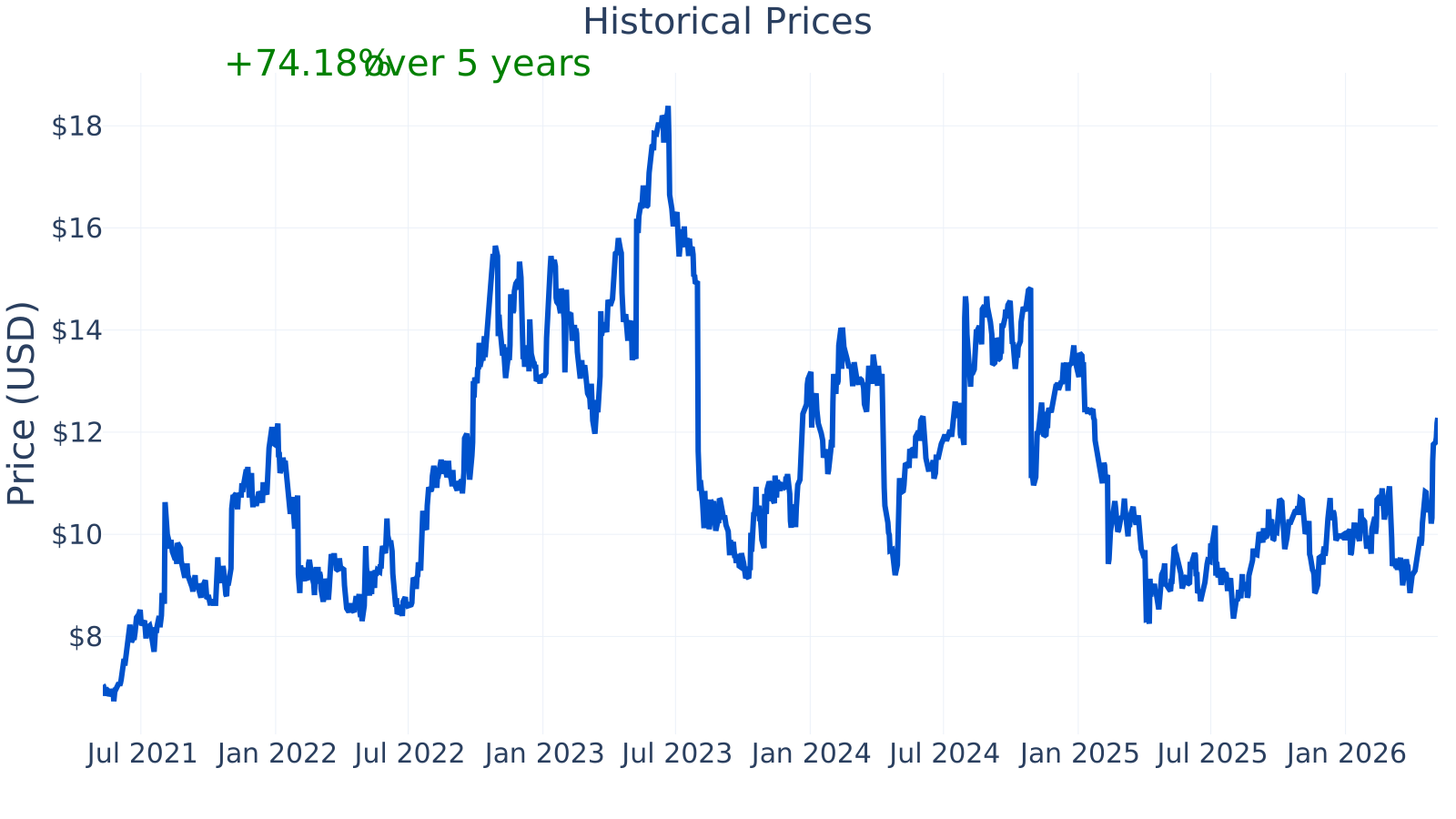
Overview
Harmonic Inc. (HLIT) is a technology company that provides hardware, software, and services used to deliver video and broadband internet services. In simple terms, it sells the equipment and platforms that help cable operators, telecom providers, and media companies distribute TV/video content and provide high-speed internet to end users.
In its SEC filings, Harmonic typically describes its business around two main areas: (1) solutions that help service providers deliver broadband (including virtualized and cloud-enabled platforms), and (2) solutions that support video delivery and streaming workflows. Revenue is generally generated from a mix of product sales (equipment and software) plus services (support, maintenance, and professional services), with results influenced by large customer deployments and project timing.
Based on the company’s reporting structure in its annual filings, the main revenue streams are commonly organized as:
- Broadband solutions (platforms and related software/services used by broadband network operators)
- Video solutions (video processing, production, and delivery solutions, plus related services)
Because revenue mix can shift year to year (and exact percentages depend on the latest annual report segment detail), the most reliable way to confirm the current split is the most recent Form 10-K segment footnote.
Business profitability can change quickly depending on volumes and operating costs. For example, total revenue rose from about $507M (2021) to $679M (2024), then dropped to about $361M (2025). Over the same period, operating income remained positive in each listed year, but net income swung to a loss in 2025 (details shown in the graphic below).
The same view also highlights that research and development and selling/general/administrative spending are meaningful recurring cost categories, which is typical for a company competing in communications equipment and software markets.
Key Figures
| Metric | Value | Industry ⓘ |
|---|---|---|
| Date | May 08, 2026 | |
| Context | ||
| Sector | Technology | |
| Industry | Communication Equipment | |
| Market Cap ⓘ | $1.33B | |
| Beta ⓘ | 1.24 | |
| Fundamental | ||
| P/E Ratio ⓘ | N/A | 52.85 |
| Profit Margin ⓘ | -12.01% | 3.98% |
| Revenue Growth ⓘ | -55.80% | 17.90% |
| Debt to Equity ⓘ | 38.58% | 78.48% |
| PEG ⓘ | 1.84 | |
| Free Cash Flow ⓘ | $96.89M | |
Harmonic’s market capitalization is about $1.33B, and the stock’s beta of 1.24 indicates it has tended to move more than the broader market. Recent profitability and growth metrics stand out versus the industry median: the latest profit margin is -12.01% (industry median about 3.98%) and the latest year-over-year revenue growth is -55.8% (industry median about 17.9%). On the balance sheet side, debt-to-equity is ~38.6%, below the industry median (~78.5%), while free cash flow over the trailing twelve months is about $96.9M.
Growth (Medium)
Harmonic operates in communications equipment and software markets tied to broadband upgrades, video delivery, and the ongoing shift toward software-based and cloud-enabled infrastructure. These areas can benefit from long-term demand for higher network capacity and improved video workflows, but they can also be cyclical because customers often buy in “project waves” rather than smoothly every quarter.
A key point for long-term context is that Harmonic’s top line has not been consistent recently, which matters because hardware-and-platform businesses often rely on scale to support stable margins. The revenue growth trend below shows periods of strong expansion followed by sharp contractions.
Cash generation is another lens on business momentum. Despite volatility in revenue and earnings, trailing free cash flow increased meaningfully over the period shown, reaching roughly $109.6M by 2025-03-31 (and about $96.9M on the latest metrics table). This can happen when working capital moves favorably, when cost levels are reduced, or when prior investments start generating returns—though it is still important to compare this with longer-term revenue stability.
Potential catalysts (in a strictly factual, non-predictive sense) typically come from large customer wins, expanded deployments with existing operators, and adoption of newer platforms described in the company’s filings—any of which can affect results materially because the customer base can be concentrated and orders can be large.
Risks (High)
The most visible risk signal is operational volatility. The latest figures show a sharp year-over-year revenue decline (down 55.8%), and profitability also turned negative on the most recent margin snapshot (profit margin -12.01%). This combination suggests that results can change quickly when customer spending slows, projects shift, or pricing/competition pressure increases.
Balance sheet leverage looks comparatively moderate against the industry median, which can reduce financial stress during downturns. Debt-to-equity trended lower over time compared with earlier periods, though it rose to about 38.6% in the latest point shown (still below the industry median level in the same chart).
Profitability has also been inconsistent. The margin chart shows periods of healthy positive margins (including double-digit levels in parts of 2024) followed by a move into negative territory by 2025-12-31. For long-term evaluation, this pattern suggests the business may be sensitive to volume swings, product mix changes, and cost discipline.
Competitive positioning is another key risk area. Harmonic participates in markets where customers (large broadband and media operators) often demand reliability, proven performance at scale, and attractive total cost. Competitors can include other communications equipment and software providers offering broadband access platforms, video processing, and related software ecosystems. In practice, competitive advantages in this space usually come from a proven installed base, product performance, interoperability with customer networks, and the ability to support large deployments. Without consistently stable revenue and margins, it can be harder to demonstrate enduring advantage, even if the product is strong.
Additional risks commonly discussed in company risk factors include customer concentration, procurement timing, reliance on key suppliers/partners, and the pace of technology shifts (for example, transitions to virtualized or cloud-based architectures). These factors can increase quarter-to-quarter variability and make long-term forecasting less straightforward.
Valuation
Traditional valuation ratios can be difficult to interpret when earnings are volatile or temporarily negative. In the latest metrics table, the P/E ratio is shown as 0.0, which typically occurs when trailing earnings are near zero or negative (a situation where a standard P/E is not meaningful). In those cases, valuation discussions often lean more on revenue trends, cash flow, and the durability of margins rather than a single earnings multiple.
Looking historically, Harmonic’s P/E (when meaningful) has moved sharply over time, sometimes above and sometimes below the industry median, reflecting changing profitability expectations and earnings levels. When the company’s earnings swing, the market’s valuation framework can shift as well, which can make the stock’s valuation appear to change quickly even without large changes in price.
From a fundamentals-only viewpoint, the current valuation context depends heavily on whether revenues stabilize after the recent decline and whether margins return to consistently positive levels. With a recent negative profit margin and steep year-over-year revenue contraction, it is harder to anchor valuation using “steady state” assumptions; cash flow and balance sheet strength become more important reference points.
Conclusion
Harmonic is positioned in broadband and video delivery infrastructure—areas supported by long-term demand for higher network capacity and modernized video workflows. The company has also shown the ability to generate meaningful free cash flow recently and carries a debt-to-equity level that is lower than the industry median.
At the same time, the recent fundamentals displayed here show high variability: a steep year-over-year revenue decline and a shift to negative profit margin in the latest period. This combination suggests that long-term evaluation depends less on broad industry tailwinds and more on whether Harmonic can convert its technology and customer relationships into steadier revenue and more durable profitability across cycles.
Sources:
- SEC EDGAR — Harmonic Inc. Form 10-K (Annual Report) (segment/business description and risk factors)
- SEC EDGAR — Harmonic Inc. Form 10-Q (Quarterly Reports) (updates to results and risk disclosures)
- Harmonic Inc. Investor Relations — SEC Filings archive (company-hosted access to reports)
- Wikipedia — “Harmonic Inc.” (basic company background)
This article is for informational purposes only and does not constitute financial advice. Some content is AI-generated. See Disclaimer


