Stock Analysis · Harley-Davidson Inc (HOG)
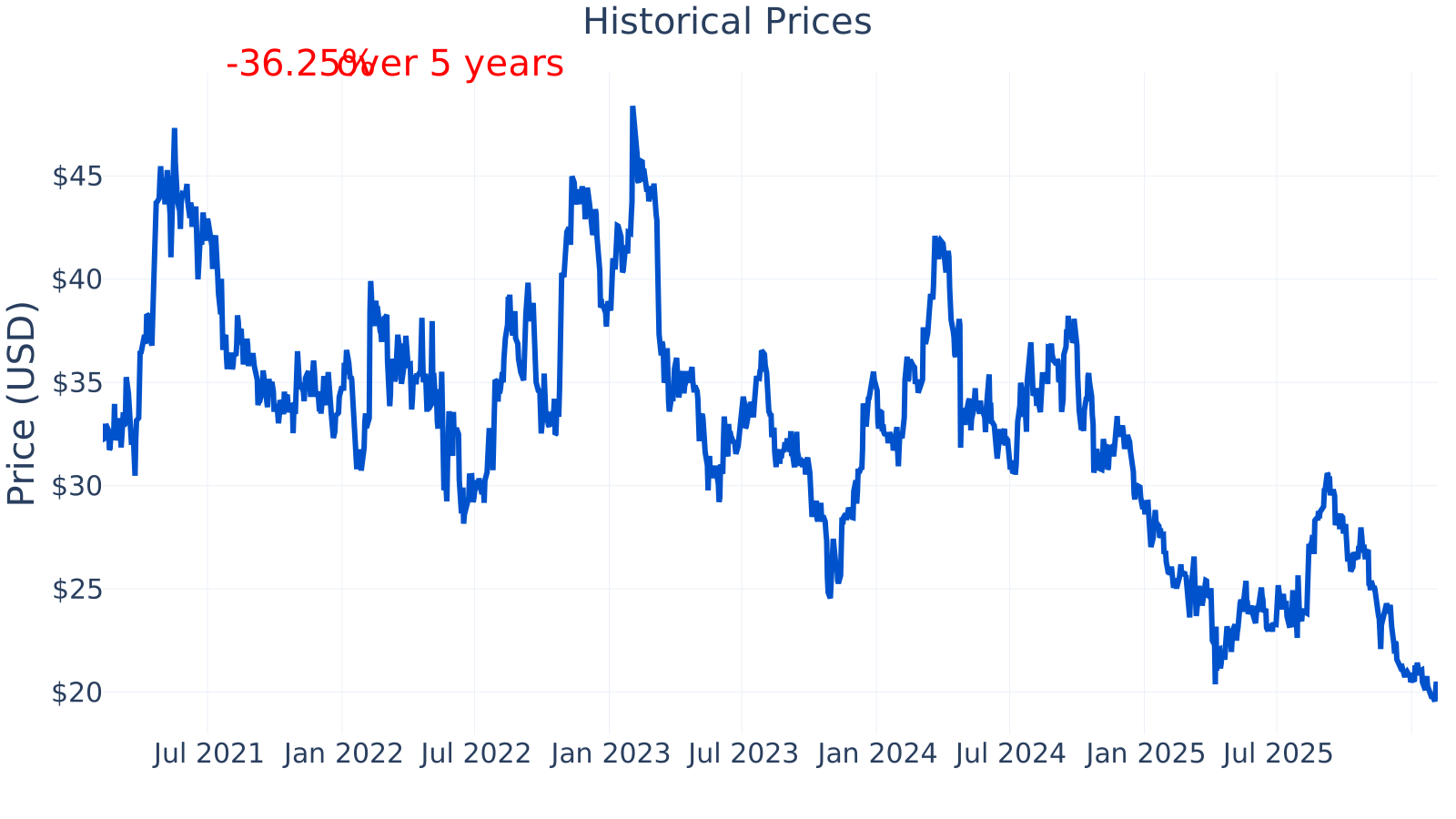
Overview
Harley-Davidson, Inc. is an American manufacturer best known for heavyweight motorcycles sold under the Harley-Davidson brand. Beyond selling bikes, the company also earns money from financing (helping customers and dealers fund purchases), parts and accessories, and branded merchandise and licensing.
Harley-Davidson is organized around a few major activities that together shape its business model:
- Motorcycles (design, manufacturing, and wholesale distribution to dealers)
- Parts & Accessories (aftermarket products sold through the dealer network and other channels)
- Apparel & Licensing (branded clothing and licensing income)
- Financial services (retail and wholesale financing through Harley-Davidson Financial Services)
Over the last several years, total revenue has been in the mid-single-digit billions of dollars annually, with profitability influenced by motorcycle unit volumes, pricing, product mix (higher-margin models vs. entry models), and the health of consumer credit conditions.
The operating picture shown above highlights that the company’s total revenue declined in 2024 versus 2023 (about $5.19B vs. $5.84B). Operating income and net income also fell in 2024 (operating income about $548M; net income about $455M), reflecting a tougher year for demand and/or margins compared with the prior year.
Key Figures
| Metric | Value | Industry ⓘ |
|---|---|---|
| Date | Feb 07, 2026 | |
| Context | ||
| Sector | Consumer Cyclical | |
| Industry | Recreational Vehicles | |
| Market Cap ⓘ | $2.49B | |
| Beta ⓘ | 1.42 | |
| Fundamental | ||
| P/E Ratio ⓘ | 4.88 | 27.18 |
| Profit Margin ⓘ | 10.74% | 2.07% |
| Revenue Growth ⓘ | 16.50% | 12.75% |
| Debt to Equity ⓘ | 145.96% | 113.36% |
| PEG ⓘ | 0.58 | |
| Free Cash Flow ⓘ | $391.85M | |
Harley-Davidson’s market capitalization is about $2.49B, and the stock has a beta of ~1.42, which commonly indicates it has tended to move more than the overall market. On profitability, the company’s profit margin is ~10.7%, which is above the industry median (~2.1%) for the Recreational Vehicles peer group shown. The table also shows a P/E ratio of ~4.9 versus an industry median of ~27.2. Revenue growth year-over-year is listed at ~16.5% (industry median ~12.8%), while debt-to-equity is ~146% (industry median ~113%). Free cash flow over the trailing twelve months is about $392M.
Growth (Medium)
Harley-Davidson operates in the recreational vehicle and motorcycle market, which tends to be economically sensitive: sales often rise when consumers feel confident and financing is easily available, and can soften when interest rates are high or discretionary spending tightens. That backdrop can make growth uneven from year to year, even for strong brands.
A key long-term question for the company is how effectively it can balance:
- Premium positioning (protecting pricing and brand value)
- Reaching new riders (bringing in younger customers and expanding beyond its historical core)
- International opportunities (growth outside the U.S., where competitive dynamics differ)
The year-over-year revenue growth pattern has been volatile. After stronger periods earlier in the timeline, growth turns negative across several recent quarters (including deeper declines in late 2024 and early-to-mid 2025). This kind of swing is consistent with a discretionary product category where demand can change quickly with consumer conditions.
Free cash flow (cash generated after operating needs and capital spending) has also moved up and down over time. It declined from 2021 into 2023, then improved in 2024 and again in early 2025 before settling around $392M on a trailing basis. For long-term business strength, the main point is whether the company can generate cash consistently across a full economic cycle, not just in peak years.
Risks (High)
Harley-Davidson’s business faces several meaningful risks. Demand for motorcycles is tied to discretionary spending and borrowing costs, so a weaker economy or tighter credit can reduce purchases and dealer inventory appetite. The company also has exposure to manufacturing and supply chain pressures, as well as foreign exchange and tariff-related effects for international sales and sourcing.
Another structural risk is demographic and preference shifts. If fewer new riders enter heavyweight motorcycling, or if competitors capture more of the interest in adjacent categories (such as adventure, sport, or lower-displacement motorcycles), it can pressure long-term volumes. Product execution matters: new model launches, quality, and the ability to maintain brand relevance are central to staying competitive.
Leverage is an important consideration. The latest debt-to-equity level is about 146%, above the peer median shown (~113%). The chart also shows that leverage has been much higher at points in the past and has fluctuated significantly. Part of this is tied to the presence of a financial services arm (which naturally uses debt funding), but higher leverage still increases sensitivity to interest rates and credit conditions.
Profitability has generally been stronger than the peer median across the period shown, but it also fluctuates. Harley-Davidson’s profit margin dips meaningfully in parts of 2024–2025 before rising again most recently (to roughly 11.4%). Sustaining margins depends on pricing discipline, product mix, warranty/quality outcomes, and how promotional the industry becomes during slower demand periods.
Competitive positioning is a mix of strengths and challenges. Harley-Davidson has a globally recognized brand, a distinctive product identity, and a large dealer network—these are real advantages that are difficult to replicate quickly. At the same time, it competes in a market with capable and well-capitalized rivals. Key competitors include:
- Indian Motorcycle (Polaris)
- Honda, Yamaha, Suzuki, and Kawasaki (broad lineups across categories and price points)
- BMW Motorrad and Ducati (strong premium competitors in specific segments)
Harley-Davidson is not the largest motorcycle producer globally by volume, but it is a leading brand in the heavyweight cruiser segment where its identity and community are especially strong.
Valuation
The valuation picture looks different depending on what someone expects for future growth and risk. The latest P/E ratio is ~4.9, which is well below the industry median (~27.2) shown. Historically on the chart, Harley-Davidson’s P/E has often been below the peer median in recent years, though it has varied over time.
In plain terms, a lower P/E can indicate the market is assigning a lower multiple to current earnings, which can happen when investors expect slower growth, higher cyclicality, or higher uncertainty. In Harley-Davidson’s case, the recent revenue declines (seen in the growth chart) and the business’s sensitivity to consumer conditions are part of the context that can influence how the market values the company.
Conclusion
Harley-Davidson is a well-known consumer brand with a long operating history in motorcycles, supported by complementary revenue streams such as parts, accessories, and financing. The company has demonstrated the ability to produce solid profit margins relative to the peer median shown, and it has generated meaningful free cash flow over time, although both revenue growth and cash generation have been uneven.
The main long-term uncertainties are tied to the category’s cyclicality, shifting consumer preferences, and competitive pressure across multiple motorcycle segments. Leverage and the presence of a financing arm add sensitivity to credit conditions and interest rates. From a valuation perspective, the company currently trades at a much lower earnings multiple than the peer median shown, which aligns with a market view that assigns elevated risk and/or lower expected growth to the business.
Sources:
- U.S. SEC EDGAR — Harley-Davidson, Inc. Form 10-K (Annual Report)
- Harley-Davidson Investor Relations — SEC Filings
- Harley-Davidson Investor Relations — Quarterly Reports (Form 10-Q)
- Wikipedia — Harley-Davidson
This article is for informational purposes only and does not constitute financial advice. Some content is AI-generated. See Disclaimer


