Stock Analysis · Harley-Davidson Inc (HOG)
Overview
Harley-Davidson, Inc. is an American manufacturer best known for heavyweight motorcycles sold under the Harley-Davidson brand. Beyond selling bikes, the company also earns money from financing (helping customers and dealers fund purchases), parts and accessories, and branded merchandise and licensing.
Harley-Davidson is organized around a few major activities that together shape its business model:
- Motorcycles (design, manufacturing, and wholesale distribution to dealers)
- Parts & Accessories (aftermarket products sold through the dealer network and other channels)
- Apparel & Licensing (branded clothing and licensing income)
- Financial services (retail and wholesale financing through Harley-Davidson Financial Services)
Over the last several years, total revenue has been in the mid-single-digit billions of dollars annually, with profitability influenced by motorcycle unit volumes, pricing, product mix (higher-margin models vs. entry models), and the health of consumer credit conditions.
The operating picture shown above highlights that the company’s total revenue declined in 2024 versus 2023 (about $5.19B vs. $5.84B). Operating income and net income also fell in 2024 (operating income about $548M; net income about $455M), reflecting a tougher year for demand and/or margins compared with the prior year.
Key Figures
| Metric | Value | Industry ⓘ |
|---|---|---|
| Date | Feb 07, 2026 | |
| Context | ||
| Sector | Consumer Cyclical | |
| Industry | Recreational Vehicles | |
| Market Cap ⓘ | $2.49B | |
| Beta ⓘ | 1.42 | |
| Fundamental | ||
| P/E Ratio ⓘ | 4.88 | 27.18 |
| Profit Margin ⓘ | 10.74% | 2.07% |
| Revenue Growth ⓘ | 16.50% | 12.75% |
| Debt to Equity ⓘ | 145.96% | 113.36% |
| PEG ⓘ | 0.58 | |
| Free Cash Flow ⓘ | $391.85M | |
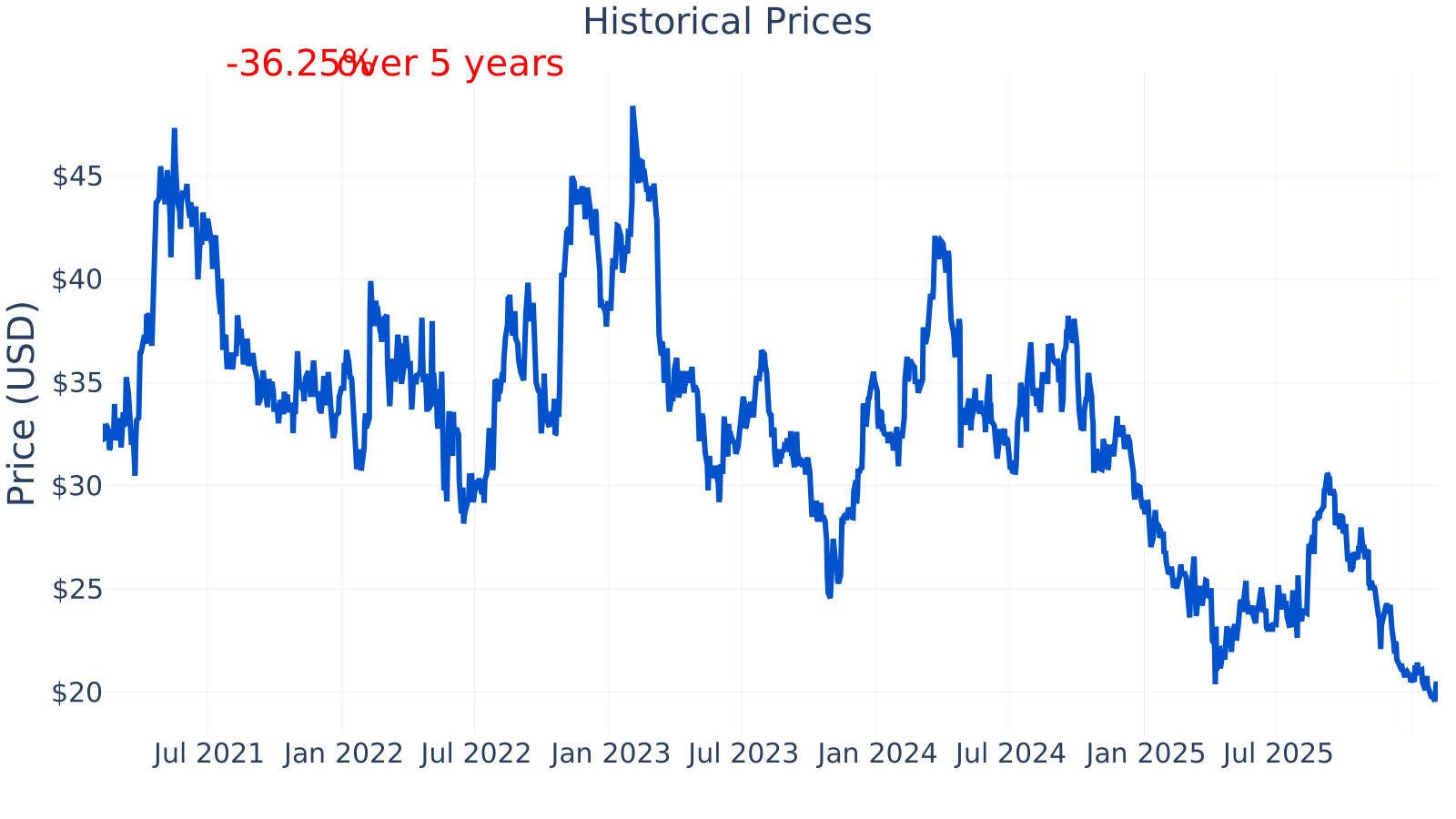
Harley-Davidson’s market capitalization is about $2.49B, and the stock has a beta of ~1.42, which commonly indicates it has tended to move more than the overall market. On profitability, the company’s profit margin is ~10.7%, which is above the industry median (~2.1%) for the Recreational Vehicles peer group shown. The table also shows a P/E ratio of ~4.9 versus an industry median of ~27.2. Revenue growth year-over-year is listed at ~16.5% (industry median ~12.8%), while debt-to-equity is ~146% (industry median ~113%). Free cash flow over the trailing twelve months is about $392M.
Growth (Medium)
Harley-Davidson operates in the recreational vehicle and motorcycle market, which tends to be economically sensitive: sales often rise when consumers feel confident and financing is easily available, and can soften when interest rates are high or discretionary spending tightens. That backdrop can make growth uneven from year to year, even for strong brands.
A key long-term question for the company is how effectively it can balance:
- Premium positioning (protecting pricing and brand value)
- Reaching new riders (bringing in younger customers and expanding beyond its historical core)
- International opportunities (growth outside the U.S., where competitive dynamics differ)
The year-over-year revenue growth pattern has been volatile. After stronger periods earlier in the timeline, growth turns negative across several recent quarters (including deeper declines in late 2024 and early-to-mid 2025). This kind of swing is consistent with a discretionary product category where demand can change quickly with consumer conditions.
Free cash flow (cash generated after operating needs and capital spending) has also moved up and down over time. It declined from 2021 into 2023, then improved in 2024 and again in early 2025 before settling around $392M on a trailing basis. For long-term business strength, the main point is whether the company can generate cash consistently across a full economic cycle, not just in peak years.
Risks (High)
This article is for informational purposes only and does not constitute financial advice. Some content is AI-generated. See Disclaimer