Stock Analysis · HNI Corp (HNI)
Overview
HNI Corp is a U.S.-based manufacturer focused on workplace and residential products. In simple terms, it makes and sells office furniture (for businesses and institutions) and heating products (for homes), serving customers through dealers, retailers, and direct/contract channels depending on the product line.
HNI reports two main operating segments that explain where revenue typically comes from:
- Workplace Furnishings (office furniture and related solutions)
- Residential Building Products (hearth products such as fireplaces, inserts, stoves, and related accessories)
Public filings describe these as the company’s primary revenue streams; exact percentage splits can change year to year and are best read directly from the latest annual report segment note.
The multi-year income “flow” below helps visualize how revenue turns into profit. Across 2021–2025, total revenue increased overall (from about $2.18B in 2021 to about $2.84B in 2025). Over the same period, operating profit and net income moved up and down rather than rising steadily, showing that costs and operating expenses (including selling and administrative spending, and interest expense) can materially affect bottom-line results.
Key Figures
| Metric | Value | Industry ⓘ |
|---|---|---|
| Date | May 04, 2026 | |
| Context | ||
| Sector | Consumer Cyclical | |
| Industry | Furnishings, Fixtures & Appliances | |
| Market Cap ⓘ | $2.70B | |
| Beta ⓘ | 1.01 | |
| Fundamental | ||
| P/E Ratio ⓘ | 33.73 | 23.21 |
| Profit Margin ⓘ | 1.91% | 3.93% |
| Revenue Growth ⓘ | 38.30% | 5.80% |
| Debt to Equity ⓘ | 88.90% | 100.56% |
| PEG ⓘ | 0.47 | |
| Free Cash Flow ⓘ | $210.40M | |
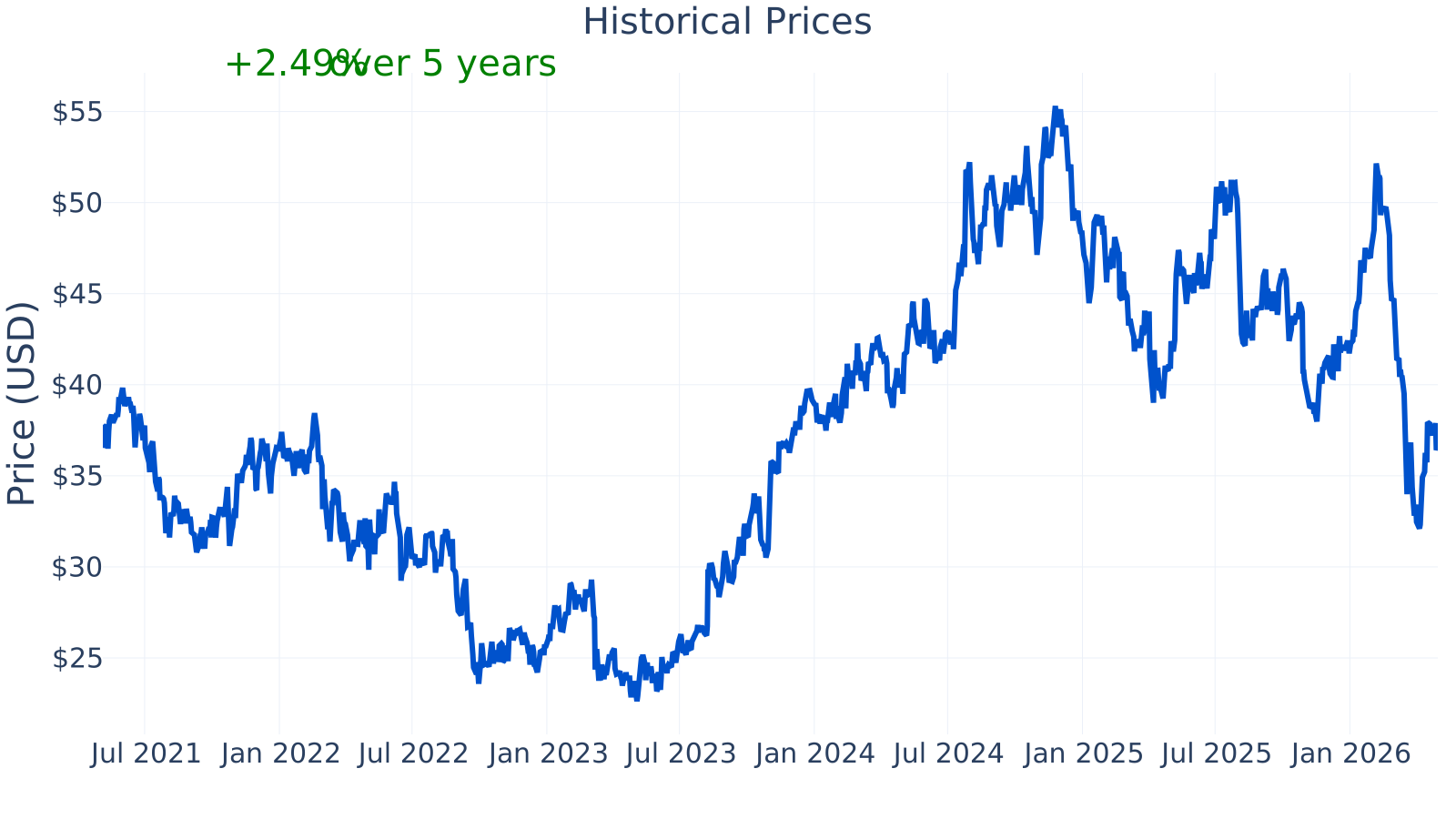
At a recent point in time, HNI’s market capitalization is about $2.7B and the stock’s beta is about 1.01, which is close to overall market sensitivity. The company’s P/E ratio is ~33.7 versus an industry median around 23.2, while its profit margin is ~1.9% versus an industry median near 3.9%. Recent year-over-year revenue growth is ~38.3% (industry median ~5.8%). Debt-to-equity is about 88.9%, somewhat below the industry median near 100.6%. Trailing twelve-month free cash flow is about $210.4M.
Growth (Medium)
HNI operates in furnishings and residential building products—areas that tend to be economically sensitive. Demand can rise when business investment, construction activity, and consumer spending are strong, and can slow when budgets tighten or interest rates and housing affordability pressure discretionary purchases. This means the long-term backdrop is not purely “structural growth”; it is a mix of replacement cycles, new construction/renovation activity, and business spending cycles.
What can support growth over time is the company’s ability to (1) keep products relevant and differentiated, (2) manage costs and pricing as input costs change, and (3) expand distribution and product categories within its two core segments. In filings, companies in HNI’s position typically emphasize innovation, channel coverage (dealers/retail/contract), and operational efficiency as repeatable levers—even when end markets fluctuate.
The revenue growth pattern has been uneven, including periods of contraction followed by re-acceleration. The most recent quarter shown reflects a sharp rebound (around +38% year over year), which stands out versus the broader peer median.
Cash generation is important for a manufacturer because it funds investment in operations, product development, and shareholder returns while buffering downturns. HNI’s trailing twelve-month free cash flow has increased substantially from early-2022 levels (tens of millions) to above $200M more recently, indicating improved cash generation over this period.
Risks (Medium-High)
HNI’s business is exposed to economic cycles. Workplace furniture demand can be influenced by corporate hiring, office space decisions, and large project timing. Residential building products can be sensitive to housing turnover, remodeling activity, and consumer confidence. In weaker periods, volumes can decline, which can pressure profitability if fixed costs cannot be reduced quickly.
Profitability is a key risk area to monitor because it can swing with product mix, pricing, freight/material costs, and operating expense levels. The profit margin series shows meaningful variability over time, and the most recent value shown (about 1.9%) is below the industry median (about 3.9%). That gap does not automatically indicate a structural disadvantage, but it does highlight that maintaining margins is a recurring execution challenge.
Leverage is another consideration. HNI’s debt-to-equity ratio has moved around over the past several years, and the latest value shown is roughly 88.9%, somewhat below the industry median near 100.6%. Even when leverage is not extreme, higher interest rates can raise interest expense as debt reprices or new financing is needed, which can affect net income.
Competition is also significant. In workplace furnishings, HNI competes with other large office furniture manufacturers and a broad set of regional and niche providers; competition can be based on design, ergonomics, price, delivery reliability, sustainability attributes, and dealer relationships. In residential building products, competition includes other hearth and heating product manufacturers, with positioning influenced by brand reputation, product safety/certification, features, and distribution reach. HNI’s potential competitive advantages typically relate to scale in manufacturing, established brands, long-standing dealer/distributor networks, and the ability to serve both large projects and ongoing replacement demand; however, the market is not a “winner-take-all” structure, and share can shift with product cycles and channel dynamics.
Valuation
Valuation is often summarized through ratios like price-to-earnings (P/E). A higher P/E can reflect expectations of higher future earnings, lower perceived risk, or temporarily depressed earnings (which mechanically raises the ratio). A lower P/E can reflect lower growth expectations, higher perceived risk, or temporarily elevated earnings.
HNI’s latest P/E (about 33.7) is above the industry median (about 23.2). Historically, the company’s P/E shown has varied widely—ranging from single digits at some points to much higher levels at others—indicating that the market’s expectations and/or the earnings baseline has changed materially over time.
In context with fundamentals shown earlier, the combination of (1) above-median P/E, (2) below-median current profit margin, and (3) strong recent year-over-year revenue growth suggests that the current valuation likely embeds expectations that profitability and earnings power will improve from recent levels (or remain resilient) rather than remain near the most recent margin reading.
Conclusion
HNI Corp is a manufacturing business centered on workplace furnishings and residential building products, with results that can be influenced by economic conditions and customer spending cycles. Over the past several years, revenue has risen overall, free cash flow has strengthened, and leverage appears broadly in line with (or slightly below) the industry median, while profitability has been variable and recently below the peer median.
The main long-term question for the company’s fundamentals is whether it can sustain growth while keeping costs and operating expenses controlled enough to translate sales into consistently stronger margins and earnings. Valuation metrics show the stock trading at a higher P/E than the industry median, which increases the importance of execution and durability of profitability through cycles.
Sources:
- SEC EDGAR — HNI Corp filings (Form 10-K, “Business” and “Management’s Discussion and Analysis”; segment reporting and risk factors)
- SEC EDGAR — HNI Corp filings (Form 10-Q, quarterly updates to results, liquidity, and risk disclosures)
- HNI Corp Investor Relations — Annual Report (segment descriptions and business overview)
- Wikipedia — “HNI Corporation” (basic company background; non-financial encyclopedic context)
This article is for informational purposes only and does not constitute financial advice. Some content is AI-generated. See Disclaimer


