Stock Analysis · Group 1 Automotive Inc (GPI)
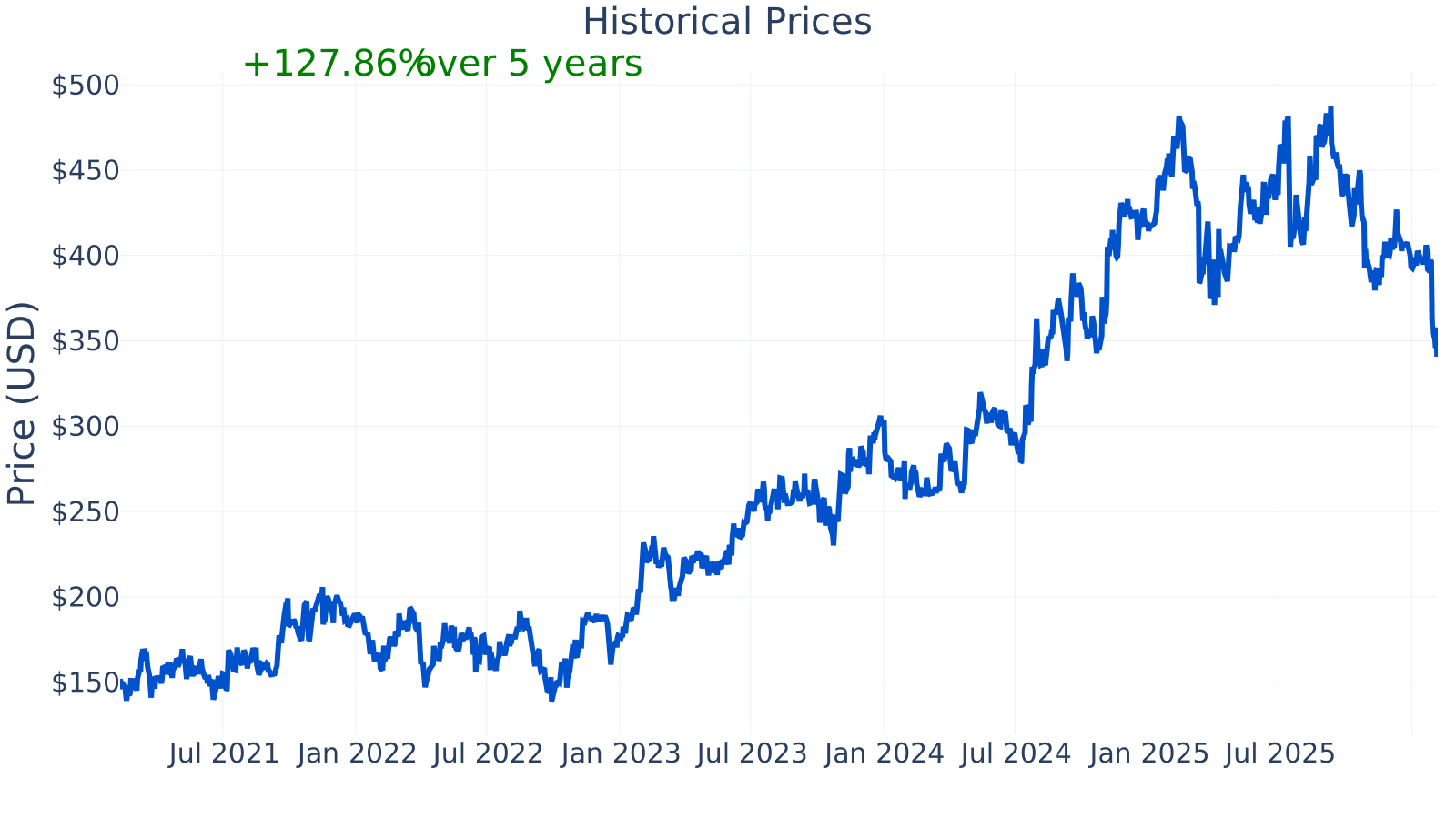
Overview
Group 1 Automotive, Inc. (GPI) is a large auto retailer. In simple terms, it operates car dealerships that sell new and used vehicles and provide after-sales services such as maintenance and repairs. Like many dealership groups, it also earns income by arranging financing and selling protection products (for example, service contracts) at the time of vehicle purchase.
Its business model is built around a mix of (1) vehicle sales, which tend to be high in revenue but lower in profit per dollar of sales, and (2) service and finance-related activities, which often produce steadier and higher-margin profit over the life of a customer relationship.
Main sources of revenue are typically organized as:
- New vehicle sales (often the largest revenue line for dealership groups)
- Used vehicle sales
- Parts and service (repairs, maintenance, parts)
- Finance and insurance (F&I) (arranging loans/leases and selling related products)
In recent years, total revenue increased materially, but profitability has not followed the same direction at the bottom line. From 2021 to 2025, revenue rose from about $13.5B to about $22.6B, while net income decreased from about $552M to about $322M. Over the same period, interest expense increased (about $83M in 2021 to about $284M in 2025), which can matter for a business that uses financing to operate and grow.
This long-term snapshot suggests a company that has been able to expand its sales base, but with a combination of higher operating costs and higher interest expense weighing on net income more recently.
Key Figures
| Metric | Value | Industry ⓘ |
|---|---|---|
| Date | Feb 08, 2026 | |
| Context | ||
| Sector | Consumer Cyclical | |
| Industry | Auto & Truck Dealerships | |
| Market Cap ⓘ | $4.37B | |
| Beta ⓘ | 0.89 | |
| Fundamental | ||
| P/E Ratio ⓘ | 13.77 | 16.79 |
| Profit Margin ⓘ | 1.44% | 2.73% |
| Revenue Growth ⓘ | 0.60% | 5.70% |
| Debt to Equity ⓘ | 132.64% | 143.50% |
| PEG ⓘ | 0.76 | |
| Free Cash Flow ⓘ | $494.00M | |
GPI’s market capitalization is about $4.37B. The stock’s beta of ~0.89 indicates it has historically moved somewhat less than the overall market on average (though individual periods can differ).
On valuation, the latest P/E ratio is ~13.8, below the industry median of about 16.8 (based on the peer set provided). On profitability, the latest profit margin is ~1.44%, below the industry median of about 2.73%. Growth has recently been modest: the latest year-over-year revenue growth is ~0.61%, well below the industry median of about 5.7%. Leverage is notable but not out of line for the sector: debt-to-equity is ~133% versus an industry median around 143%. Finally, trailing twelve-month free cash flow is about $494M, which is an important indicator of the cash left after operating needs and capital spending.
Growth (Medium)
Auto retail is a large, mature industry that tends to move in cycles. Demand is influenced by interest rates, consumer confidence, vehicle affordability, and the supply of new and used vehicles. Over the long run, dealership groups can still grow by adding locations (acquisitions), improving efficiency, and expanding higher-value services such as maintenance, repairs, and finance-related products.
Recent revenue growth has slowed meaningfully compared with the stronger growth rates seen earlier in the period shown. That pattern can be consistent with normalization after unusually strong conditions in prior years (for example, periods with tight inventory and stronger pricing), but it also means future results may depend more on execution and industry conditions than on broad, easy tailwinds.
Cash generation is another lens on growth capacity. Free cash flow can support reinvestment (such as facility upgrades), acquisitions, debt reduction, or shareholder returns, but it can also be volatile in dealership operations due to working-capital needs (especially vehicle inventory) and timing effects.
In this history, free cash flow has varied significantly year to year (from very high levels earlier in the period to much lower levels at one point, then recovering). That variability highlights that growth and cash returns may not be smooth in this industry, even for scaled operators.
Risks (High)
A key risk for dealership groups is cyclicality. Vehicle sales can fall during economic slowdowns, and higher interest rates can reduce affordability for financed purchases. A second major risk is margin pressure. Dealership profitability can compress when vehicle pricing becomes more competitive, when incentives change, or when costs (labor, facilities, technology) rise faster than gross profit.
The profit margin trend shown declines from the higher levels earlier in the period (around the 3%–4% range) to about 1.44% most recently. Even small percentage changes matter in an industry where revenue is large but margins are thin, so profitability can be sensitive to shifts in pricing, product mix (new vs. used), and service demand.
Leverage is another important consideration. Dealership groups often carry meaningful debt and also rely on inventory financing (commonly called floorplan financing in the industry). Higher interest expense can reduce net income, and tighter credit conditions can make financing more expensive or less available.
The most recent debt-to-equity level of about 133% is slightly below the peer median provided, and the series shows it has moved around over time. Even if comparable to peers, this is still a leveraged balance-sheet profile, which can amplify results in both strong and weak markets.
In terms of competitive positioning, Group 1 Automotive competes with other large public dealership groups and with many local and regional dealer operators. Large peers benefit from scale (purchasing, systems, brand relationships, access to capital), while local dealers may compete aggressively on price or have strong local customer loyalty. Competitive advantages in this space often come from operational discipline, cost control, strong execution in parts and service, effective digital retailing, and the ability to acquire and integrate dealerships successfully. Leadership is generally shared across several large groups rather than dominated by a single player.
Valuation
The P/E ratio shown for GPI has risen over time from the mid-single digits earlier in the period to the low teens more recently, ending around 13.5 on the chart. The latest level (~13.8) remains below the industry median (~16.8) in the peer set provided, which indicates the market is valuing GPI at a lower earnings multiple than many peers at the moment.
Whether that lower multiple is “cheap” or “expensive” cannot be determined from the P/E alone. It can also reflect fundamental context: the company’s profit margin has been trending down, revenue growth has recently been low, and interest expense has been rising in the multi-year income snapshot. At the same time, the company is generating meaningful free cash flow over the trailing twelve months and remains within the general leverage range of its industry peers, which can support business flexibility if sustained.
Conclusion
Group 1 Automotive is a scaled dealership operator with diversified revenue streams across vehicle sales, service/parts, and finance-related activities. The company has expanded revenue materially over the last several years, which points to business scale and ongoing demand for its offerings.
However, the recent picture includes several fundamentals that are important for long-term readers to weigh: profitability has declined versus earlier years, revenue growth has slowed sharply in the most recent period shown, and interest expense has increased over time. These are common pressure points in a cyclical, competitive industry where margins are thin and financing conditions matter.
From a valuation standpoint, the stock’s earnings multiple is below the industry median in the peer set provided, which is consistent with the market applying a discount relative to peers. Interpreting that discount depends on whether margins and cash generation stabilize and whether the company can navigate industry cycles and financing costs without further profit compression.
Sources:
- SEC EDGAR — Group 1 Automotive, Inc. filings (Form 10-K, Form 10-Q)
- Group 1 Automotive, Inc. — Investor Relations materials (annual report / filings)
- Wikipedia — “Group 1 Automotive” (basic company background)
This article is for informational purposes only and does not constitute financial advice. Some content is AI-generated. See Disclaimer


