Stock Analysis · Group 1 Automotive Inc (GPI)
Overview
Group 1 Automotive, Inc. (GPI) is a large auto retailer. In simple terms, it operates car dealerships that sell new and used vehicles and provide after-sales services such as maintenance and repairs. Like many dealership groups, it also earns income by arranging financing and selling protection products (for example, service contracts) at the time of vehicle purchase.
Its business model is built around a mix of (1) vehicle sales, which tend to be high in revenue but lower in profit per dollar of sales, and (2) service and finance-related activities, which often produce steadier and higher-margin profit over the life of a customer relationship.
Main sources of revenue are typically organized as:
- New vehicle sales (often the largest revenue line for dealership groups)
- Used vehicle sales
- Parts and service (repairs, maintenance, parts)
- Finance and insurance (F&I) (arranging loans/leases and selling related products)
In recent years, total revenue increased materially, but profitability has not followed the same direction at the bottom line. From 2021 to 2025, revenue rose from about $13.5B to about $22.6B, while net income decreased from about $552M to about $322M. Over the same period, interest expense increased (about $83M in 2021 to about $284M in 2025), which can matter for a business that uses financing to operate and grow.
This long-term snapshot suggests a company that has been able to expand its sales base, but with a combination of higher operating costs and higher interest expense weighing on net income more recently.
Key Figures
| Metric | Value | Industry ⓘ |
|---|---|---|
| Date | Feb 08, 2026 | |
| Context | ||
| Sector | Consumer Cyclical | |
| Industry | Auto & Truck Dealerships | |
| Market Cap ⓘ | $4.37B | |
| Beta ⓘ | 0.89 | |
| Fundamental | ||
| P/E Ratio ⓘ | 13.77 | 16.79 |
| Profit Margin ⓘ | 1.44% | 2.73% |
| Revenue Growth ⓘ | 0.60% | 5.70% |
| Debt to Equity ⓘ | 132.64% | 143.50% |
| PEG ⓘ | 0.76 | |
| Free Cash Flow ⓘ | $494.00M | |
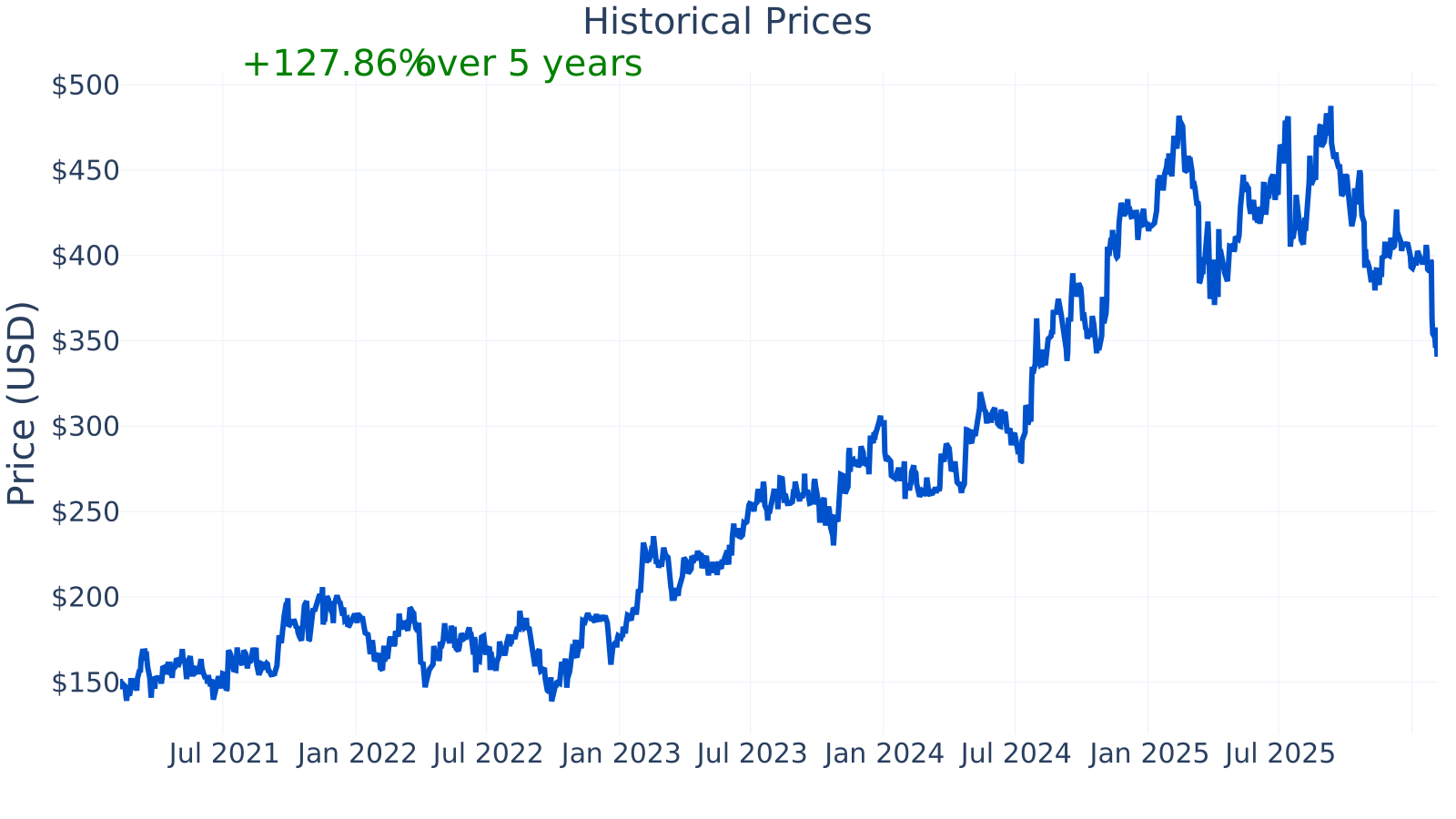
GPI’s market capitalization is about $4.37B. The stock’s beta of ~0.89 indicates it has historically moved somewhat less than the overall market on average (though individual periods can differ).
On valuation, the latest P/E ratio is ~13.8, below the industry median of about 16.8 (based on the peer set provided). On profitability, the latest profit margin is ~1.44%, below the industry median of about 2.73%. Growth has recently been modest: the latest year-over-year revenue growth is ~0.61%, well below the industry median of about 5.7%. Leverage is notable but not out of line for the sector: debt-to-equity is ~133% versus an industry median around 143%. Finally, trailing twelve-month free cash flow is about $494M, which is an important indicator of the cash left after operating needs and capital spending.
Growth (Medium)
Auto retail is a large, mature industry that tends to move in cycles. Demand is influenced by interest rates, consumer confidence, vehicle affordability, and the supply of new and used vehicles. Over the long run, dealership groups can still grow by adding locations (acquisitions), improving efficiency, and expanding higher-value services such as maintenance, repairs, and finance-related products.
Recent revenue growth has slowed meaningfully compared with the stronger growth rates seen earlier in the period shown. That pattern can be consistent with normalization after unusually strong conditions in prior years (for example, periods with tight inventory and stronger pricing), but it also means future results may depend more on execution and industry conditions than on broad, easy tailwinds.
Cash generation is another lens on growth capacity. Free cash flow can support reinvestment (such as facility upgrades), acquisitions, debt reduction, or shareholder returns, but it can also be volatile in dealership operations due to working-capital needs (especially vehicle inventory) and timing effects.
In this history, free cash flow has varied significantly year to year (from very high levels earlier in the period to much lower levels at one point, then recovering). That variability highlights that growth and cash returns may not be smooth in this industry, even for scaled operators.
Risks (High)
This article is for informational purposes only and does not constitute financial advice. Some content is AI-generated. See Disclaimer