Stock Analysis · Grindr Inc (GRND)
Overview
Grindr Inc. (GRND) operates a location-based social networking app primarily serving gay, bisexual, transgender, and queer people. The product is designed to help users connect and communicate, and the business is monetized mainly through paid features and advertising. As a mobile-first platform, the company’s results depend heavily on user engagement, subscription conversion, and the efficiency of user acquisition and retention efforts.
In broad terms, Grindr’s revenue comes from:
- Direct (paid) revenue: subscriptions and in-app purchases for premium functionality
- Advertising revenue: ads displayed to users, often tied to usage time and audience targeting
Public filings describe these as the core revenue streams; exact percentage splits can vary by period and are best confirmed in the company’s latest annual report.
Across the years shown, total revenue expands meaningfully (from about $146M in 2021 to about $440M in 2025), while gross profit rises alongside it. Operating income also improves substantially by 2024–2025 in the figures shown, suggesting that the business scaled and operating costs grew more slowly than revenue over that span.
Key Figures
| Metric | Value | Industry ⓘ |
|---|---|---|
| Date | Mar 16, 2026 | |
| Context | ||
| Sector | Technology | |
| Industry | Software - Application | |
| Market Cap ⓘ | $2.21B | |
| Beta ⓘ | 0.25 | |
| Fundamental | ||
| P/E Ratio ⓘ | 27.74 | 24.69 |
| Profit Margin ⓘ | 21.54% | 7.69% |
| Revenue Growth ⓘ | 29.00% | 16.65% |
| Debt to Equity ⓘ | 853.10% | 25.08% |
| PEG ⓘ | N/A | |
| Free Cash Flow ⓘ | $135.01M | |
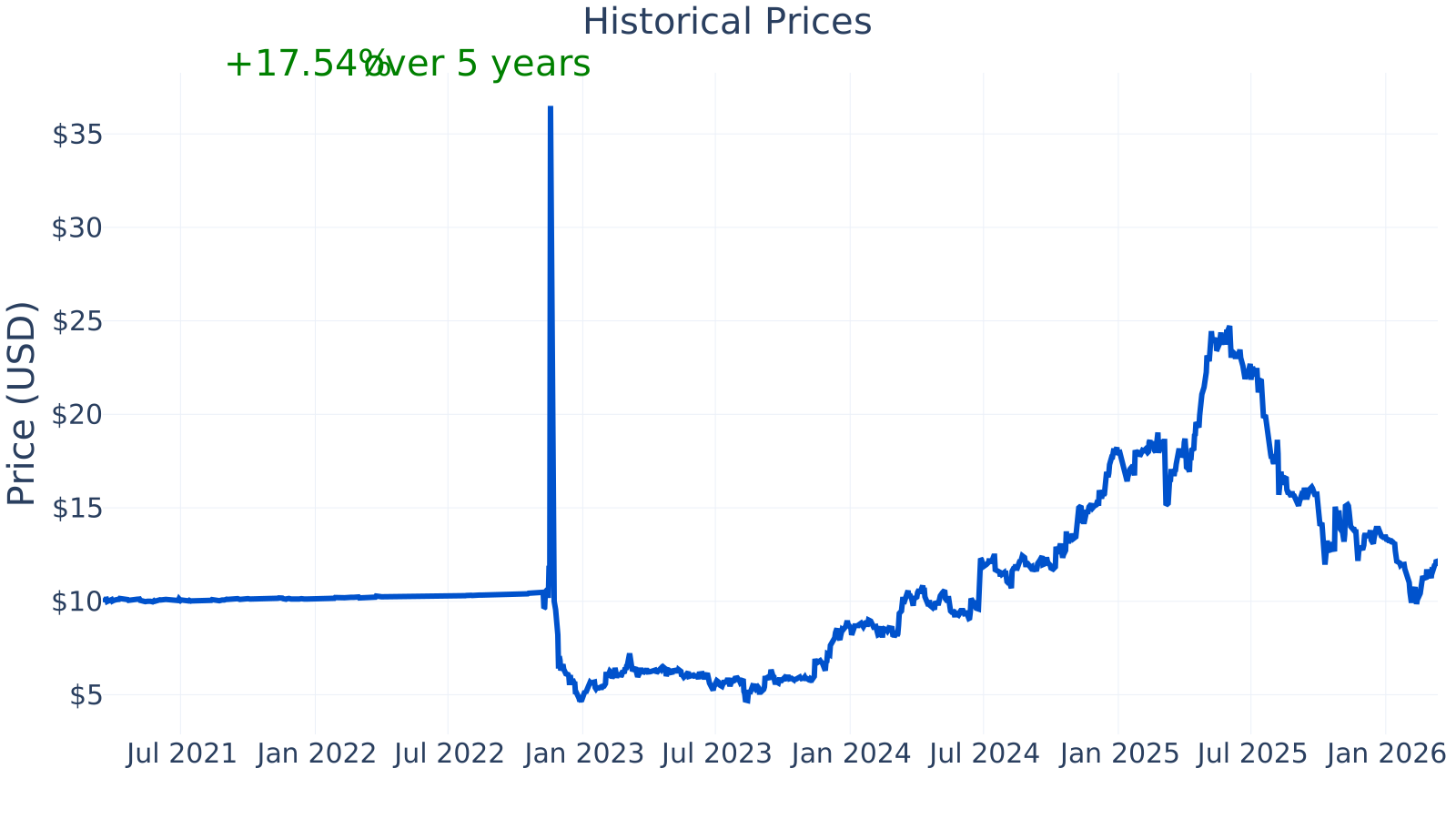
Grindr’s market capitalization is about $2.21B and its beta is 0.25, which implies the stock has historically moved less than the broader market. The latest P/E ratio is about 27.7, somewhat above the 24.7 industry median shown. The most recent profit margin is about 21.5%, well above the industry median of 7.7%. Revenue growth year-over-year is about 29% versus an industry median near 16.7%. Free cash flow (trailing twelve months) is about $135M. One outlier is leverage: the latest debt-to-equity is shown at about 853%, far above the industry median near 25%, and it also appears volatile across periods.
Growth (medium)
Grindr operates within the broader mobile app economy, where recurring digital subscriptions and advertising are established monetization models. For long-term business growth, the key question is less about whether mobile apps can grow (they can), and more about whether Grindr can steadily expand paid adoption, maintain user engagement, and monetize responsibly while preserving trust and brand strength in its core community.
The year-over-year revenue growth displayed remains consistently positive and often strong across the periods shown, generally ranging from the low-to-mid 20% area up to the 30%+ range (with earlier peaks higher). Relative to the industry median shown in the latest snapshot, the company’s recent growth rate appears higher.
Free cash flow trends upward over time in the values shown (roughly $40M in 2021 to about $93M by early 2025), and the latest snapshot indicates $135M trailing twelve months. For a subscription-and-ads app, sustained free cash flow can matter because it provides flexibility to invest in product improvements, trust and safety, marketing, and potential balance sheet needs.
Potential catalysts (in the factual, business-model sense) typically include: continued conversion of free users to paid tiers, pricing and packaging optimization, improved ad technology and yield, and international expansion where regulation and platform policies permit. Execution risk remains meaningful because user preferences and platform dynamics can change quickly in consumer apps.
Risks (high)
Grindr’s biggest risks tend to cluster around platform dependence and reputation-sensitive operations. As a mobile app business, it relies on third-party app stores and mobile operating systems for distribution and billing rules. Changes in platform policies, fees, privacy rules, or ad tracking can affect growth, margins, or marketing efficiency.
The leverage picture appears unusually volatile. Debt-to-equity swings from modest levels early in the series to extreme values (including negative figures that can occur when equity is negative). The latest reading shown is about 853%, which is far above the industry median displayed. For long-term analysis, this makes balance sheet structure and debt terms important areas to verify directly in the latest 10-K/10-Q, because high or unstable leverage can amplify both good and bad outcomes.
Profitability has also been uneven over the period shown: margins are negative for multiple quarters/years in the middle of the timeline and then improve sharply to a positive 21.5% in the latest point shown (above the industry median near 8.2%). That swing suggests results may be influenced by factors such as non-cash accounting items, financing costs, or discrete events—items that can matter a lot in how “durable” earnings are from one year to the next.
Competition is another structural risk. Grindr competes for user attention with other dating and social discovery apps (including large multi-brand operators and smaller niche apps). Grindr’s advantage is its strong brand recognition in its target community and the network effects that can come with a large, active user base; however, switching costs for users can be low, and competitive pressure can show up through marketing spend, pricing pressure on subscriptions, or lower ad yields.
Finally, regulatory and safety-related risk is material. Products enabling user-to-user messaging and meetups can face heightened scrutiny around privacy, safety, moderation, and compliance across jurisdictions. Changes in laws, enforcement, or consumer expectations can increase costs or restrict features.
Valuation
On an earnings multiple basis, the latest P/E shown is about 27.1–27.7 (depending on the exact date in the series), compared with an industry median near 35.7 on the most recent historical point shown and 24.7 on the latest snapshot table. This places the stock in a range that is neither extremely low nor extremely high versus the reference points provided, but interpretation depends heavily on how stable earnings are going forward.
Because margins and leverage have shown large swings, a simple P/E comparison can be incomplete on its own. For companies with meaningful debt or episodic net income, valuation often requires checking whether profitability is coming primarily from recurring operations and whether free cash flow remains resilient through different conditions. The latest figures show strong revenue growth, positive net margin, and sizable free cash flow, while also showing unusually high debt-to-equity—so the “expensive vs. cheap” question depends on whether the recent profitability level is repeatable and whether balance sheet risks are contained by the company’s cash generation and debt structure.
Conclusion
Grindr is a consumer app business monetized mainly through subscriptions and advertising, with revenue in the figures shown growing substantially from 2021 through 2025. Recent snapshots show strong year-over-year revenue growth and a notably higher profit margin than the industry median, alongside meaningful free cash flow.
At the same time, the risk profile appears elevated due to the volatility and level of debt-to-equity shown, the historical swings in profit margin, and the typical platform, regulatory, and competitive pressures faced by social and dating apps. The long-term picture therefore hinges on how consistently the company can sustain operating performance while managing balance sheet structure and maintaining user trust and engagement.
Sources:
- U.S. Securities and Exchange Commission (SEC) EDGAR — “Grindr Inc. Filings (10-K, 10-Q, 8-K)”
- Grindr Inc. Investor Relations — “SEC Filings / Financial Reports”
- Wikipedia — “Grindr”
This article is for informational purposes only and does not constitute financial advice. Some content is AI-generated. See Disclaimer


