Stock Analysis · Greif Bros Corporation (GEF)
Overview
Greif Bros Corporation (GEF) is a packaging company that makes and reconditions industrial containers used to ship, store, and protect goods. Its products are typically used by businesses rather than consumers directly, including customers in chemicals, coatings, food ingredients, agriculture, and other industrial supply chains. The company operates in the Packaging & Containers industry, where demand is often tied to overall manufacturing activity and trade volumes.
Revenue generally comes from selling packaging products (and related services) across a mix of container types and materials. In Greif’s public reporting, revenue is commonly discussed by business segments and product families (for example, rigid industrial packaging, flexible packaging, paper packaging, and services such as reconditioning and container lifecycle solutions). Exact revenue percentages by source are not included in the figures shown in this article.
Over the period shown, total revenue trends lower versus earlier years (from about $6.35B in 2022 to about $4.29B in 2025). Costs of revenue remain the largest expense line, which is typical in packaging because raw materials and manufacturing are significant cost drivers. Interest expense also varies meaningfully across years, which can reflect changes in debt levels and/or interest rates.
Key Figures
| Metric | Value | Industry ⓘ |
|---|---|---|
| Date | Feb 08, 2026 | |
| Context | ||
| Sector | Consumer Cyclical | |
| Industry | Packaging & Containers | |
| Market Cap ⓘ | $4.30B | |
| Beta ⓘ | 0.96 | |
| Fundamental | ||
| P/E Ratio ⓘ | 31.11 | 21.79 |
| Profit Margin ⓘ | 25.04% | 5.56% |
| Revenue Growth ⓘ | -2.20% | 6.00% |
| Debt to Equity ⓘ | 42.75% | 137.29% |
| PEG ⓘ | 2.25 | |
| Free Cash Flow ⓘ | -$299.40M | |
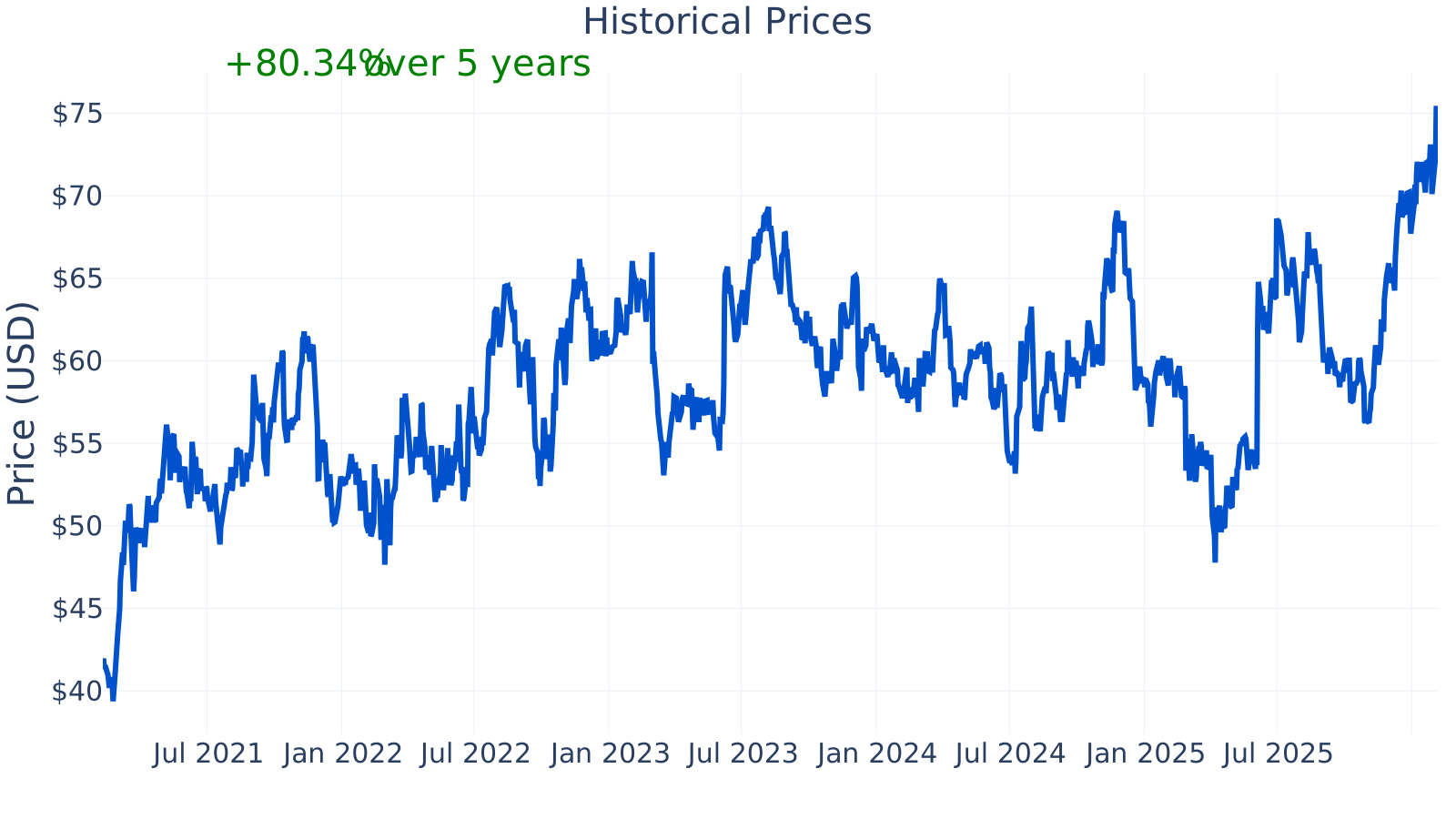
Greif’s equity value is about $4.30B, and the stock’s beta of about 0.96 suggests price moves have been close to the broader market on average. The P/E ratio is about 31.1 versus an industry median near 21.8, indicating a higher earnings multiple than many peers at this point in time. Profit margin is shown at about 25.0% versus an industry median near 5.6%, while year-over-year revenue growth is about -2.2% versus an industry median around +6.0%. Debt-to-equity is about 42.7% versus an industry median near 137.3%. Free cash flow (TTM) is shown as approximately -$299M.
Growth (Medium)
Packaging is a large, mature industry with steady long-term demand tied to consumer staples, industrial production, and shipping activity. For industrial packaging in particular, growth often depends more on volumes, pricing discipline, and efficiency than on rapid market expansion. Potential structural tailwinds can include rising focus on reuse/reconditioning, lightweighting, and sustainability-related customer requirements, but these trends typically play out gradually.
The year-over-year revenue growth pattern shown is volatile, with strong positives earlier in the period and multiple negative periods afterward. The most recent point shown in the table is slightly negative (-2.2%), which is below the industry median (+6.0%). This kind of profile can happen when end markets cool, when pricing normalizes after prior increases, or when volumes soften. For long-term business momentum, it becomes important to watch whether revenue stabilizes and whether the company can offset slower volumes through mix, pricing, and operational improvements.
Free cash flow in the trailing twelve months is shown as negative (about -$299M), while earlier points in the period were positive (roughly $239M to $463M). A swing like this can occur due to changes in profitability, working capital needs (inventory and receivables), restructuring cash costs, capital spending, or one-time items. For a packaging manufacturer, sustained free cash flow matters because it supports reinvestment in plants, debt repayment, and returns of capital over time.
Risks (Medium)
The main business risk is cyclicality. Industrial packaging demand can weaken when manufacturing activity slows, customers reduce inventory, or chemical and industrial production declines. In addition, earnings can be sensitive to raw material input costs (such as resin, steel, and paper-related inputs) and the timing of how quickly price changes can be passed through to customers.
Debt adds another layer of risk, especially when interest rates are higher or cash flows are weaker. The latest debt-to-equity shown is about 42.7%, which is lower than the industry median (about 137.3%) and also much lower than Greif’s own levels earlier in the period (often above 100%). Lower leverage can reduce financial pressure during down cycles, but it does not eliminate the need for consistent cash generation to fund operations and capital investment.
Profitability is another key watch area. The latest profit margin shown is about 25.1%, far above the industry median (about 5.6%) and also a sharp jump compared with much of the earlier period (often mid-single-digit percentages). When margins move abruptly, it can reflect one-time items, asset sales, accounting impacts, or temporary pricing/cost timing effects. A useful follow-up for readers is to compare net margin to operating margin and to review management’s discussion of what drove the change in the company’s annual report.
Competition in packaging is intense because many products can be somewhat standardized, and large customers often negotiate hard on price. Greif competes with other global and regional producers of industrial containers (steel drums, plastic drums, intermediate bulk containers), paper-based packaging, and related services like reconditioning. Competitive advantages in this industry often come from scale manufacturing, a broad network close to customers, long-term relationships, service offerings (collection and reconditioning), and the ability to manage input cost volatility. Greif’s positioning is typically described around its scale in industrial packaging and its lifecycle services, but the market remains competitive with multiple well-capitalized peers.
Valuation
The P/E ratio shown for Greif is about 31.1, above the industry median near 21.8. Historically (as displayed), Greif’s P/E has at times been below the industry median, with periods in the single digits to mid-teens, before dropping to very low values at the end of the timeline shown. Interpreting P/E requires care: it can rise when the stock price increases, but it can also rise when earnings fall. Likewise, a very low P/E can occur when earnings temporarily spike due to one-time gains or unusual items.
Given the mixed signals in the summary metrics—higher P/E than peers, negative trailing free cash flow, and slightly negative year-over-year revenue growth—valuation interpretation depends heavily on whether current profitability and margins are repeatable and whether cash generation normalizes. The PEG ratio shown (about 2.25) is one indicator that the multiple may be high relative to expected growth, though PEG depends on growth estimates that can change materially in cyclical businesses.
Conclusion
Greif is a long-established industrial packaging company operating in a generally mature, economically sensitive industry. The business can benefit from scale, manufacturing know-how, and service offerings that support repeat customer demand, but results can fluctuate with industrial cycles and input costs.
The figures shown highlight several items to monitor: revenue has been uneven and is lower than earlier years, trailing free cash flow is currently negative, and the stock trades at a higher earnings multiple than the industry median. At the same time, leverage (debt-to-equity) appears lower than both the industry median and the company’s own prior levels, and the latest net profit margin shown is unusually high versus peers—something that likely requires confirming whether drivers are recurring. For a long-term view, the most decision-relevant follow-ups typically include understanding what caused the recent margin step-up, whether free cash flow returns to sustained positive levels, and how the company performs through the next industrial demand cycle.
Sources:
- SEC EDGAR — Greif, Inc. filings (Form 10-K, Form 10-Q)
- Greif Investor Relations — Annual Report and SEC filings (company-hosted)
- Wikipedia — “Greif, Inc.” (basic company background)
This article is for informational purposes only and does not constitute financial advice. Some content is AI-generated. See Disclaimer


