Stock Analysis · Green Brick Partners Inc (GRBK)
Overview
Green Brick Partners Inc (GRBK) is a U.S. homebuilder. In simple terms, the company develops lots, builds houses (often through its subsidiary brands), and sells those homes to buyers—primarily in markets where population and job growth can support ongoing housing demand. Like many builders, it manages a pipeline that starts with land acquisition and development and ends with delivering completed homes to customers.
Its business model is tied to the residential construction cycle: when demand is strong and homes can be sold at healthy prices, results can improve quickly; when mortgage rates rise or buyers pull back, activity can slow just as fast.
Revenue mainly comes from homebuilding activities (home sales). Depending on the year, some builders also report smaller contributions from land sales and related activities; the exact split by category should be checked in the most recent annual report segment/revenue notes.
The company’s cost structure is typical for a homebuilder: direct construction and land costs are the largest expense, while overhead items such as selling, general, and administrative costs sit below gross profit.
Recent profitability context (annual totals): total revenue increased from about $1.40B (2021) to about $2.10B (2024–2025). Net income rose from about $190M (2021) to about $382M (2024), then moved to about $313M (2025), showing the business can generate meaningful earnings but also that results can fluctuate with market conditions.
Across the years shown, revenue expanded meaningfully from 2021 to 2024 and then stayed roughly flat in 2025. Gross profit dollars also grew into 2024, while net income peaked in 2024 and eased in 2025—consistent with a housing environment where volume, pricing, incentives, and costs can shift from year to year.
Key Figures
| Metric | Value | Industry ⓘ |
|---|---|---|
| Date | Mar 02, 2026 | |
| Context | ||
| Sector | Consumer Cyclical | |
| Industry | Residential Construction | |
| Market Cap ⓘ | $3.21B | |
| Beta ⓘ | 2.00 | |
| Fundamental | ||
| P/E Ratio ⓘ | 9.67 | 13.00 |
| Profit Margin ⓘ | 14.93% | 8.65% |
| Revenue Growth ⓘ | -2.60% | -6.05% |
| Debt to Equity ⓘ | 0.77% | 33.34% |
| PEG ⓘ | 0.76 | |
| Free Cash Flow ⓘ | $208.45M | |
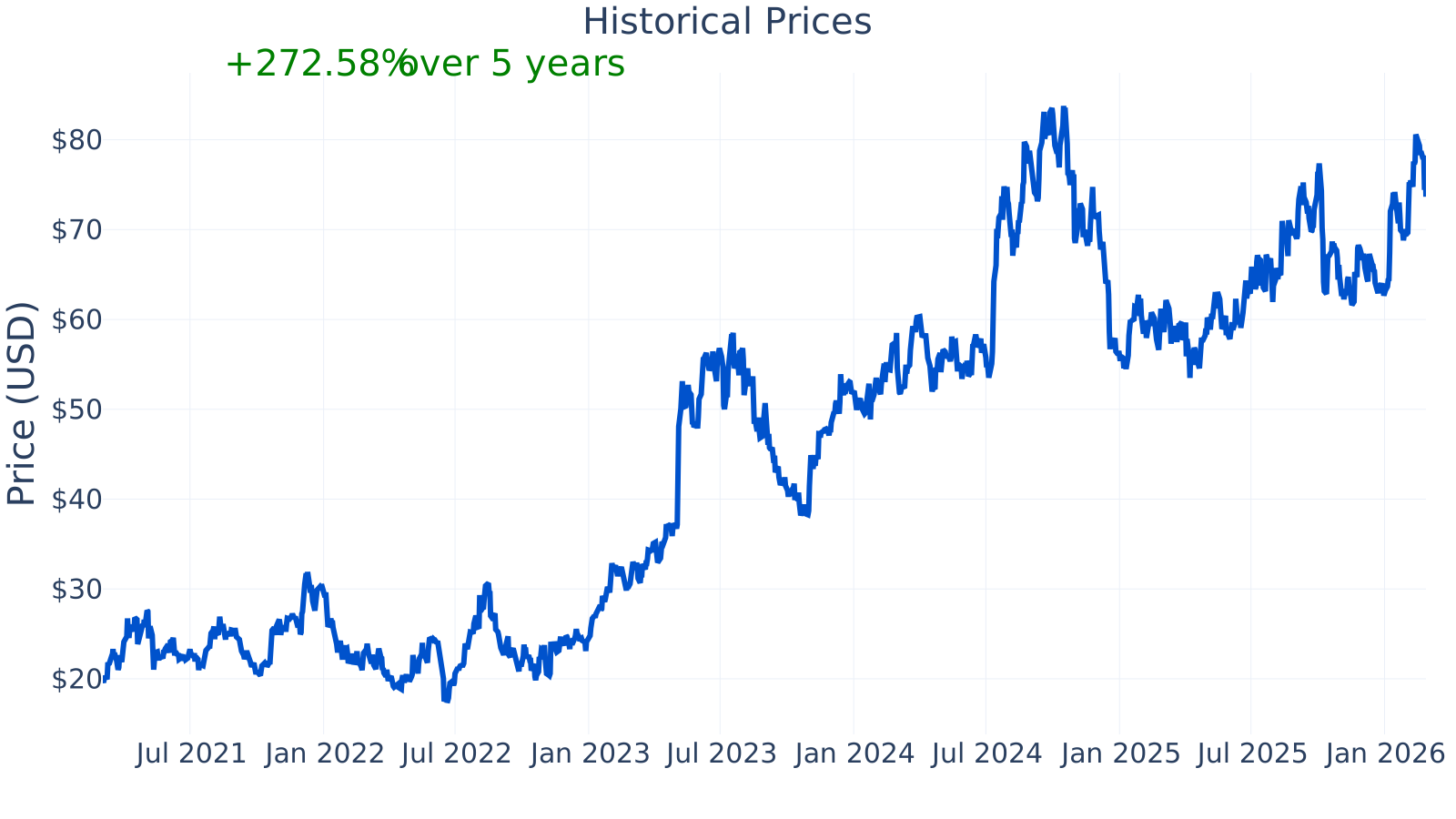
Green Brick Partners has a market capitalization of about $3.2B and a relatively high beta (~2.0), which means the stock has tended to move more sharply than the broader market. Profitability stands out versus the industry median: the latest profit margin is about 14.9% versus an industry median near 8.7%. Revenue growth (year over year) is slightly negative at about -2.6%, but still better than the industry median (around -6.1%). The balance sheet leverage shown here is unusually low: debt-to-equity is about 0.8% versus an industry median near 33.3%. Free cash flow over the trailing twelve months is about $208M, and the P/E ratio is about 9.7 versus an industry median near 13.0.
Growth (Medium)
Residential construction is a large, long-lived industry tied to household formation, employment, migration patterns, and the cost of financing a home (mortgage rates). Demand can be supported by structural factors like long-term housing needs and local population growth, but the industry is also highly cyclical because affordability can change quickly when interest rates and home prices move.
For Green Brick Partners, a sensible long-term growth strategy typically depends on disciplined land investment (so it can build profitably through cycles), efficient construction operations, and maintaining a product mix aligned with what buyers in its markets can afford. In homebuilding, execution and local market selection often matter as much as national housing headlines.
The year-over-year revenue growth pattern shows strong growth earlier in the period, followed by more mixed results and recently slightly negative growth. That kind of “surge then normalize” pattern is common in homebuilding: the business can expand quickly during favorable demand, then cool when affordability tightens or comparisons get harder.
Free cash flow has been volatile over time, including periods of negative free cash flow and periods of strong positive generation. For homebuilders, this can happen because land purchases and development spending may rise ahead of future home deliveries. Positive free cash flow (about $208M most recently) can provide flexibility, but the historical swings are a reminder that cash generation is not always steady in this line of business.
Potential catalysts for growth in a homebuilder generally include easing mortgage rates (improving affordability), strong job and population growth in served markets, and successful community/lot development that supports future deliveries. The flip side is that these factors can also reverse.
Risks (High)
Homebuilding carries meaningful risks because it depends on consumer confidence and financing conditions. If mortgage rates rise or credit tightens, demand can fall quickly. Builders may respond with price cuts or buyer incentives, which can pressure margins. Costs for labor and materials can also swing, and local regulations or permitting delays can affect build timelines.
Debt-to-equity has trended down substantially over the period shown, reaching a very low level (about 0.8%) compared with the industry median (about 33%). Lower leverage can reduce financial risk during housing downturns, though it does not remove operational risk tied to inventory, land values, and sales pace.
Profit margins have been consistently above the industry median across the period shown. Even though the margin eased to about 14.9% most recently (down from higher levels in parts of 2024), it remains notably higher than the industry median (about 8.7%). This can indicate solid execution and/or favorable market positioning, but margins in homebuilding can compress quickly if incentives rise or costs climb.
Competitive positioning is another key risk factor. Green Brick Partners competes with other public and private homebuilders for land, labor, and buyers. Larger national builders can benefit from scale in purchasing, marketing, and financing programs, while regional builders can benefit from deep local knowledge and focus. The company is not the overall U.S. market leader; it operates in a competitive field that includes large national builders and strong regional players. How it compares often depends on local market share, land pipeline quality, and the ability to maintain returns through a full cycle.
Other risks that long-term shareholders often track in homebuilders include: potential land impairment risk if lot values fall, concentration in certain geographic markets, and volatility in earnings due to the timing of community openings and closings.
Valuation
The company’s current P/E ratio is about 9.7, which is below the industry median of roughly 13.0 in the metrics shown. Over the historical period displayed, Green Brick Partners’ P/E has generally moved within a single-digit to low-double-digit range, sometimes below and sometimes near the industry median. This type of valuation level is common in cyclical industries where profits can be strong in good years but may be less predictable over a full housing cycle.
Interpreting valuation for a homebuilder typically requires looking beyond a single multiple. A lower P/E can reflect stronger current earnings, but it can also reflect market expectations that earnings may normalize if housing conditions soften. In this case, the combination of above-industry profit margins and very low leverage may support resilience, while the recent slightly negative year-over-year revenue growth highlights that growth is not linear.
Conclusion
Green Brick Partners is a residential homebuilder whose results are closely tied to housing demand and affordability. The company has shown the ability to scale revenue from 2021 to 2024 and generate substantial net income, with profitability metrics that have been above the industry median in recent years. Its balance sheet leverage appears very low compared with peers, which can reduce financial strain in weaker markets.
At the same time, the business remains cyclical: revenue growth has recently turned slightly negative, free cash flow has been volatile over time, and margins can change quickly with incentives, mortgage rates, and construction costs. The stock’s higher beta also suggests larger price swings than the broader market. Overall, the long-term picture depends heavily on how effectively the company manages land, costs, and pricing through different housing environments.
Sources:
- SEC EDGAR — Green Brick Partners, Inc. Form 10-K (Annual Report)
- SEC EDGAR — Green Brick Partners, Inc. Form 10-Q (Quarterly Reports)
- Green Brick Partners — Investor Relations materials and press releases (company-hosted)
- Wikipedia — “Green Brick Partners” (basic company background)
This article is for informational purposes only and does not constitute financial advice. Some content is AI-generated. See Disclaimer