Stock Analysis · Goodyear Tire & Rubber Co (GT)
Overview
Goodyear Tire & Rubber Co (GT) is a global tire company that designs, manufactures, distributes, and sells tires for passenger cars, trucks, buses, aircraft, and off-the-road uses. Beyond selling tires, Goodyear also participates in parts of the “replacement” ecosystem (tires sold to drivers after the original tires wear out) and provides related services through its retail and service network. In practical terms, its business is tied to how much people drive, how much freight moves, and how healthy the automotive market is in regions where it operates.
In its SEC filings, Goodyear typically reports revenue across operating segments rather than “product lines.” The largest segment is generally the Americas, followed by Europe/Middle East/Africa (EMEA), and then Asia Pacific. The underlying revenue mix is primarily tire sales (replacement and original equipment), with additional contribution from services and other tire-related offerings. Exact percentages can change by year and are best read directly from the most recent annual report segment disclosures.
The simplified revenue picture is:
- Tire sales (replacement and original equipment) — the core driver of revenue
- Related services and other — retail/service, commercial services, and ancillary offerings (varies by region and period)
- Revenue by geographic operating segment — Americas (largest), EMEA, Asia Pacific (the exact split is disclosed in annual filings)
Over recent years, Goodyear’s revenue has been large (tens of billions of dollars), but profitability has moved around notably. Operating income and net income show meaningful swings, and interest expense is a visible, recurring cost—highlighting how financing costs can materially affect bottom-line results even when gross profit remains substantial.
Key Figures
| Metric | Value | Industry ⓘ |
|---|---|---|
| Date | Feb 08, 2026 | |
| Context | ||
| Sector | Consumer Cyclical | |
| Industry | Auto Parts | |
| Market Cap ⓘ | $3.02B | |
| Beta ⓘ | 1.10 | |
| Fundamental | ||
| P/E Ratio ⓘ | N/A | 25.56 |
| Profit Margin ⓘ | -9.44% | 3.38% |
| Revenue Growth ⓘ | -3.70% | 4.95% |
| Debt to Equity ⓘ | 305.26% | 66.87% |
| PEG ⓘ | 1.67 | |
| Free Cash Flow ⓘ | -$352.00M | |
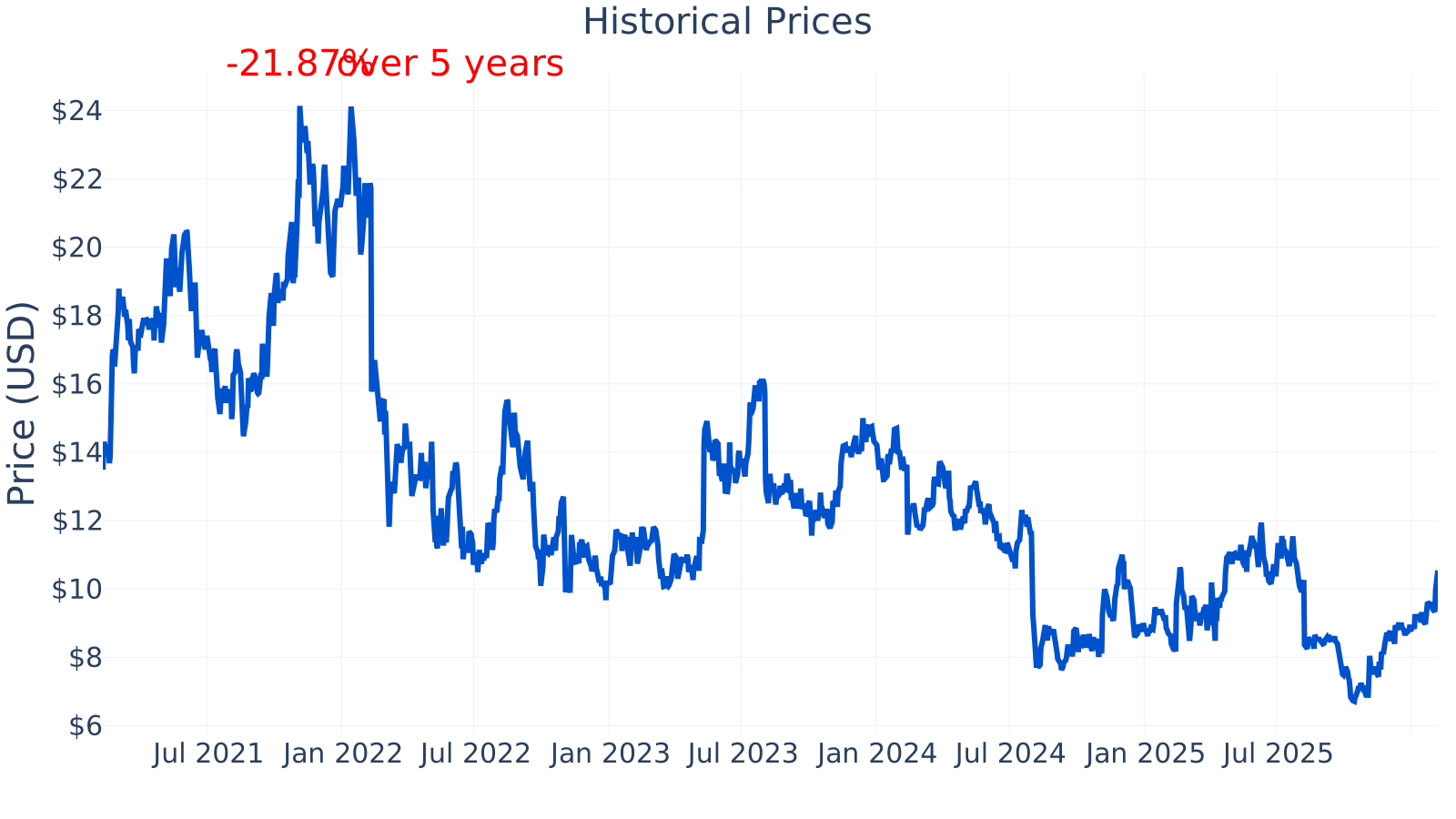
Goodyear’s market capitalization is about $3.0B, and the stock’s beta of ~1.10 suggests it has historically moved somewhat more than the overall market. Recent profitability is a key weak point: the latest profit margin is about -9.4%, versus an industry median near +3.4%. Revenue growth year over year is also negative at about -3.7% compared with an industry median near +5.0%. Leverage stands out: debt-to-equity is roughly 305% versus an industry median near 67%. Free cash flow over the trailing twelve months is about -$352M, indicating the business has recently used more cash than it generated from operations after capital spending.
Growth (Low)
The tire industry is generally mature. Demand is supported by long-lived drivers such as miles driven, the size and age of the vehicle fleet, freight activity, and tire replacement cycles. That tends to create steady baseline demand over time, but it also means growth is often incremental rather than explosive. Industry dynamics can be heavily influenced by raw material costs, pricing competition, and the mix between higher-margin premium products and lower-priced commodity tires.
For Goodyear specifically, recent results point to a business still working through volatility rather than compounding steadily. The revenue trend has been soft on a year-over-year basis in several recent periods, and profitability has been inconsistent. A long-term growth narrative typically depends less on “market growth” and more on company execution—improving product mix, pricing discipline, cost structure, and the stability of cash generation across cycles.
The year-over-year revenue growth pattern shows a shift from strong growth earlier in the period to multiple quarters of contraction more recently, aligning with the view that the environment has been challenging and/or the company’s volume/mix has not been supportive in the near term.
Free cash flow has swung between positive and negative over time, including a negative trailing twelve months. For long-term business resilience, a key item to watch is whether Goodyear can produce more consistently positive free cash flow across a full cycle, since that cash can be used to reduce debt, reinvest in the business, or absorb downturns.
Risks (High)
Goodyear’s main risks are tied to a combination of cyclicality and financial structure. Tire demand is influenced by economic activity (consumer driving and commercial freight), and pricing can be pressured when competition is intense. In addition, input costs (such as oil-linked and other commodity-based materials) can change quickly, and there can be a lag before higher costs are fully reflected in tire pricing. Currency movements and regional economic differences also matter because operations span multiple geographies.
A major company-specific risk is leverage. Higher debt increases fixed obligations (interest payments) and can reduce flexibility during weak periods.
The debt-to-equity ratio is elevated versus the industry median and has also shown variability over time, including a recent spike. This can amplify outcomes: if operations improve, equity holders may benefit more, but if operations weaken, financial pressure can increase faster.
Profitability consistency is another central risk. A business can have strong brands and large revenue, but long-term outcomes are often driven by the ability to earn steady margins through different environments.
Margins have moved from modestly positive in parts of 2021–2022 to negative in several later quarters, with a notably weak recent reading versus the industry median. This gap suggests Goodyear has recently underperformed typical peers on profitability, which may reflect mix, pricing, cost structure, restructuring charges, or other company-specific factors discussed in filings.
On competitive positioning, Goodyear is one of the best-known global tire brands, which can help in premium segments and in distribution relationships. However, tires are highly competitive, with large global manufacturers and substantial price competition, particularly in value tiers. Key global competitors commonly include Michelin, Bridgestone, and Continental, alongside many regional and low-cost producers. In this landscape, competitive advantages tend to come from brand strength, scale, product performance, distribution reach, and manufacturing efficiency. Goodyear’s brand and scale are meaningful, but recent margin and cash flow instability indicate that competitive strength has not consistently translated into superior financial performance in the near term.
Valuation
Valuation for a cyclical manufacturer like Goodyear is often difficult to summarize with a single metric because earnings and margins can swing significantly. When profits are depressed or temporarily boosted, the price-to-earnings (P/E) ratio can become less informative, and investors often look more at normalized earnings power, cash flow, and balance sheet strength over a cycle.
The P/E ratio has been volatile across the period shown, and there are stretches where it is not meaningful (commonly when earnings are very low or negative). When a P/E is available, it has at times been below the industry median and at other times above it, reinforcing that the market’s expectations have been shifting and that earnings have not been stable enough to anchor a consistent multiple comparison. In practice, the justification of the current price tends to hinge on whether profitability and free cash flow can become more durable while leverage trends lower over time.
Conclusion
Goodyear is a large, established participant in a mature but essential industry, with demand supported by replacement cycles and broad vehicle usage. The company has brand recognition and global scale, but recent fundamentals show meaningful pressure: negative profit margin versus the industry median, negative year-over-year revenue growth, negative trailing free cash flow, and notably higher leverage than typical peers.
From a long-term perspective, the central questions are operational and financial rather than purely “industry growth”: whether Goodyear can improve and sustain margins, return to consistent positive free cash flow, and reduce balance-sheet risk. Those factors are likely to be more important than near-term tire demand fluctuations in shaping long-run outcomes.
Sources:
- SEC EDGAR — Goodyear Tire & Rubber Co filings (Form 10-K, Form 10-Q)
- Goodyear Investor Relations — Annual Report materials and investor presentations (company-hosted)
- Wikipedia — “The Goodyear Tire & Rubber Company” (basic company background)
This article is for informational purposes only and does not constitute financial advice. Some content is AI-generated. See Disclaimer


