Stock Analysis · Global Business Travel Group Inc (GBTG)
Overview
Global Business Travel Group Inc. (GBTG) operates a business-to-business travel platform focused on managing corporate travel for companies. In simple terms, it helps organizations plan, book, and manage work-related trips (air, hotel, ground transportation), while also handling policy compliance, traveler support, reporting, and expense-related workflows. The company typically sits between corporate clients and travel suppliers, using its technology and service teams to coordinate high volumes of bookings and provide companies visibility and control over travel spending.
GBTG’s revenue model is closely tied to business travel activity (how many trips are taken, and how much is spent), along with technology and management fees for servicing corporate travel programs. Based on typical disclosures for travel management companies, the main revenue sources generally include:
- Travel transaction and supplier-related revenues (fees and incentives linked to booking volumes and travel spend)
- Management and service fees from corporate clients for running their travel programs
- Technology and solutions revenues (tools, reporting, and related services)
Exact percentages can vary by year and contract mix, and the most reliable breakdown is the company’s latest annual report (Form 10‑K) segment and revenue notes.
Business performance in plain terms: from 2021 to 2025, total revenue expanded substantially (from about $0.76B in 2021 to about $2.72B in 2025). Over the same period, gross profit also increased (about $0.29B to $1.63B). This points to a business that benefited from recovering corporate travel demand and scaling transaction volumes. Net income moved from sizable losses in earlier years to a profit in 2025.
The multi-year view shows revenue rising each year since 2021, with gross profit rising as well. It also highlights meaningful ongoing operating costs (including technology-related spending and overhead) and interest expense, which can matter for how much of revenue ultimately turns into profit.
Key Figures
| Metric | Value | Industry ⓘ |
|---|---|---|
| Date | Mar 16, 2026 | |
| Context | ||
| Sector | Consumer Cyclical | |
| Industry | Travel Services | |
| Market Cap ⓘ | $2.94B | |
| Beta ⓘ | 0.79 | |
| Fundamental | ||
| P/E Ratio ⓘ | N/A | 23.26 |
| Profit Margin ⓘ | 4.01% | 8.78% |
| Revenue Growth ⓘ | 34.00% | 12.00% |
| Debt to Equity ⓘ | 93.66% | 93.66% |
| PEG ⓘ | N/A | |
| Free Cash Flow ⓘ | $151.08M | |
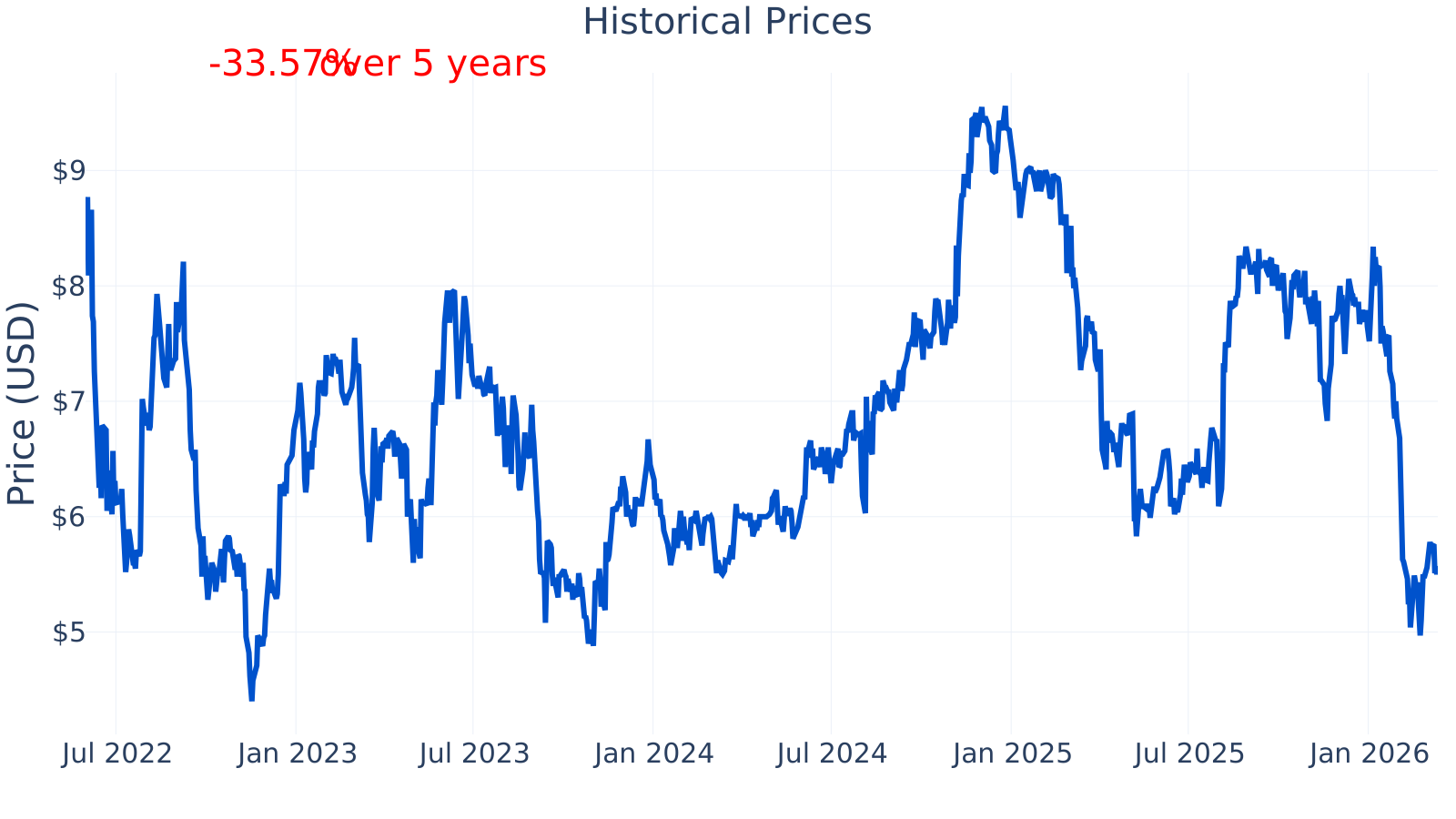
GBTG’s market capitalization is about $2.94B. The stock’s beta (~0.79) suggests price moves that have historically been less volatile than the broader market on average, although company-specific events can still drive significant swings. Profitability remains a key focus: the latest profit margin shown is about 4.0%, below the industry median of about 8.8%. On the other hand, the latest year-over-year revenue growth shown is about 34%, above the industry median of about 12%. Debt-to-equity is about 93.7%, roughly in line with the industry median shown. Free cash flow over the trailing twelve months is about $151M, indicating the company has recently been generating cash after operating needs and capital spending.
Growth (Medium)
GBTG participates in the corporate travel ecosystem, which tends to grow with overall economic activity, employment, and corporate budgets. Business travel is also cyclical: it usually contracts during downturns and can rebound strongly during recoveries. This means long-term growth can be supported by global economic expansion, but shorter-term results may swing with corporate sentiment and travel volumes.
From an operating perspective, a sensible growth strategy in travel management often combines (1) increasing transaction volumes as corporate travel demand rises, (2) expanding wallet share within existing enterprise clients (more bookings and services per client), and (3) improving take-rate and efficiency through technology. For GBTG, the recent pattern of rising revenue and a shift toward positive earnings suggests the company has been moving from a recovery phase toward a more normalized operating environment.
The year-over-year revenue growth rate was extremely high in 2022 (consistent with a rebound off a depressed base) and then moderated in 2023–2025, before accelerating again in the most recent period shown (around 34%). For long-term context, it can be useful to separate “recovery growth” from “structural growth” driven by client wins, share gains, pricing, and new products.
Free cash flow improved markedly from negative levels in 2022–2023 to positive levels in 2024–2025 (most recently around $151M on a trailing basis). In practical terms, sustained positive free cash flow can support balance-sheet flexibility (paying down debt, investing in products, or funding integrations) without relying as heavily on new financing.
Potential catalysts for future growth typically include: additional large corporate client wins, higher adoption of paid technology solutions, improvements in servicing efficiency, and continued normalization of global business travel. The company’s filings are the best place to track these items because they describe contract wins, product initiatives, and volume trends in a standardized format.
Risks (High)
GBTG’s main risks are tied to the nature of corporate travel and the structure of travel distribution. Demand can fall quickly during recessions, geopolitical shocks, health-related disruptions, or periods when companies cut discretionary spending. In addition, some organizations permanently reduce travel through virtual meetings, which can limit long-run volume growth in certain categories.
Competition is another important risk. Corporate travel management is a crowded field with global and regional players. Key competitors commonly include other large travel management companies and business travel platforms (for example, major travel management providers and online booking solutions focused on business travelers). Competitive pressure can show up as pricing concessions, higher service costs, or the need for increased product investment to retain and win clients.
Regarding competitive advantages, scale can matter in this industry because high transaction volume can support supplier negotiations, broader content access, and investment in technology and service infrastructure. However, advantages are not absolute: large customers can be price-sensitive, and switching travel programs can happen, particularly when procurement teams re-bid contracts.
Leverage is a meaningful consideration. The debt-to-equity ratio declined dramatically from very high levels in 2022 to below 1.0 by late 2025 (about 93.7%). While that trend indicates a healthier balance-sheet profile than earlier periods, interest expense remains a real cost in the income statement, and higher rates or refinancing needs can affect future profitability.
Profitability has been improving from negative margins in 2022–2024 to positive territory more recently (about 4.0% at the latest point shown). Even so, the company’s margin remains below the industry median displayed (about 8.8%). This gap suggests that execution on cost control, automation, and mix (more revenue from higher-margin services and technology) can be important for closing the difference over time.
Valuation
Traditional price-to-earnings (P/E) comparisons can be difficult for companies that have recently moved from losses to profits or that have volatile earnings, because the “E” in P/E may be small, unstable, or temporarily affected by one-time items. In the periods shown, GBTG’s P/E is not consistently meaningful (displayed as 0 for many dates, then showing very high or more normal values later), while the industry median P/E shown generally sits in a range around the low-to-mid 20s (with some variation).
In cases like this, valuation discussions often lean more on a combination of factors rather than a single ratio: revenue growth durability, free cash flow generation, leverage/interest burden, and the ability to expand margins. With GBTG, the context includes (1) strong recent revenue growth versus the industry median, (2) a return to positive free cash flow, (3) improving but still relatively modest profit margin versus peers, and (4) leverage that has come down but still matters.
Conclusion
GBTG is a corporate travel management company whose results are closely linked to business travel activity and to how efficiently it can deliver service and technology at scale. The recent multi-year picture shows a significant rebound in revenue since 2021, improving operating performance, and a move toward positive profitability, alongside a notable turnaround in free cash flow.
At the same time, the business carries meaningful risk factors: corporate travel is cyclical and can drop quickly, competition is intense, and profitability (while improving) still trails the industry median shown. Because earnings have not been consistently stable across the period, P/E-based valuation signals are less straightforward, making cash flow, margins, and balance-sheet trajectory especially important areas to monitor over time.
Sources:
- SEC EDGAR — Global Business Travel Group Inc. filings (Form 10‑K, 10‑Q, 8‑K)
- Global Business Travel Group Inc. Investor Relations — SEC filings and investor materials (company-hosted)
- Wikipedia — “Global Business Travel Group” (company background and general description)
This article is for informational purposes only and does not constitute financial advice. Some content is AI-generated. See Disclaimer


