Stock Analysis · Gitlab Inc (GTLB)
Overview
GitLab Inc. (GTLB) develops a software platform used by teams to build, secure, and deliver software. In simple terms, it helps organizations manage the full “software development lifecycle” in one place: planning work, writing code, reviewing changes, testing, security checks, and deploying updates. GitLab’s platform is used by software engineers, IT teams, and security teams across many industries, because modern businesses frequently rely on software to run operations and serve customers.
The company primarily sells subscriptions to its platform (typically paid per user and/or by tier), and it can be deployed in the cloud or run by customers in their own environments. This model is designed to produce recurring revenue because customers usually renew subscriptions over time as the platform becomes embedded in day-to-day workflows.
Based on the company’s filings, revenue is mainly generated from:
- Subscription revenue (the largest component): recurring fees for access to paid tiers and enterprise features
- Support and services (smaller component): assistance and professional services related to deployments and usage
How the business “flows” financially: GitLab has grown revenue quickly, and it generates substantial gross profit, but it also spends heavily on operating expenses—especially research and development and sales/marketing-related costs—resulting in operating losses in recent years.
The overall pattern visible is that total revenue expanded strongly over the period shown (from about $253 million in fiscal year 2022 to about $957 million in fiscal year 2026), while operating expenses also increased (from about $351 million to about $953 million). That combination explains why operating income remained negative even as gross profit rose.
Key Figures
| Metric | Value | Industry ⓘ |
|---|---|---|
| Date | Mar 09, 2026 | |
| Context | ||
| Sector | Technology | |
| Industry | Software - Infrastructure | |
| Market Cap ⓘ | $4.20B | |
| Beta ⓘ | 0.79 | |
| Fundamental | ||
| P/E Ratio ⓘ | N/A | 27.58 |
| Profit Margin ⓘ | -5.86% | 6.83% |
| Revenue Growth ⓘ | 23.20% | 16.30% |
| Debt to Equity ⓘ | N/A | 24.92% |
| PEG ⓘ | N/A | |
| Free Cash Flow ⓘ | $222.03M | |
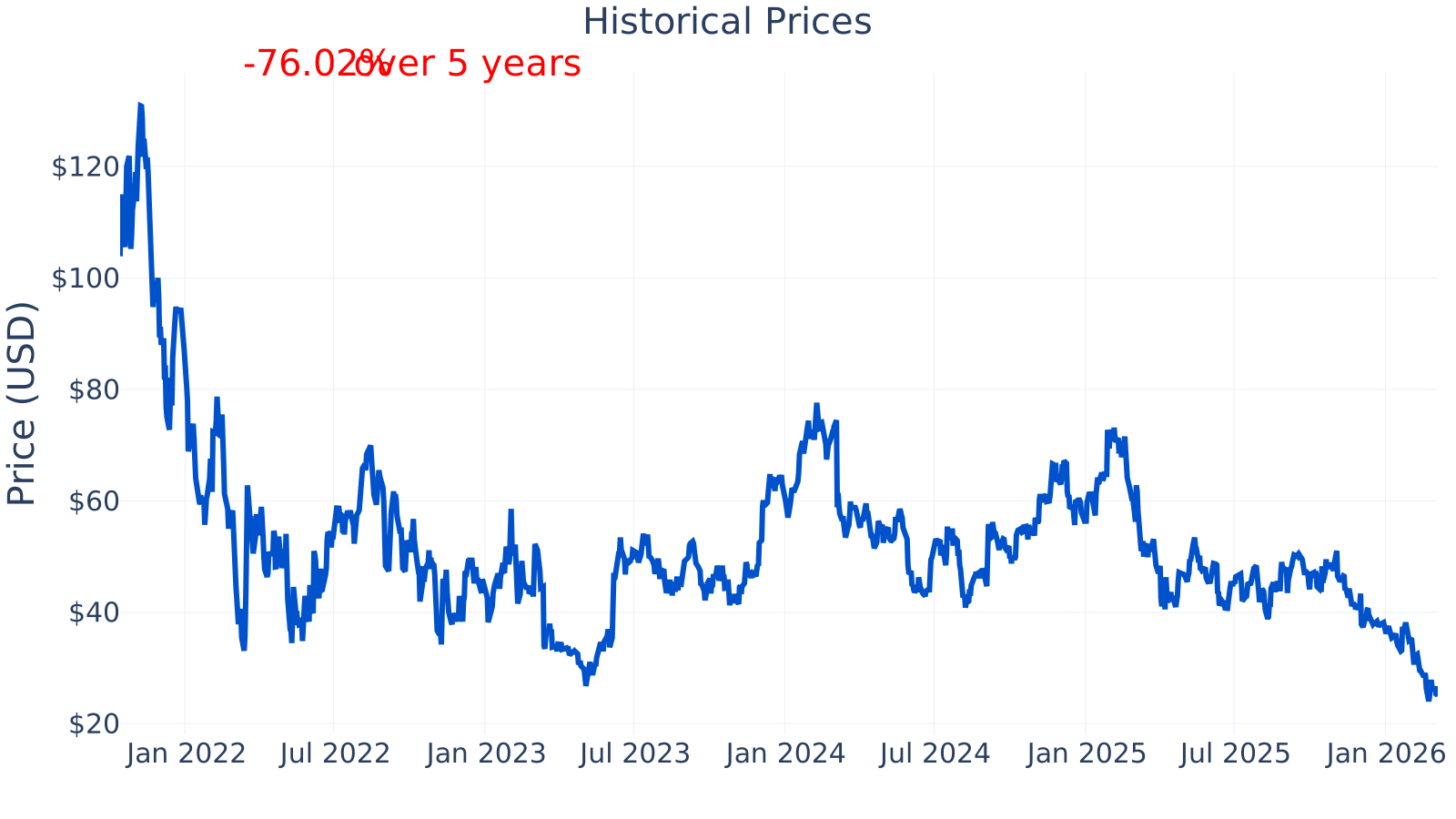
GitLab’s market capitalization is about $4.2 billion. The stock’s beta (~0.79) suggests it has historically moved somewhat less than the overall market on average, though individual software stocks can still be volatile.
On profitability, the latest profit margin is about -5.9%, below the industry median of about +6.8%, indicating the company is still slightly unprofitable on a net basis. On growth, latest year-over-year revenue growth is about 23.2%, above the industry median of about 16.3%. Free cash flow over the last twelve months is about $222 million, which indicates cash generation despite net losses (often influenced by non-cash expenses and the timing of cash receipts and payments).
Growth (Medium)
GitLab operates in the software development tools market, which is supported by long-term trends such as continued cloud adoption, ongoing software modernization inside large organizations, and increased focus on software supply-chain security. As companies ship updates more frequently and face higher security expectations, there is steady demand for tools that standardize and automate development, testing, and security checks.
GitLab’s strategy centers on providing a single, integrated platform rather than many separate tools stitched together. For organizations, an “all-in-one” approach can reduce complexity, improve visibility across teams, and simplify compliance and security processes. If customers consolidate tools, that can also increase the importance of the platform they choose, which may help retention over time.
The revenue growth trend shows a clear deceleration from very high rates earlier (above 50% year-over-year in parts of 2021–2022) to a more mature pace more recently (about 24% year-over-year at the latest point). This is not unusual as a company scales, but it means future returns may depend more on maintaining solid mid-range growth while improving profitability.
Free cash flow has improved meaningfully over time, with the latest trailing twelve-month figure at about $222 million. The pattern is not perfectly smooth (there were periods of negative free cash flow), but the most recent result suggests improved cash efficiency—an important consideration for long-term durability, especially in a competitive software category.
Potential catalysts discussed in company materials typically relate to expanding enterprise adoption, growing usage of higher-tier plans (which bundle more security and compliance features), and product improvements that increase the value of consolidating workflows into GitLab. The pace of enterprise IT spending and the level of competitive pressure can influence how strongly these catalysts translate into results.
Risks (High)
GitLab’s biggest risks are tied to competition and execution. The market for developer tools is crowded, and many customers already use competing platforms. Switching costs can be meaningful, but buyers can still reevaluate tools at renewal time, especially if budgets tighten or alternatives are bundled with other software they already pay for.
A second major risk is profitability durability. While the company has shown progress in cash generation, net income is still negative at the latest point, and sustained profitability typically requires careful control of operating expenses while continuing to invest enough to stay competitive. Stock-based compensation can also be a relevant factor for software companies because it may affect shareholder dilution over time (this is detailed in filings).
Leverage appears very low based on the debt-to-equity series shown (well under 1% in the displayed periods), compared with an industry median around the mid-20% range. Low leverage can reduce financial risk in downturns, although it does not eliminate business risks like customer churn or pricing pressure.
Profitability has improved substantially versus earlier years (when margins were deeply negative), but the latest net profit margin is still about -5.9%, while the industry median is about +6.7%. That gap highlights that GitLab is closer to break-even than it used to be, but not yet consistently at industry-typical profitability levels.
In terms of competitive positioning, GitLab competes with:
- Microsoft GitHub (including GitHub Enterprise and associated developer tooling)
- Atlassian (notably Jira for planning and other developer collaboration tools)
- Cloud providers and platform vendors offering DevOps and CI/CD tooling (for example, integrated services within major cloud ecosystems)
- Specialized point-solution vendors in testing, security scanning, deployment automation, and observability
GitLab’s core competitive argument is consolidation (one platform covering many stages of development and security) and enterprise-grade features. However, it is not the only well-known brand in this space, and some competitors benefit from large ecosystems, bundling power, or extremely high developer mindshare.
Valuation
Traditional valuation methods often rely on earnings (profit) and the price-to-earnings (P/E) ratio. For GitLab, the P/E ratio is not meaningful in the periods shown because earnings have been negative or otherwise not suitable for a standard P/E calculation.
Because P/E is not currently informative for GitLab, valuation discussions typically lean more on revenue growth, gross margin structure, free cash flow trends, and the path toward sustained profitability (all of which are addressed in company filings). The key question becomes whether the company can maintain durable growth while expanding margins over time; if margin improvement stalls or growth slows more than expected, valuations based on “future potential” can compress quickly in software markets.
Conclusion
GitLab is a software platform company serving an important, long-lasting need: helping organizations build and deliver software efficiently while managing security and compliance. The business has scaled revenue substantially over the last several years and, more recently, has shown strong improvement in free cash flow generation.
At the same time, GitLab still shows a negative net profit margin at the latest point and operates in a highly competitive category with powerful incumbents and multiple credible alternatives. For long-term, fundamentals-focused analysis, the central items to track over time are the sustainability of mid-range revenue growth, retention and expansion within enterprise customers, and the company’s ability to translate scale into consistently positive profitability while continuing to invest in product capabilities.
Sources:
- U.S. SEC EDGAR — GitLab Inc. Form 10-K (Annual Report), “Business” and “Management’s Discussion and Analysis” sections
- U.S. SEC EDGAR — GitLab Inc. Form 10-Q (Quarterly Reports), “Management’s Discussion and Analysis” sections
- GitLab Inc. Investor Relations — Shareholder letters and financial updates (company-hosted)
- Wikipedia — “GitLab” (basic company background only)
This article is for informational purposes only and does not constitute financial advice. Some content is AI-generated. See Disclaimer