Stock Analysis · Genuine Parts Co (GPC)
Overview
Genuine Parts Co (GPC) is a distributor of replacement parts and related products. In simple terms, it helps keep vehicles and industrial equipment running by supplying parts to repair shops, businesses, and other customers. The company is best known for its NAPA Auto Parts brand and operates through a broad distribution network (including stores, warehouses, and delivery routes) designed to get parts to customers quickly.
GPC’s revenue is mainly split between two operating segments (listed from largest to smaller, based on how the company reports its business in filings):
- Automotive Parts Group (NAPA and other automotive distribution operations)
- Industrial Parts Group (motion/industrial products such as bearings, power transmission, and related services)
The business model is typically driven by: (1) the size and age of the vehicle fleet (older vehicles need more repairs), (2) miles driven, (3) repair activity in commercial fleets and do-it-yourself customers, and (4) industrial maintenance spending. Because replacement parts are often needed regardless of the broader economy, demand can be steadier than many other consumer-facing categories, although it is not immune to downturns.
Across recent years, revenue has grown, but profitability has not moved in a straight line. Operating costs (especially selling, general, and administrative expenses) take a large share of gross profit, and interest expense has risen materially in the most recent year shown, which can weigh on net income.
Key Figures
| Metric | Value | Industry ⓘ |
|---|---|---|
| Date | Apr 20, 2026 | |
| Context | ||
| Sector | Consumer Cyclical | |
| Industry | Auto Parts | |
| Market Cap ⓘ | $15.83B | |
| Beta ⓘ | 0.77 | |
| Fundamental | ||
| P/E Ratio ⓘ | 242.11 | 24.66 |
| Profit Margin ⓘ | 0.27% | 3.56% |
| Revenue Growth ⓘ | 4.10% | 4.90% |
| Debt to Equity ⓘ | 187.08% | 76.35% |
| PEG ⓘ | 1.32 | |
| Free Cash Flow ⓘ | $420.92M | |
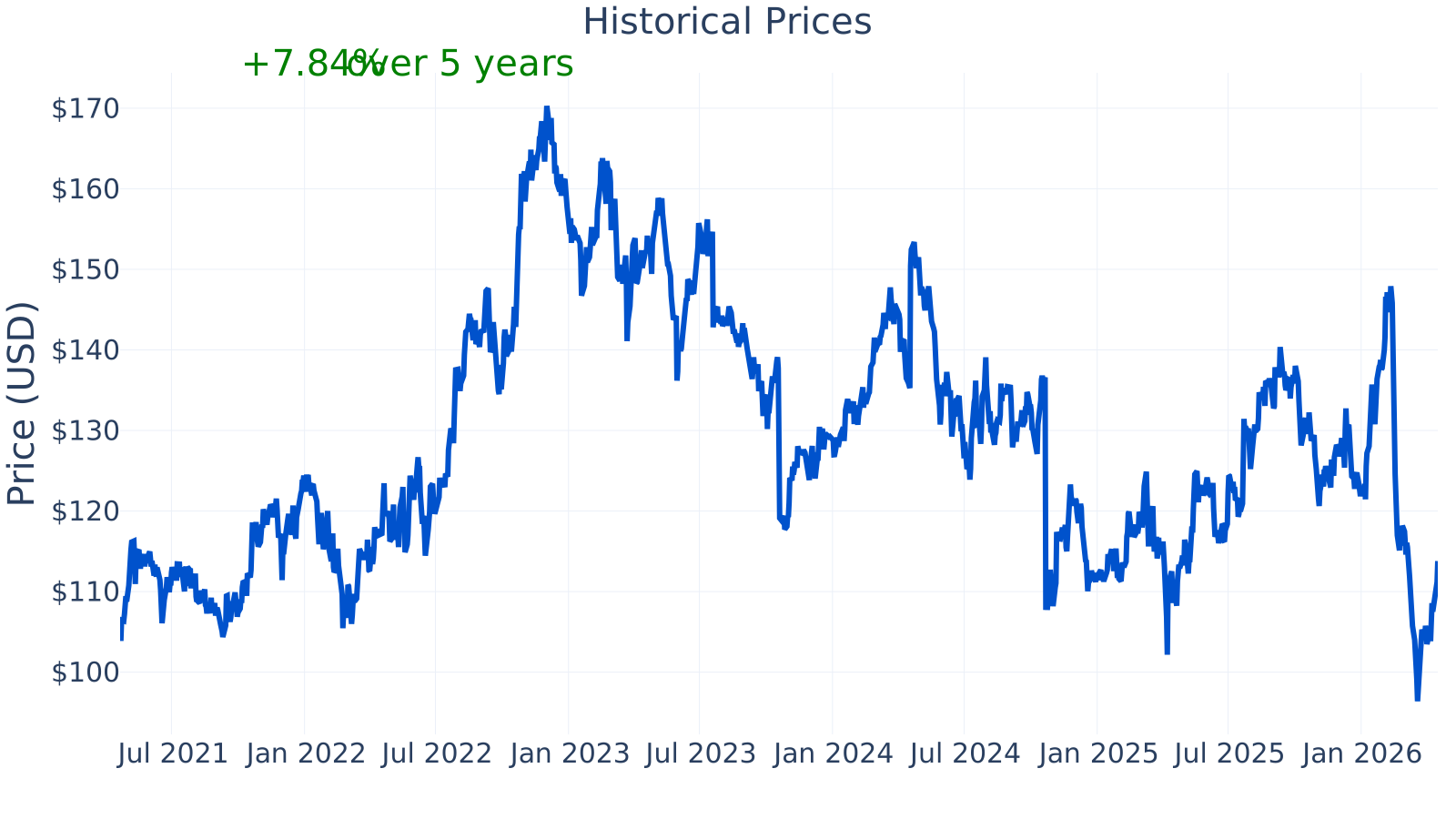
GPC’s market capitalization is about $15.8B, and the stock’s beta of 0.77 suggests it has historically been less volatile than the overall U.S. stock market. The latest P/E ratio shown is 242.1, far above the industry median of 24.7; this kind of gap often happens when recent earnings are unusually low (which mechanically pushes the P/E up). The latest profit margin shown is 0.27% versus an industry median of 3.57%, while revenue growth year-over-year is about 4.1% versus an industry median near 4.9%. Debt-to-equity is 187%, well above the industry median of about 76%. Free cash flow over the trailing twelve months is approximately $421M.
Growth (Medium)
GPC operates in the replacement (aftermarket) auto parts and industrial maintenance supply chains. These are not typically “hyper-growth” areas, but they can expand steadily over time, supported by long-lived vehicles and ongoing maintenance needs in both transportation and industry. A common long-term tailwind for automotive aftermarket demand is an aging vehicle fleet, which tends to require more frequent repairs and replacement parts.
Revenue growth has moderated meaningfully from the stronger rates seen earlier in the period to low-single-digit growth more recently (ending around 4% year-over-year). This pattern is consistent with a mature distribution business: growth can be supported by pricing, market share, acquisitions, and service levels, but it may slow when comparisons get tougher or demand normalizes.
Free cash flow has been positive, but it declined sharply in the most recent trailing period shown (to about $421M, down from roughly $1.0B in earlier periods). For a distributor, free cash flow can swing with working capital needs (inventory and payables) and profitability. Sustained cash generation matters because it supports reinvestment in the network, technology, and the ability to manage debt.
Potential catalysts in a business like GPC’s typically include improvements in operational efficiency (distribution productivity, inventory management), benefits from past acquisitions, and stabilization in input costs and supply chains. In automotive, commercial customer penetration (repair shops and fleets) can also be an important driver, since those customers value availability and fast delivery.
Risks (High)
GPC’s recent financial profile shows several pressures that long-term owners usually track closely: profitability compression, higher leverage, and higher interest costs. When margins are thin, even small changes in pricing, labor costs, freight, shrink, or product mix can have a large impact on net income.
Debt-to-equity has trended higher over time and ends at about 187% (vs. an industry median near 76%). Higher leverage can amplify outcomes: it can support growth and acquisitions, but it also increases required interest payments and reduces flexibility if the economy weakens or if profits fall.
Profit margin declined substantially across the period shown, ending at about 0.27% (vs. an industry median near 3.40%). This is a notable change from earlier periods when margins were several percentage points. A margin level this low can indicate unusually weak earnings in the latest period (for example, from one-time charges, higher operating costs, or other non-recurring factors). In practice, understanding what drove the decline usually requires reading management’s discussion in the annual report.
Competition is a central risk in auto parts distribution. The market includes large retailers and distributors, along with many smaller local players. Competitors commonly discussed for U.S. automotive aftermarket parts include AutoZone, O’Reilly Automotive, and Advance Auto Parts (retail-focused, with professional/installer sales as well). In industrial distribution, competition is fragmented and can include broadline industrial suppliers and specialized regional distributors.
GPC’s competitive strengths are typically associated with scale, a well-known brand (NAPA), established relationships with professional repair shops, and a logistics network built around frequent delivery. However, the recent margin and leverage trends suggest execution and cost control are especially important. Other structural risks include exposure to economic cycles (industrial demand can be cyclical), wage and transportation cost inflation, and the long-run evolution of the vehicle fleet (including the gradual shift toward EVs, which changes the mix of parts over time).
Valuation
The P/E ratio shown over time is often in the mid-teens to low-20s, frequently near the industry median. The latest P/E displayed in the table (242.1) is a major outlier versus both GPC’s prior history and the industry median, which usually signals that earnings in the most recent period were unusually low rather than that the stock price rose dramatically.
For valuation context, a distributor like GPC is often judged on normalized (through-the-cycle) earnings power, operating margin stability, cash generation, and balance sheet risk. With revenue growth in the low single digits and recent profitability under pressure, the key valuation question becomes whether margins and earnings revert closer to historical levels, and how much of cash flow is needed for debt service and reinvestment rather than discretionary uses.
Conclusion
Genuine Parts Co is a long-established parts distributor with large-scale automotive and industrial operations and a business that can benefit from ongoing maintenance needs. The recent picture is mixed: revenue has continued to grow modestly, but profit margins fell sharply in the latest period shown, free cash flow declined versus prior levels, and leverage increased while interest expense rose.
From a long-term perspective, the central items to monitor in company filings are whether profitability stabilizes (and why it changed), whether free cash flow recovers as working capital and earnings normalize, and whether leverage trends reverse or at least stop increasing. These factors also matter for interpreting valuation metrics like the P/E ratio, which can become difficult to read when earnings are temporarily depressed.
Sources:
- SEC EDGAR — Genuine Parts Company Forms 10-K (Annual Report) and 10-Q (Quarterly Reports)
- Genuine Parts Company — Investor Relations materials (Annual Report/10-K package and press releases, where applicable)
- Wikipedia — “Genuine Parts Company” (basic company background)
This article is for informational purposes only and does not constitute financial advice. Some content is AI-generated. See Disclaimer


