Stock Analysis · General Motors Company (GM)
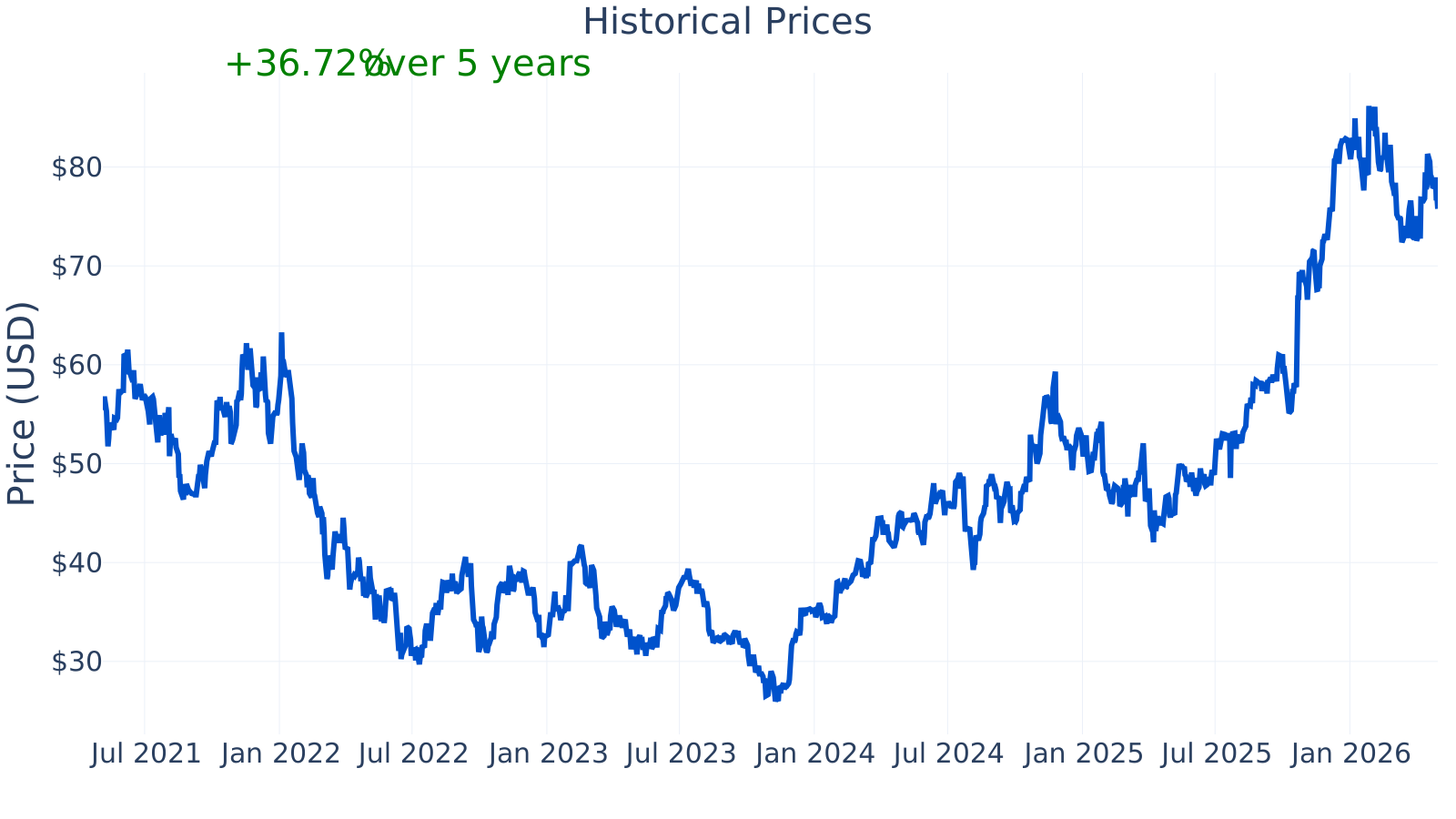
Overview
General Motors Company (GM) is a global vehicle and mobility company best known for designing, manufacturing, and selling trucks, SUVs, and cars under brands such as Chevrolet, GMC, Cadillac, and Buick. Beyond building vehicles, GM also runs a large financing operation that supports vehicle sales by offering retail and dealer financing, and it is investing in software-enabled services and electric vehicles (EVs) as part of its longer-term strategy.
In its SEC reporting, GM organizes its business around automotive operations and a financial services arm (GM Financial). At a high level, revenue is primarily generated from selling vehicles and related parts/services, plus interest income and fees from its financing activities. Percentages can vary by year depending on vehicle volumes, pricing, and the size of the finance book, but the typical ranking of major revenue sources is:
- Automotive sales (vehicles): the largest source, driven by wholesale shipments and pricing across GM’s brand lineup
- Automotive-related revenue: parts, accessories, service, and other automotive revenue streams
- Financial services revenue (GM Financial): primarily interest income and fees tied to retail loans/leases and dealer financing
From 2021 to 2025, total revenue increased from about $127.0B to about $185.0B, while profitability varied materially by year (details below).
Across 2021–2025, total revenue rose meaningfully, but the path from revenue to net income became less favorable in 2025: operating income fell to about $2.9B (from $12.8B in 2024) and net income decreased to about $2.7B. Over the same period, GM maintained large ongoing spending in areas like research & development (roughly $7.9B–$9.9B annually in 2021–2025), reflecting continued investment needs in a rapidly changing industry.
Key Figures
| Metric | Value | Industry ⓘ |
|---|---|---|
| Date | May 04, 2026 | |
| Context | ||
| Sector | Consumer Cyclical | |
| Industry | Auto Manufacturers | |
| Market Cap ⓘ | $68.32B | |
| Beta ⓘ | 1.34 | |
| Fundamental | ||
| P/E Ratio ⓘ | 27.65 | 23.35 |
| Profit Margin ⓘ | 1.38% | -1.49% |
| Revenue Growth ⓘ | -0.90% | 11.40% |
| Debt to Equity ⓘ | 203.89% | 108.09% |
| PEG ⓘ | 0.34 | |
| Free Cash Flow ⓘ | $12.48B | |
GM’s market capitalization is about $68.3B, and the stock’s beta of ~1.35 indicates it has tended to move more than the overall market. The latest P/E ratio is ~27.7, above the industry median (~23.4). Profitability is currently thin: the latest profit margin is ~1.38% (while the industry median is negative, around -1.49%). Recent growth is also softer: the latest year-over-year revenue growth is about -0.9% versus an industry median of about 11.4%. Leverage is higher than the peer median, with debt-to-equity ~204% versus an industry median around 108%. The latest trailing twelve-month free cash flow is ~$12.48B, a sharp improvement compared with the negative readings shown in several prior periods.
Growth (Medium)
The auto industry is large but cyclical, and long-term growth is increasingly shaped by electrification, software features, and manufacturing efficiency. GM’s growth strategy, as described in its filings, centers on evolving its product lineup (including EVs), scaling software and services where feasible, and supporting sales through its financing subsidiary. In practical terms, this is an industry where growth opportunities exist, but execution and timing matter because new technologies require heavy investment and consumer adoption can be uneven.
Revenue growth has been uneven over the period shown. After several quarters of solid positive growth in 2022–2024, the more recent readings trend closer to flat to modestly negative (down to about -0.9% in the latest point). This pattern is consistent with an industry where results can be influenced by production constraints, pricing changes, model cycles, and broader economic conditions.
Free cash flow shows a notable swing: it was negative in multiple earlier periods shown (reaching roughly -$5.1B at one point) and then improved sharply to about +$12.48B in the latest period. For a capital-intensive manufacturer, sustained free cash flow can be an important signal because it helps fund factory investment, technology programs, and balance sheet needs without relying as heavily on additional borrowing.
Risks (High)
GM operates in a highly competitive and capital-intensive sector where profits can change quickly. Key risks commonly emphasized in automaker filings include: demand sensitivity to interest rates and economic slowdowns; manufacturing and supply chain disruptions; commodity and input cost inflation; product quality and recall exposure; regulatory changes (including emissions and safety requirements); and execution risk in major technology transitions (including EVs and software features). In addition, labor relations and wage/benefit costs can materially influence profitability over time.
Competitive advantages for GM include established brands, a broad dealer and service footprint, large-scale manufacturing, and a financing arm that can support vehicle affordability and dealer inventory flow. However, the company is not insulated from intense pricing and product competition. The global competitive set includes large automakers such as Ford, Stellantis, Toyota, Honda, Hyundai/Kia, Volkswagen Group, BMW, Mercedes-Benz, and EV-focused companies such as Tesla, along with fast-growing manufacturers in China. GM’s positioning is strongest where it has scale and brand strength (notably trucks and SUVs in North America), while newer segments like EVs tend to have more uncertain near-term economics and faster-moving competitive dynamics.
GM’s debt-to-equity ratio is elevated versus the industry median throughout the period shown, and it ends around 204% compared with an industry median around 117%. Higher leverage can amplify outcomes in both directions: it can improve returns when business conditions are strong, but it can also reduce flexibility during downturns. For GM specifically, part of overall leverage is tied to the existence of a large financing business, which typically uses debt to fund earning assets (loans and leases), but it still increases the importance of credit performance, funding access, and disciplined risk management.
Profit margins have compressed significantly over time, falling from roughly 9% in mid-2021 to around 1–3% in 2025–2026, with the latest point at about 1.38%. Even though the industry median is negative in the latest snapshot, this downward trend matters because thin margins leave less room for operational missteps, pricing pressure, or higher costs.
Valuation
The P/E ratio shown in the historical series was in the mid-single digits for several years and then rose sharply, reaching above 30 in the latest point. In general, a rising P/E can reflect higher expectations, lower recent earnings, or both. This matters for GM because profitability has been volatile and margins have been trending lower, which can mechanically push the P/E higher even if the share price does not rise proportionally.
Relative to the industry snapshot in the key figures, GM’s latest P/E (~27.7) is above the industry median (~23.4), while its latest year-over-year revenue growth is below the median (slightly negative versus a positive peer median) and leverage is higher than the median. At the same time, GM’s latest trailing free cash flow is strongly positive, which can be a supportive data point when assessing how the business is funding its needs. Overall, the valuation picture depends heavily on whether earnings and margins stabilize versus remain pressured, and on how effectively GM converts revenue into durable cash generation through a full industry cycle.
Conclusion
GM is a large, established automaker with significant scale and a meaningful financing arm. The company has demonstrated the ability to generate substantial revenue (roughly $185B in 2025) and, in the latest period shown, a strong rebound in trailing free cash flow. At the same time, profitability has weakened materially over the last few years, and leverage is high relative to the industry median, which can increase sensitivity to economic downturns and execution challenges.
From a long-term perspective, the main questions raised by the facts above are whether GM can improve and sustain margins while continuing to invest in next-generation vehicles and software-related capabilities, and whether cash generation remains resilient across cycles. The current valuation metrics shown (including a higher P/E than the industry median) place additional weight on the company’s ability to translate its strategy into more consistent earnings power.
Sources:
- U.S. SEC EDGAR — General Motors Company filings (Form 10-K, Form 10-Q)
- General Motors Investor Relations — SEC filings and shareholder materials (as published by GM)
- Wikipedia — “General Motors” (for basic company background only)
This article is for informational purposes only and does not constitute financial advice. Some content is AI-generated. See Disclaimer


