Stock Analysis · General Motors Company (GM)
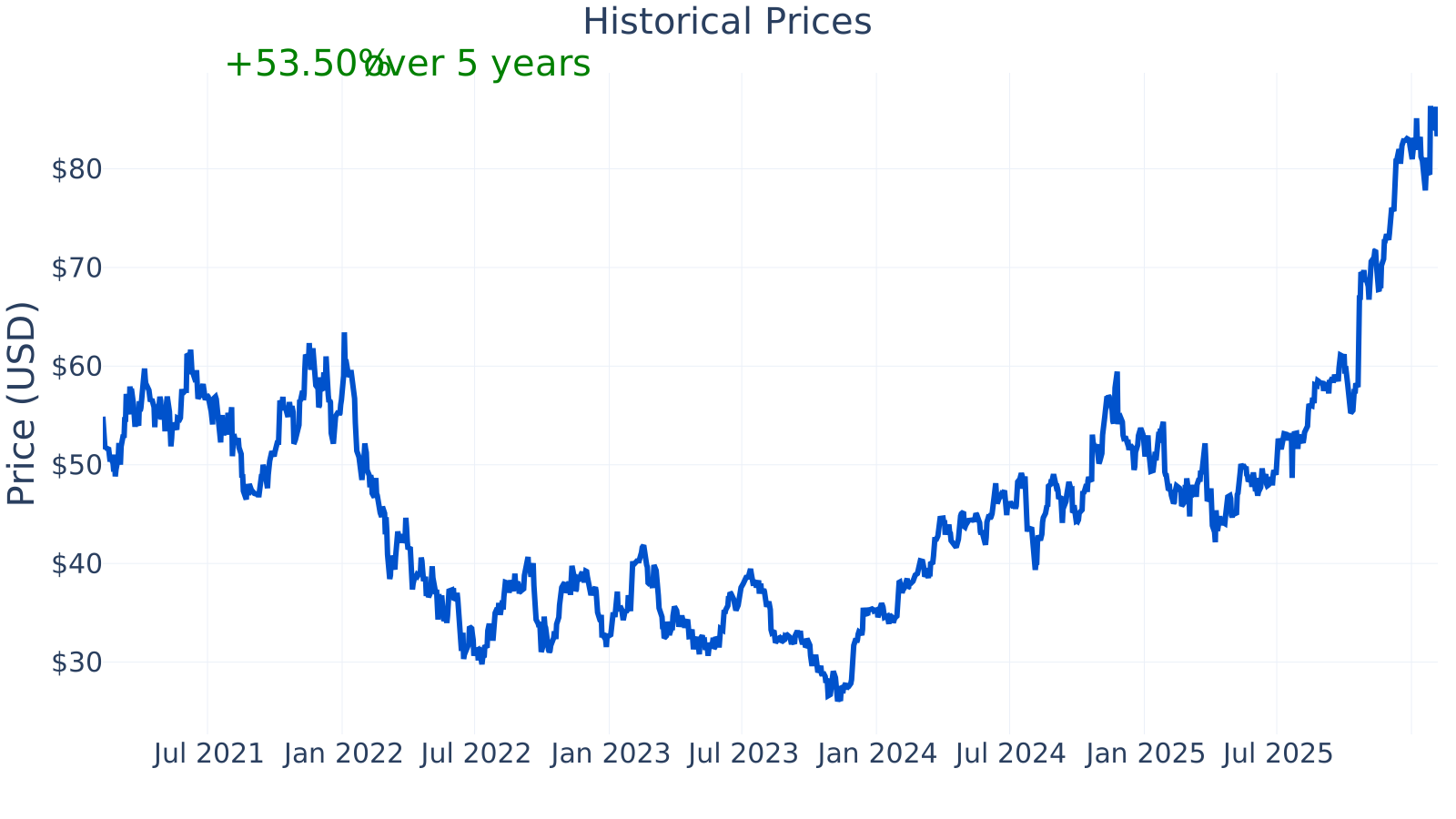
Overview
General Motors Company (GM) is a global vehicle manufacturer best known for designing, building, and selling cars, trucks, and SUVs under brands such as Chevrolet, GMC, Cadillac, and Buick. Beyond selling vehicles, GM also operates a large financing business that supports retail buyers and dealers, which can meaningfully affect results across economic cycles.
At a high level, GM’s business is built around (1) manufacturing and selling vehicles, (2) providing vehicle-related financing, and (3) investing in newer technologies such as electric vehicles (EVs) and software-enabled services. As disclosed in its filings, GM reports results through automotive operations and financial services (GM Financial), with additional items (such as certain corporate/other activities) depending on the reporting period.
Main sources of revenue (typical structure based on GM’s reporting):
- Automotive: vehicle sales (retail and fleet), plus parts and accessories (largest contributor)
- GM Financial: interest income and fees from auto loans and leases, plus dealer financing
- Other / eliminations: smaller items that vary by period
The company’s cost structure is heavily influenced by manufacturing costs (materials, labor, logistics), while operating spending includes large and ongoing research and development (R&D) efforts tied to new vehicle programs, EV platforms, batteries, and software.
Across the years shown, revenue increased from about $127.0B (2021) to $187.4B (2024) before edging down to about $185.0B (2025). Over the same period, net income declined from roughly $10.0B (2021–2023 range) to $6.0B (2024) and $2.7B (2025), illustrating how profitability can swing even when revenue stays high—common in a cyclical, capital-intensive industry.
Key Figures
| Metric | Value | Industry ⓘ |
|---|---|---|
| Date | Feb 07, 2026 | |
| Context | ||
| Sector | Consumer Cyclical | |
| Industry | Auto Manufacturers | |
| Market Cap ⓘ | $78.58B | |
| Beta ⓘ | 1.36 | |
| Fundamental | ||
| P/E Ratio ⓘ | 25.76 | 21.50 |
| Profit Margin ⓘ | 1.46% | 1.46% |
| Revenue Growth ⓘ | -5.10% | 9.40% |
| Debt to Equity ⓘ | 213.15% | 87.12% |
| PEG ⓘ | 3.73 | |
| Free Cash Flow ⓘ | $11.07B | |
GM’s market capitalization is about $78.6B. The stock’s beta (1.37) indicates it has historically moved more than the overall market on average. Profit margin is about 1.46%, in line with the industry median shown, which underscores how thin margins can be in auto manufacturing after accounting for all costs. Year-over-year revenue growth is about -5.1% versus an industry median of about +9.4% (as presented), highlighting a recent slowdown relative to peers. Debt-to-equity is about 213%, above the industry median of about 87%, reflecting heavier leverage (not unusual for companies with large financing operations, but still a key balance-sheet sensitivity). The price-to-earnings (P/E) ratio is about 25.8 versus an industry median of about 21.5. Trailing twelve-month free cash flow is about $11.1B.
Growth (Medium)
The auto industry is mature in many developed markets, but it is going through major transitions that can reshape long-term demand and profit pools. The most important is the shift toward electrification, alongside software and connected services (features delivered digitally, subscriptions, safety/driver-assist systems), and ongoing efficiency improvements in manufacturing and supply chains. These trends can create growth opportunities, but they also require high, sustained investment and strong execution.
GM’s strategy—as described in its filings—centers on evolving its vehicle portfolio (including EVs), investing in battery and platform development, and expanding software-defined vehicle capabilities. In practice, a long-term growth question for GM is whether these investments translate into durable demand, competitive cost structures, and recurring revenue streams beyond one-time vehicle sales.
The year-over-year revenue pattern shown is volatile, with periods of strong expansion followed by moderation and contraction. Most recently, the chart shows revenue growth turning negative to about -5.1% by the latest point, which may signal a tougher comparison period, mix changes, pricing normalization, or demand variability. In a cyclical business, investors often track whether revenue weakness is temporary (cycle-driven) or structural (share loss, product gaps, or sustained pricing pressure).
Free cash flow has also been uneven over the time window shown, including several periods of negative trailing free cash flow. That said, the latest metrics table reports about $11.1B in trailing twelve-month free cash flow, which—if sustained—can support balance-sheet flexibility and ongoing investment. For manufacturers, free cash flow can swing due to inventory changes, capital spending cycles, and timing of production and deliveries.
Risks (High)
This article is for informational purposes only and does not constitute financial advice. Some content is AI-generated. See Disclaimer


